Origin of
the Harding name and the Hardinger
|

Hello, I am Steve Harding, a Harding from Wirral in north-west
England: welcome to my Harding page, I hope you like it! Harding is a Germanic
or Anglo-Scandinavian name, and is still used in
Norway today for people who come from the Hardanger fjord area, and their
dialect is Hardingmål. The name is also used in
Norway and Sweden (as Hårding - pronounced as "Hawding" - or Hardingz) to
represent a "Tough Guy". A cross-country skier would for example be a
Harding
THE HARDINGER OF HARDANGER
Click the picture to see this clip of Erling Skjalgsson address the Hardinger at a meeting of the Thing assembly. From the 2005 Rygekongen Festival, Hafrsfjord, 2005.
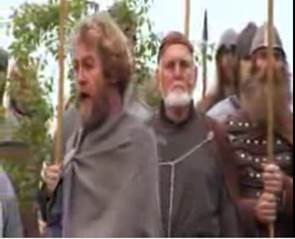
Click here to hear (and download)
Erling address the Hardinger.
HARDING & HARDANGER BRYGG
 (thanks to Nigel Harding).
From Balder.no
(thanks to Nigel Harding).
From Balder.no
ANGLO-SCANDINAVIAN NAME
The Harding name seems to have its origins in
Scandinavia and Germany. It appears to be an old Nordic/Teutonic term for
"tough guy" and is still used as such in Sweden and Norway. There
seems to be two sources which may be linked, one from Norway - the Hardanger
Fjord, where people are still called "Hardings"
or Hardinger (Viking times: "Hardingar"):
the dialect of the people from this area is known as Hardingmål.
The other as Danish/Angle hordes where they were recorded in the Anglo Saxon Rune Poem as the Germanic warrior tribe "Heardingas". Both groups may have originated from the
same source … the Charudes of the Jutland peninsula, who under
pressure of expanding groups around them moved to Horderland/Hardanger
area where they became the Horders or Hardinger.
Ancient forms: Harding, Hardinge, Hartung, Hearding, Hadding, Herdan, Herden, Herdene. The name
also appears in Nordic/Teutonic mythology: in Icelandic literature they are the
"Haddings" and their legendary leader
Hadding is protected by both Thor and Odin. In German mythology Hadding appears
as Hartung. In Viking times and before Harald Harfagre had tried to unite Norway at the end of the 9th
century, Hardanger was a separate kingdom ruled by King Harding. He apparently
lived in Kinsarvik, which now has the excellent
Harding Motel og Hyttentun,
but in Viking times it had a boat house which held King Harding's ships (the
walls of this boat house still exist today). The Norwegian Hardings
have their own saga about him (recalled here by Tor Instanes):
THE SAGA OF KING HARDING OF HARDANGER
King Harding ruled Hardanger in
the time of the Vikings (c.900ad) and lived in Kinsarvik.
During a crusade to eastern England England

... after which they managed to get to the prison tower &
switched the king with an old man dressed like the king. Then they set sail
& made their escape but with the black side of the ship facing the shore...

The English did not recognize them as the invaders as they were
looking for a white ship. The saga ends with King Harding returning safely to Kinsarvik, Hardanger.
See also the Kinsarvik
page.
Kinsarvik,
(with promotional video for Hardangertun)
and the excellent Harding Motell/ Hyttetun sounds like
a great place of pilgrimage for the Harding clan. And for footie fans there is
even a Harding
Soccer Team, where? .. you've
guessed it, in Kinsarvik! i vakre Hardanger… in
beautiful Hardanger: Heia Harding! And there are some connections with another
Scandinavian group - the Normans: the following web-site in France http://hagdik.fr/prenoms-normands/says:
HARDING (anglo-scandinave) : celui qui
est dur, solide, fort -
attest en Normandie dans le nom de lieu Hardinvast.
THE HARDING FIDDLE - THE NATIONAL INSTRUMENT OF NORWAY
 The Harding Fiddle (Hardingfele).
The Harding fiddle (Harding fele or
Hardanger Fiddle) has been said to be "almost
as famous as Stave Churches and Viking Ships", and one of its famous exponents was Hallvard T Bjørgum. Hear this traditional Norwegian Waltz Finn Jenta.
HARDINGMÅL
Hardingmål is a dialect of Norwegian still spoken
in Hardanger/
Hordaland. F.ex. dai
is used instead of de or du (you), fann
is used instead of fant (found), ikkje instead of ikke
(not): dai fann ikkje
sild: you didn’t find any herring?
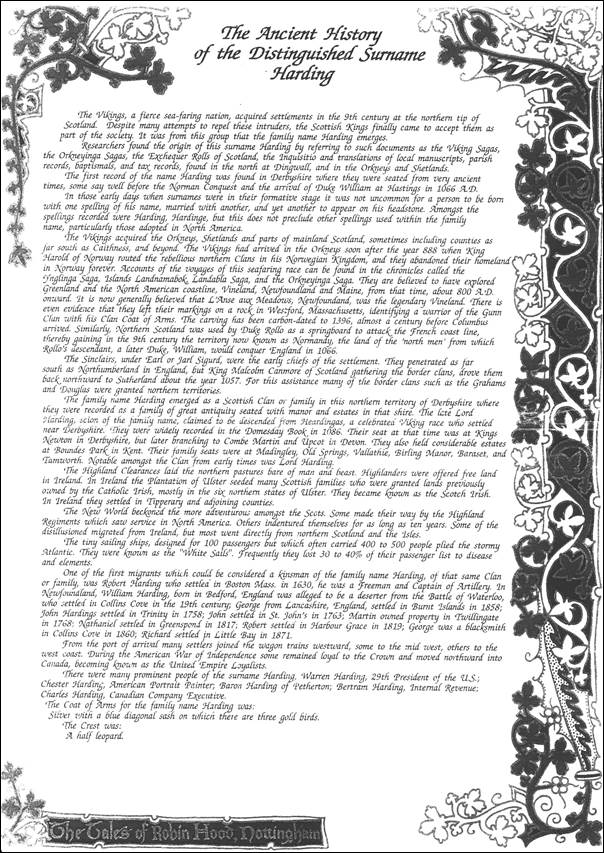
"THE ANCIENT HISTORY OF THE DISTINGUISHED SURNAME HARDING”… Courtesy of
the Tales of Robin Hood, Nottingham
KING’S NEWTON, DERBY
In Kings
Newton, at the Derbyshire/Leicestershire
border and also within the Danelaw, there is the 17th century home of the
Hardinge Family, restored in 1910 and the excellent pub/hotel The Hardinge Arms -
like the Harding Motell at Kinsarvik,
this is strongly recommended to all pilgrims of the Harding/ Hadding clan! A
stain glass window at Madingley Hall (just west of Cambridge
near the Cavendish Laboratory) proudly shows Baron Harding.
ANGLO SAXON RUNE POEM
This is
where the Heardingas appear, in connection with Ing
and the East-Danes:
Ing wæs ærest mid East-Denum
gesewen secgun, oþ he siððan est
ofer wæg gewat; wæn æfter
ran;
ðus Heardingas ðone hæle nemdun
Ing was first seen by men among the
East-Danes,
till, followed by his chariot,
he departed eastwards over the
waves.
So the Heardingas named the hero.
Hear this reciting of the poem in old and modern English
…and if you’ re really interested, hear Julian Glover
(introduction by Sir Ralph Richardson) with his superb reading
of Beowulf
NORDIC/TEUTONIC MYTHOLOGY
In Icelandic literature they are the "Haddings" and their legendary leader Hadding is
protected by both Thor and Odin: see part 24 and onwards of from Viktor Rydberg's TEUTONIC MYTHOLOGY
HARDING AS A SURNAME
It has to be remembered that patrilineal
surnames did not come into common use in the British Isles until the 14th
Century. Here is a record of the escapades of one the earliest recorded Hardings Thomas Harding from Wirral from 1353:
Hardings in Wirral: Extract from "Calendar of
Cheshire Trailbaston Proceedings 1353" ed. P.
Booth in
Henry Cherleton v. Robert Poole and Thomas
Harding. Henry Cherleton complained that Robert
Poole and Thomas Harding killed his dog at Great Neston, Wirral on Friday 1st
Feb 1348 & broke his hedges. They denied guilt. Jury verdict - Not guilty.
Although the name Harding clearly has Germanic roots, despite some claims to
the contrary it is impossible to properly trace surname lineages from these
areas into the British Isles since the patrilineal system of surnames came well
after the Anglo Saxon and Viking Age invasions and colonisations. Its use as a
proper surname in the British Isles possibly
evolved in England from a description of someone coming from these groups
of people or possibly from Anglo-Scandinavian communities using the expression
to describe a particular tough guy in a village or region. Ultimately when in
these various communities patrilineal surnames did
eventually emerge, one particular Harding passed his name to his sons and
daughters and so on. In Scandinavia this never happened because the use of
patrilineal surnames is quite recent, and in the case of Iceland they still use
the son of and daughter of system of surnames.
AT LEAST 3-4 LINEAGES IN THE BRITISH ISLES
There may well have been a number of these tough guys
around starting different lineages when paternal surnames came into being. We
can get an idea of this from the 1891 Census and maps showing the distribution
of people with the surname Harding. There appear to be 3 separate main cores in
England: I: Northern England (focusing on Yorkshire-Lancashire); II: Southern
England; III: South-West England and an additional smaller core (IV) in Eastern
Scotland


Adapted from the 1891
census and Ancestry.com
The
highest density (compared to other surnames) was in what is now the Borough of Dacorum,
incorporating Hemel Hempstead (NE part of Core II). This was formerly the Hundred of Dacorum (Latin for "of the Danes")
within the old Danelaw. It was also listed in the Domesday book as Tring and
Danais. When there is enough data available the Y-DNA results for the Hardings may give us a better idea as to how many different
lineages there are.
SOME WELL-KNOWN HARDINGS
Some well-known Hardings include Gunnar
Harding prize winning author/poet/critic from Sundsvall,
Sweden and Daniel
Harding the principal guest conductor of the London Symphony
Orchestra and Nottingham Forest footballer Dan Harding.
Famous past Hardings
include Peder (Petrus) Harding, 13th century hero of the Baltic Sea island of
Gotland. Descendants of Peder apparently bear the name Hardingz in Gotland. The (uncoloured) rose symbol on his
gravestone at the church in Vall/Visby has become an emblem for Gotland and appears on the coat of arms for
their annual Medieval Festival:

The rose of Peder (Petrus) Harding, 13th
century hero of Gotland
Visit
the Kinsarvik, Hardanger page
and visit the Wirral & West
Lancashire Viking Anniversary page.
The site is maintained by Stephen Harding