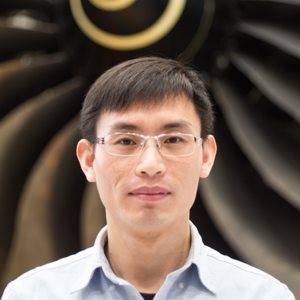
Erhui Sun
By Erhui Sun, KTP Associate
A Knowledge Transfer Partnership (KTP) offers you the opportunity to apply your academic knowledge to real world challenges. KTPs are a three-way partnership between an organisation, a university and a graduate or postgraduate (known as a KTP Associate).
Projects are varied, spanning all academic disciplines and organisations of any size and in any industry or sector. Read on to hear Erhui's experience.
Please tell us a bit about yourself
I got my BEng and MEng degrees in China and came to the UK to pursue my PhD at UoN in 2018. After I finished the research on the PhD programme, I stayed in the same academic team to continue my research as a Research Fellow until I became a KTP associate.
My expertise focuses on the design and control of robot and automation systems, including visual inspection systems, automated eddy current and ultrasonic inspection systems, and automated machining systems.
Why did you choose to become a KTP Associate?
After nearly six years in academia, I decided to broaden my career development by exploring a different professional area. The KTP project enables me to apply my knowledge to real industrial challenges.
Despite being company-based, I still maintain a close and active relationship with the academic team. This provides an excellent opportunity to support a smooth transition from academia to industry as a researcher.
Tell us a bit about the company and your role
I’m currently working with Rolls-Royce plc, a British multinational company which designs, manufactures and distributes power systems for various industries including civil aerospace, defence and power generation. Rolls-Royce is one of the world's largest manufacturers of aircraft engines and has major businesses in the marine propulsion and energy sectors.
I’m based in the Design and Services Engineering - Capability Programs team, working on advanced Non-Destructive Inspection technologies for service-run components, including enhancement of the inspection tool and the richness of inspection data.
The deployment and automation of NDT systems would bring significant benefits to Rolls-Royce in terms of lowering business costs and minimising customer disruption.
What has been the most memorable part of your KTP experience?
During my KTP, I was involved in a wide range of professional development activities, including associate training, KTP Associate Conference, academic conferences, and so on.
In particular, I had the opportunity to play an active role in coordinating and organising the Rolls-Royce University Technology Centre (UTC) Conference, an annual event that brings together researchers to present their latest work at Rolls-Royce. This conference provides a valuable platform for connecting industrial challenges with academic research and fostering effective industry–academia collaboration.
How have the university and the company supported you?
My academic supervisor has held regular meetings with me to review project progress and to collaboratively explore innovative solutions, ensuring that the work remains academically rigorous and aligned with the KTP objectives.
The company team in which I am embedded has been highly supportive and proactive, providing a strong industrial environment, and I have also received consistent support from my industrial supervisors and the wider engineering teams, enabling me to deliver practical and impactful outcomes.
How has the KTP experience benefitted you?
The KTP experience has been highly valuable in multiple ways. It has enabled me to apply my academic knowledge to real-world industrial challenges, enhancing my practical problem-solving skills and deepening my understanding of industry processes.
I have also gained extensive professional experience, including project management, cross-functional collaboration, and exposure to senior stakeholders. Through mentorship and close collaboration with engineers and researchers, I have further developed both technical and interpersonal skills.
In addition, I have had the opportunity to participate in training courses covering areas such as project management, technical expertise, and professional development, which have contributed significantly to my overall growth.
How did you find the application process?
I found the application process to be quite straightforward. The role is clearly defined, and the university manages the application and interview process. The interview typically involves both the industrial supervisor and the academic supervisor, ensuring a balanced assessment of the candidate’s suitability for the KTP.
Would you recommend becoming a KTP Associate?
Absolutely. I would strongly recommend becoming a KTP Associate, particularly for individuals seeking a transition from academia to industry.
The role offers a unique opportunity to work on real industrial challenges while maintaining strong links with academia. In addition, it provides excellent professional development opportunities, including formal training, networking through the KTP Associate community, and exposure to senior stakeholders within industry.
Want to apply your knowledge and create a transformative impact in a real-world project? Launch your career with the Knowledge Transfer Partnership.
Posted on Tuesday 17th February 2026