Physical development to 2 years
There are lots of changes throughout the body that occur as the newborn develops into a toddler. The major changes to be aware of are those affecting the child's skin and the skeleton; the head, neck and face and the chest and kidneys.
Click on the following images to find out more.
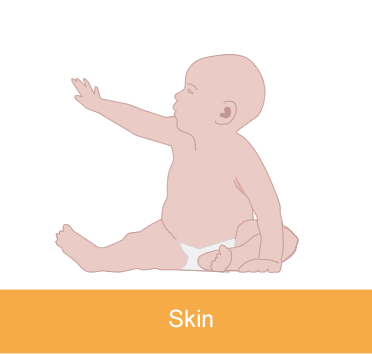
Skin - The newborn baby's skin is thin and delicate with only a thin layer of subcutaneous fat. The thinness and immaturity of the layers in the skin means that it can easily be broken for example by using a plaster. It needs to be carefully protected.
Soaps, shampoos and lotions can contain chemicals that can irritate the newborn baby's skin. Even those that are designed for the newborn baby can be risky for some babies. It is best to use water and a simple soap or even just water! Try not to use a fragranced soap or shampoo as these can be very irritating.
Heat is easily lost through the skin, so small babies and toddlers need to be kept warm.
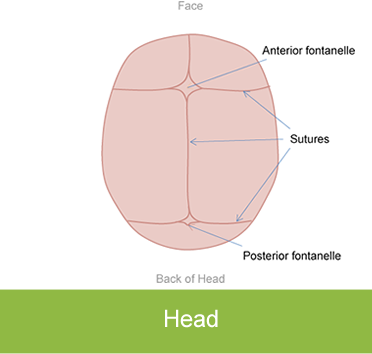
Head - Proportionally the baby has a large head in contrast to their body. Up to the age of 2 years old, the head circumference can be larger than the circumference around the chest! The larger head is also heavier and babies need to develop an ability to hold their head up and to control its movement.
The sutures between the plates of the skull need to allow movement of the head through the birth canal, so as a baby, these will start to fuse and form a solid skull. There are 'soft' spots - one on the top of the head called the anterior fontanelle and one at the back of the head called the posterior fontanelle. Gradually, in the first six weeks of life, the posterior fontanelle will close. The larger anterior fontanelle is usually closed by 12 to 18 months old.
Eyes - The pigment in the eyes develops gradually over the first year of life, so baby's true iris colour is not fully set until after 1 year old.
Nose - Newborn babies do not always 'know' intuitively to open their mouths to breathe if their nose is blocked which can mean feeding becomes difficult when the baby has a cold or a snuffle.
Mouth - Teeth start to erupt between 6 months and 2yrs old. The tongue is usually large in proportion to the baby's mouth.
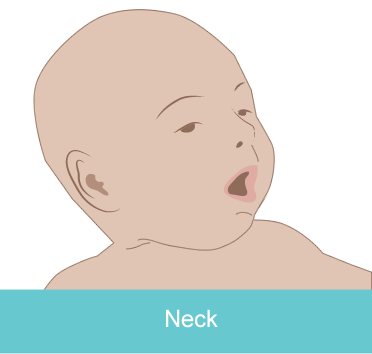
Neck Within the first year of life, the baby's throat needs to change to enable the baby to practise and to refine an ability to make sounds and therefore to learn speech.
Up to 2 years of age the neck is usually short, lengthening around 3-4yrs old. This supports the movement of the throat and the lowering of the larynx to allow the voice to develop and refine noises and to learn speech.
The newborn's throat is high in the neck at the back of the mouth. This provides the baby with an ability to eat whilst breathing, minimising choking as the entry to the trachea or windpipe is higher than the entry to the oesophagus or gullet.
As the newborn grows, the neck lengthens and the larynx drops its position until from 4 years old, the trachea and the oesophagus are level with each other. From 12 months old though, the larynx has dropped sufficiently for the baby to form specific words. Together with the baby's intellectual development and the need to communicate, so verbal language can develop.
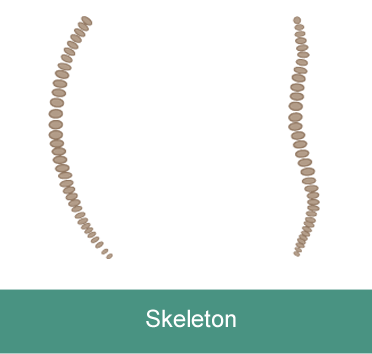
Skeleton The spine is C shaped at birth and the baby needs to develop the muscles required to lift and control the head (around 6 weeks old), and then to sit up, as the spine develops secondary curves (around 3-4 months old).
Individual bones are soft and easily bend, but grow slowly and continually until adolescence and the end of puberty. The rate of growth is fast up to around 2 years old, then slows until puberty.
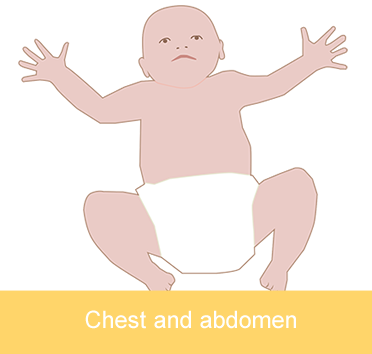
Chest and Abdomen The baby and toddler will usually breathe by moving their abdomen, not the chest as more energy is required to move the chest wall and ribs.
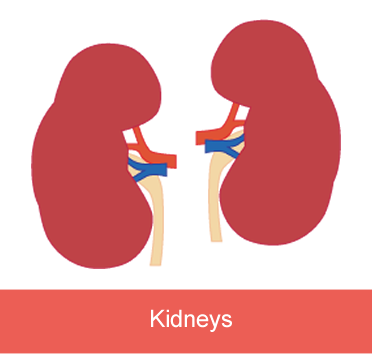
Kidneys As the kidneys continue to develop through the first year, the ability to concentrate urine increases. Thus, the newborn baby has a need to pass a lot of dilute urine very frequently. Newborns may subsequently require up to 12 nappy changes a day.
As babies are unable to concentrate their urine, salt and other concentrated substances need to be avoided in their diet. The newborn baby is also prone to dehydration due to the need to produce large urine volumes.