Operational or logical thought
Piaget believed that learning occurs through interaction with physical and social environments. He divided this into a number of stages. Between 5 and 7 intuitive thought develops. This refers to a growth in curiosity and basic reasoning. The child becomes more fascinated and curious about the world. Questions such as "why is the grass green?", "where do babies come from?" begin. Piaget explained that in this stage, a child is acquiring a great deal of knowledge, but doesn't yet know how to use it. He called this the preoperational stage.
According to Piaget, children between the ages of 7 and 11 go through the concrete operational stage. They begin to think logically about objects and events.
At about 6 to 7, understanding that quantities don't change just because the appearance is changed develops. This is known as conservation. For example, they know that different shaped glasses can contain the same amount. Secondly the child develops decentration. This is a way of considering matters from many different perspectives, rather than just one. It can be compared to guessing about another's point of view and therefore shows a decrease in egocentrism. Until a child can decentre they can’t classify things in a systematic or logical way.
Thirdly, they show an understanding that the objects can be changed and then returned back their original state, known as reversibility.
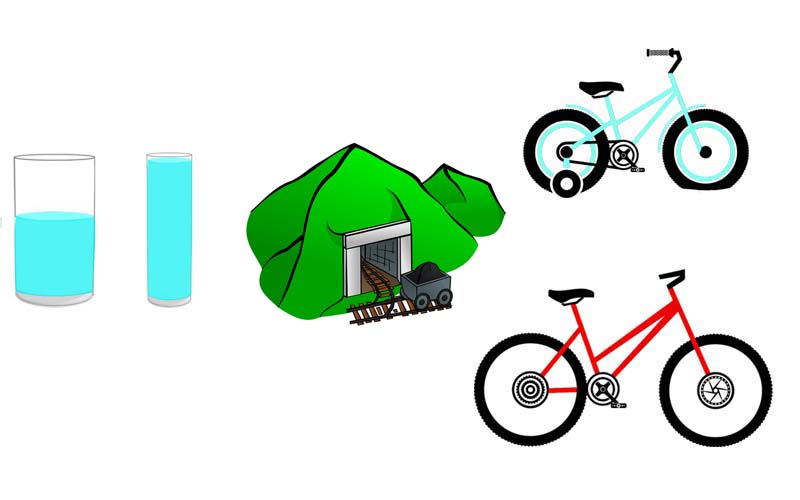
Piaget's theory of intellectual development. Select the buttons to explore experiments that illustrate children's intellectual development.
Conservation: These 2 glasses contain the same amount of water. Children aged 5 will typically think the tall glass holds more fluid because the water level is higher. At 6 to 7 years this begins to change and children will begin to understand that the same amount of water can look different in different containers.
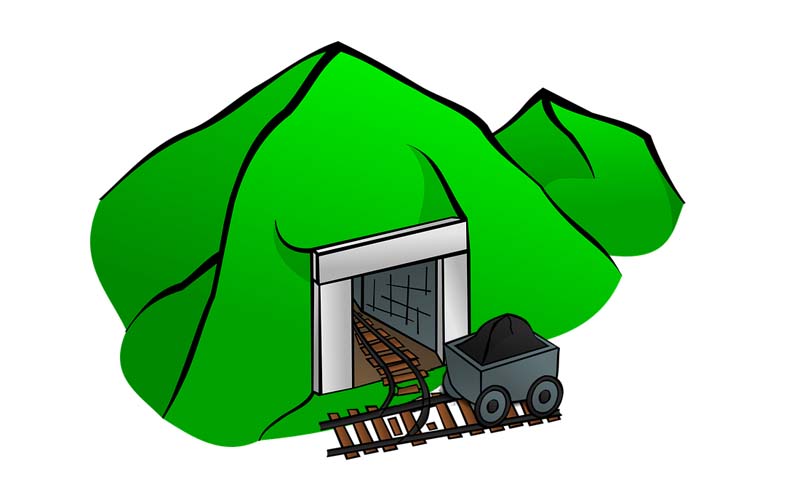
Decentration: The mine cart beside this mountain can only be seen from one side. At 5 years of age children sitting on the side of the mountain where the cart is in view will think that other people can see the cart even when it's obviously hidden from their point of view. As children age they understand that everyones point of view is unique and that others can't see what they see.
Reversibility: A 5 year old child will get very upset if the tyre is punctured on their bike. The young child does not understand that a puncture can be fixed or reversed, so they think their bike is permanently broken. An older child understands that a tyre can be re-inflated and will then work perfectly afterwards. This is reversibility.