Gestures
Over time infants change the way they use gestures in their communication.
Be aware: Some children are naturally quieter than others. If a child loses previously acquired speech this needs further investigation. A child who consistently uses gestures and facial expressions to communicate when you would expect them to use spoken word needs further investigation.
Skip through the age groups below to find out more.
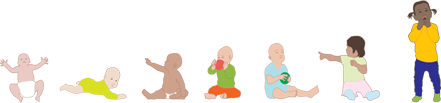
Gestures in communication
0-3 months:
Between 0 and 3 months of age babies learn to turn when someone speaks to them, and smile when they hear a voice. In fact, they seem to recognise familiar voices, and will quieten to the sound of that voice. Babies under 3 months will also stop their activity and attend closely to the sound of an unfamiliar voice. They will often respond to comforting tones whether the voice is familiar or not.
They listen to the speech of those close to them, and startle or cry if there is an unexpected noise. Loud noises wake them, and they become still in response to new sounds.
6 months:
Between 3 and 12 months of age, infants advance greatly in their ability to use gestures to communicate. By the time babies are 3 or 4 months of age adults offer and show things to them and by 6 months infants respond with smiles, gestures, movements and sounds.
Around this time they begin to use a pointing gesture to guide the attention of others to particular objects, yet it is not until 12 months of age that the child can follow the pointing gesture of another person.
9 months:
Shaking or nodding of the head may start as early as 6 months but is not associated with meaning to represent yes or no until around 12 months, but these movements are highly culturally and socially dependent.
12 months:
Over time, children reduce their use of gestures. By 18 to 24 months they rely increasingly on their verbal skills as they become able to express their needs, desires and thoughts through words and object association. However, the use of gestures can help children, particularly those experiencing difficulties with language to infer meaning from speech.