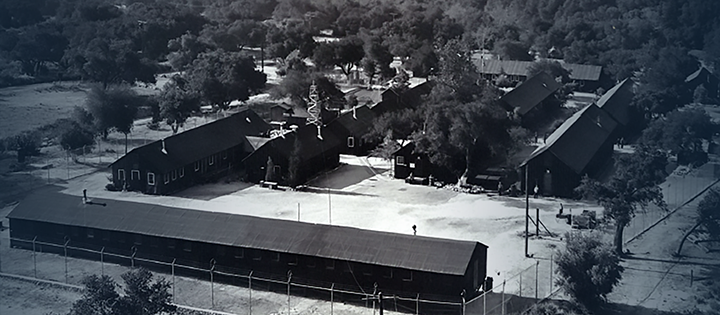
The university invites staff and students to a roundtable discussion on Tuna Canyon Detention Station and wartime incarceration from historical, cultural and political perspectives.
Today, U.S. news reports are full of items about the Trump Presidency’s war on so-called illegal immigrants. The actions of U.S. Immigration and Customs Enforcement (ICE) agents are based on a 1798 U.S. law called the Alien Enemies Act (AEA). This is not the first time this law has been used: it formed the basis for the U.S. government to arrest persons of Japanese, Italian and German heritage at the beginning of World War II. History is repeating itself.
The Tuna Canyon exhibition currently on display at the University of Nottingham in Monica Partridge Atrium from Monday 2 to Thursday 12 March presents the story of how the AEA was used after Pearl Harbor in December 1941 to arbitrarily incarcerate over 30,000 Japanese, German, and Italian immigrants and their children from the U.S. and from 18 Latin American countries, first in prison facilities and then in hastily established camps across the United States.
Focusing on one such camp, the Tuna Canyon Detention Station, located only 14 miles north of downtown Los Angeles, the exhibition will highlight this little-known aspect of U.S. history and offer a fascinating glimpse into the individual stories and histories of the diverse groups detained there.
Linked to the exhibition, this roundtable discussion will take place between Russell Endo (Tuna Canyon Detention Station Coalition), Rachel Pistol (University of Southampton) and Ruth Maxey (University of Nottingham).
The roundtable will focus on Tuna Canyon Detention Station, presidential responses to the memory of internment and incarceration and what it means for current affairs in the USA, and how incarceration has been remembered and portrayed in literature and the visual arts. There will also be a Q&A session including participation from Conrad Caspari, whose father was interned in Tuna Canyon.
Speakers
Russell Endo is an emeritus professor of sociology and Asian American studies at the University of Colorado. He has been teaching and doing research in Asian American studies since 1970, and he helped create Asian American studies programs at the University of Washington, Cornell University, and the University of Colorado. Russ is currently investigating the World War II arrests and imprisonment of enemy aliens, primarily in Southern California. He is the historian for the Tuna Canyon Detention Station Coalition and a researcher for the Amache Alliance and a coalition supporting legal challenges to the US government's contemporary use of the Alien Enemies Act. During World War II, members of his family were incarcerated at Tuna Canyon, Santa Anita, Jerome, Rohwer, and Manzanar.
Rachel Pistol is Senior Research Fellow and Director of the UK Holocaust Research Infrastructure (EHRI-UK) at the University of Southampton. She is a digital historian who focuses on Second World War internment in the UK and the USA, immigration in the UK and the USA pre-WW2, and refugees in Britain during the 1930s and 1940s. She has published widely on all of these topics including Internment during the Second World War: A comparative study of Great Britain and the USA (Bloomsbury, 2017). Rachel’s latest edited collection, The Obama Administration: Perceptions and Encounters (Bloomsbury, 2025) has been recognized as one of Choice’s Outstanding Academic Texts for 2025.
Ruth Maxey is Associate Professor of Modern American Literature at the University of Nottingham. She teaches and researches Asian American literature and culture and has published six books, including South Asian Atlantic Literature, 1970-2012 (Edinburgh University Press, 2012); Understanding Bharati Mukherjee (University of South Carolina Press, 2019), named a Choice Outstanding Title in 2021; and Power Plays in Transnational American Fiction: Gender, Race and Genre (Bloomsbury, 2026).
Conrad Caspari is a member of the Board of Directors for the Tuna Canyon Detention Station Coalition, the camp where his father, Fritz Caspari, was interned during WW2, and the Director of Agri-food and Bioenergy Consulting Ltd. He has a BA in Philosophy, Politics and Economics and a MSc in Agricultural Economics from Oxford University. Conrad worked for the Food and Drink Industries Council and the Economist Intelligence Unit in London before joining the Agra CEAS Consulting Ltd. in 1986. He was Managing Director of this company for 15 years before setting up an independent consultancy. He has directed well over 500 projects both in the EU-28 and worldwide for both the agri-business sector as well as for national and international institutions.
The event and exhibition are sponsored by the Tuna Canyon Detention Station Coalition, the British Association for American Studies and the Centre for U.S. in the World Studies at the University of Nottingham.