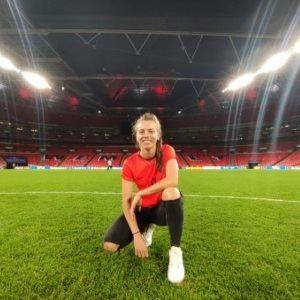
Lauren Heria
By Lauren Heria, politics graduate and CEO of Equal Kicks
This insight is part of our Skills Beyond Sport series involving Nottingham graduates.
Lauren answered our questions about her involvement in sport while at UoN, the experiences and skills she has and how they have shaped her career.
What sports activities were you involved in during your time at the University of Nottingham?
I played football and futsal for the UoN Women’s First Team and held several committee roles, including Futsal Officer. I was also part of the Sports Exec, where I was responsible for delivering IMS women’s football, and I played intermural sports (IMS) volleyball with the Sports Exec team.
Alongside this, I served on the Welcome Committee, helping organise daytime activities for Freshers, including the Welcome Sports Day.
In my final year, I was elected Sports Officer and served as UoNSU Sports Officer for the 2016–2017 academic year.
What role do you work in now, and in what ways do you feel your sporting experience at Nottingham has influenced your success in that position?
I am the CEO of Equal Kicks, a women’s sports consultancy I founded. Through Equal Kicks, I have worked on projects including the UEFA Women’s Euros 2022, the implementation of women’s football into Football Manager, and, most recently, supporting Foudys, a women’s football retail company, on marketing projects alongside global brands such as Nike, Adidas, and Puma.
I also play semi-professional football for Dulwich Hamlet, which I joined after returning from playing professional football in Spain in 2025.
University was where I rediscovered my love for football, and without playing at UoN I honestly don’t think I would be on this career path. The organisational, teamwork, and problem-solving skills I developed through university sport are ones I use daily, and I still collaborate with people from the network I built through UoN Sport.
What skills did you develop through sport that you feel have been most valuable in your career?
Sport helped me develop resilience, confidence, and teamwork. In any team environment, the ability to work towards a shared goal and use the strengths of those around you is key to success.
Sport also teaches you to reflect on both successes and setbacks, and to keep improving.
Just as important has been the community I built through sport. These relationships have supported both my personal and professional development, from trusted people I turn to for advice to industry connections that have helped grow my network and create new opportunities.
This is particularly important in women’s sport, which is often under-resourced. Having a strong network that supports and lifts each other up helps both individuals and the wider industry progress.
Did you find that your sporting experience helped you stand out when applying for jobs, and did it play a part in landing your first role?
Sporting experience gives you strong examples of skills employers look for, particularly if you have taken on leadership roles within your team or club.
My first role after university was working in a Students’ Union with teams and societies, so being able to demonstrate my understanding of that environment and student sport was particularly valuable during the interview process.
How did participating in sport influence your confidence or mindset as you transitioned into the workplace?
Sport develops your ability to problem-solve and think critically. On the pitch, you need to recognise challenges, work with your team to find solutions, and understand both individual and team strengths and weaknesses.
It also teaches resilience. You learn to deal with both highs and lows, stay committed, and keep improving. Balancing sport alongside studying also builds strong time-management skills and discipline.
These qualities translate directly into the workplace. Throughout my career, I have often heard the phrase “athletes make the best employees,” and there is definitely truth in that.
Did your involvement in sport help you build connections that later supported your career development?
Absolutely. I am still in regular contact with many people from my university sports network. Despite studying different degrees at UoN, our shared sporting experiences have helped many of us build successful careers in the sports industry.
Those experiences created strong foundations of trust, and we continue to support each other professionally wherever possible.
If you could give advice to current students about getting involved in sport, what would you tell them?
Get involved in sport at any level. Whether you compete at a high level or play casually in Intramural Sports (IMS) leagues, you will gain valuable skills that will stay with you throughout your life.
But beyond that, sport is fun. It’s a great way to express yourself, find your community, and take a break from the pressures of your degree. And if one sport isn’t for you, try another; there are so many opportunities at UoN that you’re bound to find something you enjoy.
If you're interested in working in sport or articulating the skills you've gained for job or further study applications, book an appointment with a careers adviser.
Posted on Tuesday 24th March 2026