Motor skills
Between the ages of 5 and 11 years old a child starts to become more aware of their body and their abilities. They are usually very active expending lots of energy in physical activity. Even when not physically active, such as when watching TV, children of this age tend to do a lot of fidgeting and moving. Movement coordination also starts to become more refined. Movements become smoother, more practiced, less jerky, less clumsy and more purposeful. A 5 year old should be able to coordinate gross or large motor skills such as hopping, jumping and balancing, moving to music and starting to dance rhythmically. Many will ride a tricycle or a scooter easily. Around 7 years old a child is able to develop more complex skills such as skipping with skipping rope and riding a two-wheeled bicycle. With most skills there is an average age to learn, but some children may be able to do this earlier and others later. This will depend not only on physical ability, but also on other factors such as opportunity to learn and incentive from peers.
It is very important for school-age children to be physically active in order to develop and practise motor skills. Children naturally seek out opportunities to be active and energetic, however, as a consequence, they may find it hard to sit and concentrate on a task for too long. Teachers know to change the subject or the activity frequently as the average child’s attention span is short at only 5 to 10 minutes. The ability of a child to learn a new skill depends on a number of factors relating to both muscle and brain development.
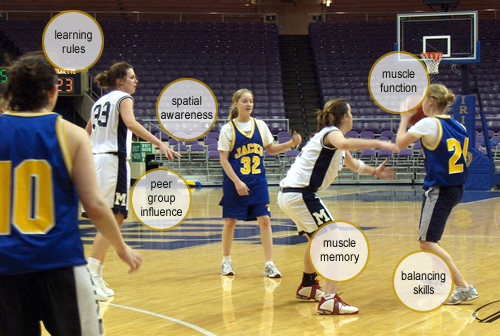
Select the areas indicated to learn more about motor skills and other skills that allow this game to be mastered.
Spatial awareness: Most children develop the spatial awareness to aim a ball at a recipient at around 6 years old. Once the muscles start to remember what to do, so the skills once learnt can be picked up again throughout the child’s life.
Muscle function: Strength to throw and catch the ball and accuracy to catch and aim the ball. The ability to catch a ball changes from clasping it to the chest to holding the ball. This, combined with the ability to start to throw a ball accurately helps in playing ball games.
Learning rules: As the child starts to learn about rules in games and playing as part of a team, they will start to develop skills that support playing with others.
Muscle memory: Once the muscles start to remember what to do, the skills once learnt can be picked up again throughout the child’s life.
Balancing: As this develops, the child can throw and catch the ball without falling over.