Brain development
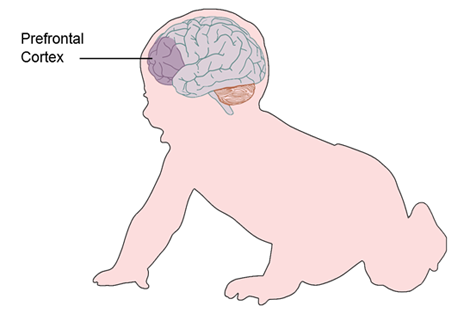
A modern understanding of brain development allows us to see how social development is paralleled by changes in the developing brain. We are beginning to appreciate that early experiences shape the way babies respond to the world. The brain uses neural pathways to interpret social interactions with synapses, or links developing between the neurones, in the first 18 months. The prefrontal cortex plays the most important role in our social interaction and provides a platform to help step back and look at our emotions.
Social neuroscience involves both biological theories and social concepts and attempts to connect findings from both disciplines. For example, recent research has highlighted that the brain cells involved when performing an action, e.g. holding a spoon, are also active when you observe someone holding a spoon. So called mirror neurones. Experiments with humans using functional scans, in an MRI, show that the brain areas which are active when we feel strong emotions are also active when we see others feel the same emotions. This suggests that mirror neurones may be involved in empathy, but the function and importance of mirror neurones is the focus of active ongoing research.