Sport Rehabilitation
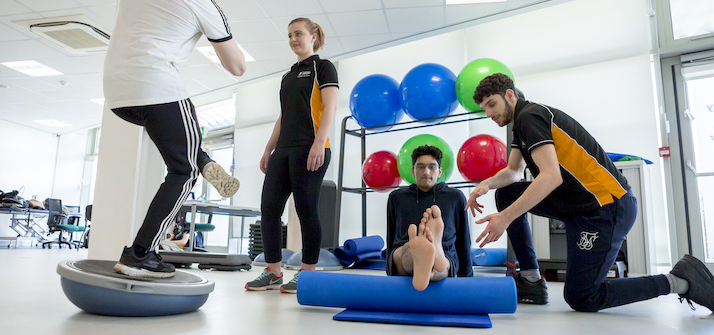
A degree in sport rehabilitation can lead to a diverse range of employment and postgraduate study opportunities. We expect most students will commit to careers in the sports and wellbeing sector undertaking roles such as:
- a graduate sport rehabilitator working:
-
- with both professional and amateur athletes
- in private practice with members of the public on either an employed or self-employed basis
- with injured service personnel as a civilian exercise remedial instructor with the Ministry of Defence
- within the NHS supporting the recovery and rehabilitation of patients with a range of medical conditions
- to deliver public health initiatives with members of the public.
- teaching in the education sector within further education, higher education or lifelong learning institutions.
- researcher in injury and rehabilitation with charities, such as Versus Arthritis
- undertake further study and professional development within allied fields, such as strength and conditioning, physiotherapy or osteopathy
The British Association of Sport Rehabilitators (BASRaT) provide a number of sport rehabilitator case studies on their website.
Some graduates choose to undertake further study and professional development within allied fields, such as strength and conditioning, physiotherapy or osteopathy.
The University of Nottingham Sport Rehabilitation degree is accredited by BASRaT. This accreditation gives you the ability to work internationally via the International Arrangement.
Spotlight On: Sport Rehabilitator
We invited four professionals to talk to you about their roles in sports rehabilitation:
- Michael Nicol, Owner of a private practice
- Oliver Ware, Head of Medial, Jersey Reds
- Andrew Thompson, Sports Rehabilitator and Rehabilitation Practitioner
- Mickila O'Boyle, Owner
Login to SharePoint to watch a recording of this event
- Alumni: Email us to gain access to the webinar
The need for sports rehabilitators
The UK regulator for sport rehabilitation, the British Association of Sport Rehabilitators and Trainers (BASRaT) states:
‘As the number of people participating in sport and exercise at all levels continues to increase, so too do the diverse demands on healthcare practitioners. Couple this with the nationwide drive to make Britain a healthier place and get people of all ages and physical conditions exercising; there is a definite need for exercise and rehabilitation professionals who can work alongside and complement the existing healthcare practitioners.
Sport rehabilitators help people suffering from pain, injury or illness involving the musculoskeletal system. They help people of all ages to maintain their health and fitness, recover from and prevent injury and reduce pain using exercise, movement and manual based therapeutic interventions.
The course at the University of Nottingham is accredited with BASRaT which entitles graduates who meet their entry criteria to apply for full graduate membership and bestows the professional title of graduate sport rehabilitator.
Find out more about BASRaT
Where could I work? What job titles should I look for?
As expected, most sport rehabilitation graduates will go on to work in the health and sport sector.
Employers are varied and may include:
- Ministry of Defence
- private practice
- NHS
- professional sports clubs and teams
- health and well-being sector including charities, associations and not for profit organisations
- leisure industry
Opportunities for BASRaT graduates are advertised nationally and will appear under a variety of job titles including:
- team therapist
- remedial instructor
- rehabilitation case manager, therapist or trainer
- sports rehabilitator
- exercise rehabilitator/practitioner
- clinical assistant
- sports therapist
- physiotherapist
- fitness instructor
The average annual UK salary of University of Nottingham sport rehabilitation graduates in 2022/23 was £25,442 (latest data)
Please note that further qualifications or accreditation may be required as well as your degree. Professional body membership (such as BASRaT) and suitable insurance coverage is often required for employment.
Where to look for jobs
You can also explore the following websites to assess the job market and internships opportunities.
BASRaT
Jobs in Sport
Leisure Jobs
NHS
Careers in Sport
Sporting Opportunities
Sport England
Joining LinkedIn could be valuable as you can find other sport scientists, track their careers to date, and perhaps make contact with them. Or you could join a specific online community.
Advice on LinkedIn profiles and making contacts on the BASRaT website
Pursing a non-clinical career
While most students who study sport rehabilitation progress into clinical practice, you may decide that becoming a sport rehabilitator isn’t for you.
Fortunately, your sport rehabilitation degree has equipped you with many transferrable skills that are highly sought after by graduate employers. These skills combined with a positive attitude, can open doors to a great number of career opportunities within sport, healthcare and beyond.
When exploring alternative careers options, it is important to reflect on your strengths, your values, motivators and interests.
Our Choosing your career webpages are a good place to start. Whether you have some ideas or are unsure about your next steps, booking a careers appointment can help you gain clarity and explore the possibilities available to you.
Book an appointment with a careers adviser
What do graduates from my course go on to do?
Graduate Outcomes is a national survey capturing the activities and perspectives of graduates launched in 2018 and is the biggest annual social survey in the UK.
You can view the destinations of graduates, who completed the survey, from your course by booking an appointment with an adviser. This can help you to explore your options if you are unsure what you want to do.
Find out more about the Graduate Outcomes survey
Enhancing your employability during your degree
To ensure currency and safety in practice all graduate sport rehabilitators are required to complete continuing professional development (CPD) to compliment, update and further specialise the knowledge gained as part of the BSc (Hons) Sport Rehabilitation programme.
Some graduates will choose to complete additional qualifications or short course learning in areas such as Strength and Conditioning with organisations such as the UK Strength and Conditioning Association (UKSCA) or the National Strength and Conditioning Association (NSCA), dry needling and or specialist manual therapy skills with short course providers or further their studies to higher degrees at universities in allied subjects such as Physiotherapy.
The UKSCA state that: having a degree does not make you exempt from completing the UKSCA’s accreditation process but of course the knowledge and skills you have obtained should support you in your assessment.
Topics they will cover include:
- foundation in strength and conditioning
- applied coaching science
- weight lifting for sport performance
- plyometrics
- agility and speed
- planning effective programmes
Coaching qualifications
- You may want to acquire coaching qualifications within a particular sport or acquire multi sport coaching skills. Check out UK Coaching for more information
- Alternatively, choose a sport and acquire specific coaching qualifications such as Learning Football England coaching programme
- Free online training and qualifications are available through groups such as England Rugby, UK Sport, the Football Association and World Rugby on a wide variety of coaching topics including concussion, child welfare and mental health
Away from sport you could be active in the community or student societies and make a positive contribution to the communities you live within
Skills to develop during your course or through extracurricular activities
As well as the skills developed on your course, participation in extracurricular and work experience, organisations large and small are also looking for students to have developed a range of attributes such as the following while at university. What employers seek from candidates is evolving all the time and it is important that you keep up to date with recruitment trends in the career areas that interest you.
- Collaboration
- Relationship building
- Initiative
- Resilience
- Adaptability
- Influencing online and in person
- Business appropriate communication
- Self-motivation
- Career management
Working with young or vulnerable people
Knowledge and understanding of child protection issues will be required if you apply for jobs with young or vulnerable people. For example, The Football Association may ask you to hold a current FA Safeguarding Children Workshop certificate (or willing to complete a FA Safeguarding Children Workshop certificate).
What are my further study options?
You may decide that a job on graduation is not for you, or wish to pursue a career that requires further training; consequently you might consider undertaking a master's degree or PhD in sport science.
There are a variety of Level 7 MSc qualifications such as strength and conditioning, nutrition, physiotherapy and public health. Short CPD courses are also commonplace within this profession.
For some PhDs a master's degree might be preferred.
Examples of PhDs include:
- Rehabilitation
- Rehabilitation science
- Human performance and rehabilitation sciences
- Shoulder and upper limb research
- What are the mechanisms underlying the effects of exercise on chronic knee pain and function?
FindAMasters
Prospects - for masters courses
FindAPhD
Jobs.ac.uk - for PhDs
Further study