Different types of intelligence
Adolescents who are very skilled and talented on some areas may have weaknesses in others. For example, an adolescent who has trouble learning mathematical concepts may excel on the football pitch.
Gardner proposed the idea of multiple intelligences such as verbal/linguistic, logical/mathematical, spatial, musical, bodily/ kinaesthetic, intrapersonal, naturalist and interpersonal. It is important to acknowledge development in all types of intelligence during adolescence. Evidence suggests that giving young people the ability to learn in ways that emphasise different types of abilities, increases their chances of success.
Logical/mathematical: Can you solve problems using deductive reasoning?
Verbal/Linguistic: Are you a storyteller, can you speak and write well?
Musical: Can you play or sing by ear?
Bodily kinaesthetic: Are you good at doing experiments, learning motor skills and sports?
Interpersonal: Can you work well with others? Are you good at reflecting?
Naturalist: Are you sensitive to the natural world, can you recognise plants and animals?
Intrapersonal: Do you have a good understanding of yourself, your own behaviour and what you are good at?
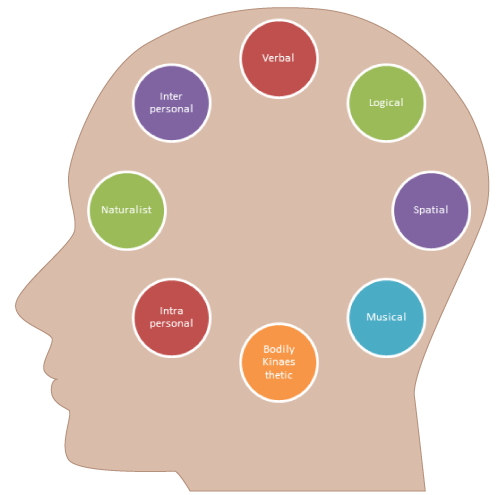
Logical and mathematical: Can you solve problems using deductive reasoning?
Verbal/Linguistic: Are you a storyteller, can you speak and write well?
Spatial: Do you like to visualise spatial patterns, like mind maps?
Musical: Can you play or sing by ear?
Bodily kinaesthetic: Are you good at doing experiments, learning motor skills and sports?
Interpersonal: Can you work well with others? Are you good at reflecting?
Naturalist: Are you sensitive to the natural world, can you recognise plants and animals?
Intrapersonal: Do you have a good understanding of yourself, your own behaviour and what you are good at?