Stages of pregnancy and prebirth development
Development of the baby starts at the point of conception where the nuclei of the sperm and egg fuse to form a single combined cell called a zygote. The whole period of development within the uterus is known as gestation, ending when the baby is born at around 38 weeks after the egg is fertilised.
In order to help understand and manage pregnancy from the woman's perspective, we split this into three roughly equal periods of time called trimesters. From the baby's perspective, development, whilst continuous, can also be divided into three phases. These three distinct phases lasting different lengths of gestational time are the germinal, embryological and foetal phases.
Be aware:
Whilst some drugs, alcohol and other environmental factors can affect the development of a baby during pregnancy, these effects are not the same throughout pregnancy. For example, the effects tend to involve whole limb or organ development during the germinal phase, whereas later exposure, may affect organ maturation or growth.Trimester 1 0-12 weeks
Starts from the date of the mother's last menstrual cycle, incorporating conception at around 14 days into the next cycle to the fully formed, embryo. Within this trimester, both the germinal phase, when the major tissue types are laid down and embryonic phase, when all the major organs and limbs are formed. By 11 or 12 weeks into the trimester, the embryo has the rudiments of all organs and limbs, although these are not functional at this stage.
Trimester 2 12-24 weeks
From 12 weeks until around 24 weeks, the embryo, now a foetus, is growing in length and the body systems are starting to develop functionality.
Trimester 3 24-38/40 weeks
From 24 weeks until birth, the baby could be born and live, although the body systems are still maturing and developing. The ability to breathe is the last system to develop functionality during this trimester and the foetus is developing layers of fat or (adipose tissue) to use following birth for maintaining warmth. This makes every day that the baby can remain in the uterus beneficial until 38 weeks gestation.
The germinal phase 0-2 weeks
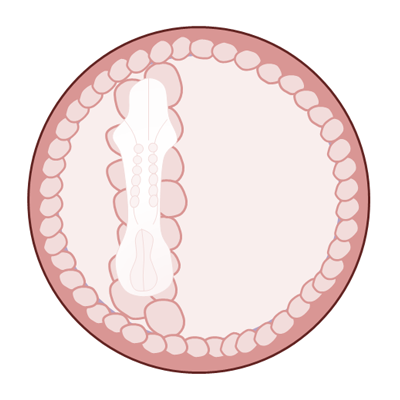
The germinal phase starts as the egg is fertilised by the sperm and lasts until the egg implants in the uterine wall. As the egg implants, the germ layers start to develop.
The embryological phase 2-8 weeks
This starts at 2 weeks of gestation and lasts until all the body's organs are produced, by the end of the 8th week of gestation. During these 6 weeks, the embryo produces all the organs required but very few of these are able to work effectively.
The foetal phase 8 weeks onwards
This is the longest phase and starts at 8 weeks gestation and carries on to the end of the pregnancy at around 38 weeks or 9 months. During this phase, the foetus grows first in length and then increases in weight. The organs and tissues develop an ability to work together so when the baby is born, the baby has the ability to live.