Penances
Penances were the standard punishment of the Archdeaconry court for sexual misdemeanours, but were also occasionally imposed for a variety of other offences. Penance was a ritual of repentance and reconciliation involving humiliation, which was designed to foster contrition, deter others and give satisfaction to the good people of the community for the sin.
Content and format
Most penances were imposed by the Correction court. The offender was given a Schedule of Penance which detailed where, when, how often, and in what way the penance was to be performed. In the most severe cases, penances were performed in the parish church during a busy Sunday service, when all the penitent's friends and neighbours were present. The offender was required to kneel at the front of the church, or stand on a bench so that he or she could be clearly seen. The minister would preach a sermon denouncing the sin, and the penitent then read out loud a statement acknowledging their sin, saying that they were sorry and asking for forgiveness. They were bare legged and bare headed, carrying a white rod, and dressed in a white sheet. Penances were sometimes performed two or three times in the same church, or occasionally in even more public places such as the market place of a large town. In less serious cases, penitents could appear in their own clothes, and in the 18th century, an increasing number were performed in private, in front of the minister and churchwardens only, and were termed mere 'Declarations'.
A similar procedure was gone through by people who had made defamatory or slanderous remarks about one of their neighbours and been brought before the court of Instance. They were asked to apologise to the injured party and take back the defamatory words in a Declaration - called a 'Revocation' by the 18th century.
When the penance, declaration or revocation had been satisfactorily performed, the minister and churchwardens signed the schedule and the penitent returned it to the court and was dismissed on payment of the court fees. The Penances (AN/PN) form part of the Archdeaconry archive.
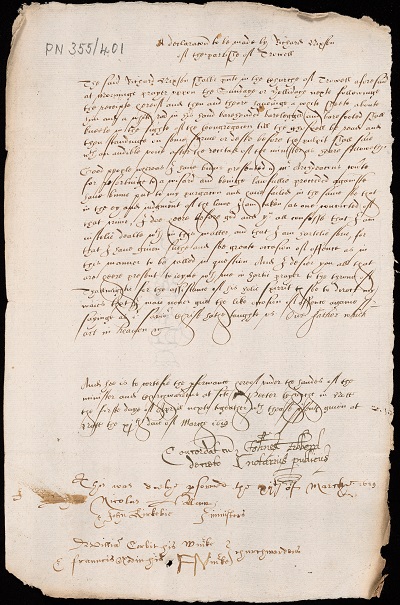
Example schedule of penance of Richard Nixon of Trowell, who was accused of consulting a wizard, 12 March 1620. (AN/PN/355/401)
Holdings
Penances have survived from 1590-1595, 1602, 1607-1622, 1624-1641, 1662-1665 and 1668-1794. There was a decline both in the number of Penances issued and the severity of the punishment ordered in the years following the Restoration of King Charles II in 1660. The system of calling lay parishioners to account in the Archdeaconry courts, as recorded in the Act Books (AN/A) appears to have ceased at the beginning of 1796.
The Penances are arranged chronologically for the most part, although there is some confusion evident in the bundles of Penances dated before the mid 17th century.
Catalogues and indexes
The names of people mentioned in most penances dated 1590 to 1794 are now indexed and can be accessed through the Advanced and Index Searches - People Search form in the Manuscripts Online Catalogue. Descriptions of the penances are also available to be searched or browsed through the Advanced Search option.
Three bundles of penances are too fragile to handle, and require conservation work before they can be catalogued or indexed:
- AN/PN 358 (1626)
- AN/PN 364 (1707-1713)
- AN/PN 367 (1740-1744)