Building a safe space: optimising maternity care for survivors of modern slavery by co-creating supporting resources for women and professionals

Project Leads: Dr Sara Borrelli, Prof Helen Spiby
Co-Investigators: Dr Minh Dang, Dr Liz Such, Dr Nicola Wright, Dr Matthew Young.
Partner organisations: University of Nottingham (School of Health Sciences and The Rights Lab) and Causeway.
Funders: NIHR Research for Patient Benefit and The Salvation Army.
Project dates: 1 July 2024 - 31 December 2025.
Programme : Systems and Communities
Background
A scoping review was undertaken to explore care and support during maternity for mothers affected by modern slavery (Borrelli et al., 2023), which highlighted barriers and challenges faced by mothers and HCP. However, we did not find clear evidence about how care and support should be provided during maternity. Healthcare professionals identified a clear need for raising awareness about modern slavery, training and maternity-specific guidance/recommendations. The experiences of staff working in non-statutory services were not reported in any detail. The University of Nottingham (School of Health Sciences and Rights Lab) and Causeway were awarded NIHR and The Salvation Army funding to undertake research to understand how the best maternity care and support can be provided for survivor mothers and their babies. The project was developed jointly by maternity, mental health and modern slavery researchers, survivor mothers and a service supporting survivors of modern slavery.
Aims
- To explore what support and care women affected by modern slavery and their babies need during maternity and how these should be provided.
- To explore the experiences and needs of statutory and non-statutory services to support provision of excellent care during maternity.
- To produce guidance and recommendations for statutory/non-statutory services, policy + incorporate and mobilise these into existing resources, platforms and education opportunities.
Design
The project comprised three phases delivered over 18 months, from the 1st of July 2024 to the 31st of December 2025:
- Phase I: qualitative enquiry with survivor mothers and professionals to identify how optimal maternity care and support should be provided.
- Phase II: co-creation of resources for survivor mothers, healthcare professionals and Third Sector professionals in consultation with PPI Group and key stakeholders.
- Phase III: integration of recommendations and resources into existing platforms and training provision.
Methods
The project used interviews and focus groups for data collection, including 27 survivor mothers from varied backgrounds and cultures. We also interviewed 7 maternity professionals and staff from non-statutory services. Using the information gathered and working with stakeholders, we co-created resources with stakeholders to support women’s decision-making and guide those providing care and support during maternity. The research benefitted from the advice of a group of individuals with lived experience and an Advisory Group with varying expertise, including maternity, safeguarding, and modern slavery perspectives.
Impact and Dissemination
The recommendations developed through this project are designed for all professionals and organisations involved in providing or commissioning maternity care and related support for women with current or previous experiences of human trafficking and exploitation, and for their babies. These include midwives, obstetricians, health visitors, mental health practitioners, safeguarding leads, social workers, voluntary and community sector organisations, and commissioners of maternity and perinatal services. The guidance is intended to help services embed safe, respectful, and trauma-informed approaches throughout all aspects of maternity care - from initial contact and antenatal care to birth, postnatal support, and beyond. The guidance can be used to review policies and practice, inform staff training and service development, and strengthen multi-agency care pathways. It offers a practical framework to recognise and respond to the specific needs of survivor mothers, and to guide organisational change that promotes safety, consistency and collaboration.
Acknowledgments
We would like to thank all participants for sharing their experiences, the Advisory Group for their guidance, the Survivor Involvement Group for their valuable contributions, and all stakeholders and organisations who supported this research. We would also like to acknowledge the contribution of The University of Nottingham Health and E-Learning Media Team, who provided support in producing the infographic resources.
Outputs
SCOPING REVIEW PUBLICATION
Borrelli S., Ramasamy R., Wong R., Spiby H. (2023) Care and support during maternity for mothers affected by modern slavery: a scoping review. International Journal of Nursing Studies Advances, 5: 100139. https://doi.org/10.1016/j.ijnsa.2023.100139
INFOGRAPHIC RESOURCES
A set of co-created infographics includes targeted versions for survivor mothers, healthcare professionals, and third sector workers:
If you’ve experienced control, exploitation, trafficking or abuse, this could be modern slavery. Do you need maternity care and support?
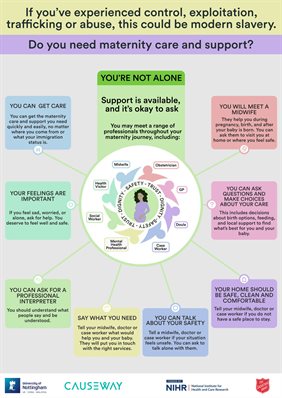
Click on the image preview to enlarge and/or download.
Are you a healthcare professional caring for pregnant women or mothers who have experienced control, exploitation or abuse? This may include people affected by modern slavery.
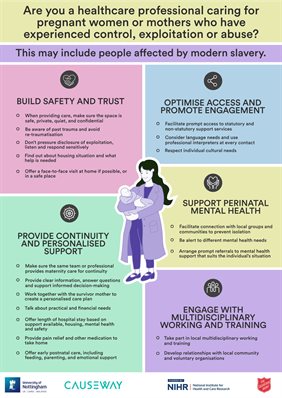
Click on the image preview to enlarge and/or download.
Are you a third sector worker supporting pregnant women or mothers who have experienced control, exploitation or abuse? This may include people affected by modern slavery.
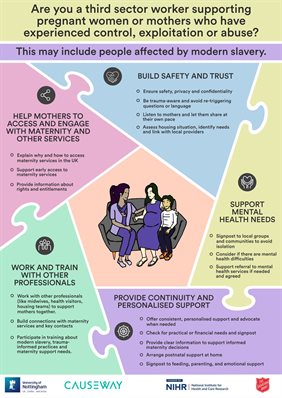
Click on the image preview to enlarge and/or download.