Thursday, 26 February 2026
An international team of scientists has shed light on the development of the malaria parasite and have identified a unique protein essential for its survival and transmission, which offers a promising new target for antimalaria drugs.
The discovery centres on a molecule named Aurora-related kinase 1 (ARK1). In a new study published in Nature Communications, researchers from the University of Nottingham, National Institute of Immunology (NII), India, University of Groningen, the Netherlands, the Francis Crick Institute, and international collaborators, have revealed that ARK1 acts as a ‘traffic controller’ during the parasite's unusual cell division and growth process.
Malaria remains one of the world's deadliest diseases, caused by Plasmodium parasites that replicate rapidly within humans and mosquitoes. Understanding how these parasites divide and multiply is crucial to stopping the disease.
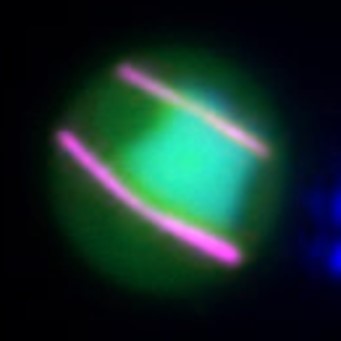 Malaria parasite cell with aurora kinases
Unlike human cells, the malaria parasite divides and grows in a unique, atypical way. The research team discovered that ARK1 is responsible for organising the ‘spindle’ —the molecular machinery that pulls genetic material apart to create new parasites.
When the researchers turned off ARK1 in the lab, the results were striking. The parasite could no longer form proper spindles, causing its replication to fail, and crucially, parasites lacking ARK1 could not complete their development both in the host and the mosquito, effectively stopping the disease from being passed on.
“The name 'Aurora' refers to the Roman goddess of dawn, and we believe this protein truly heralds a new beginning in our understanding of malaria cell biology," said Dr Ryuji Yanase first author of the study from the School of Life Sciences at the University of Nottingham.
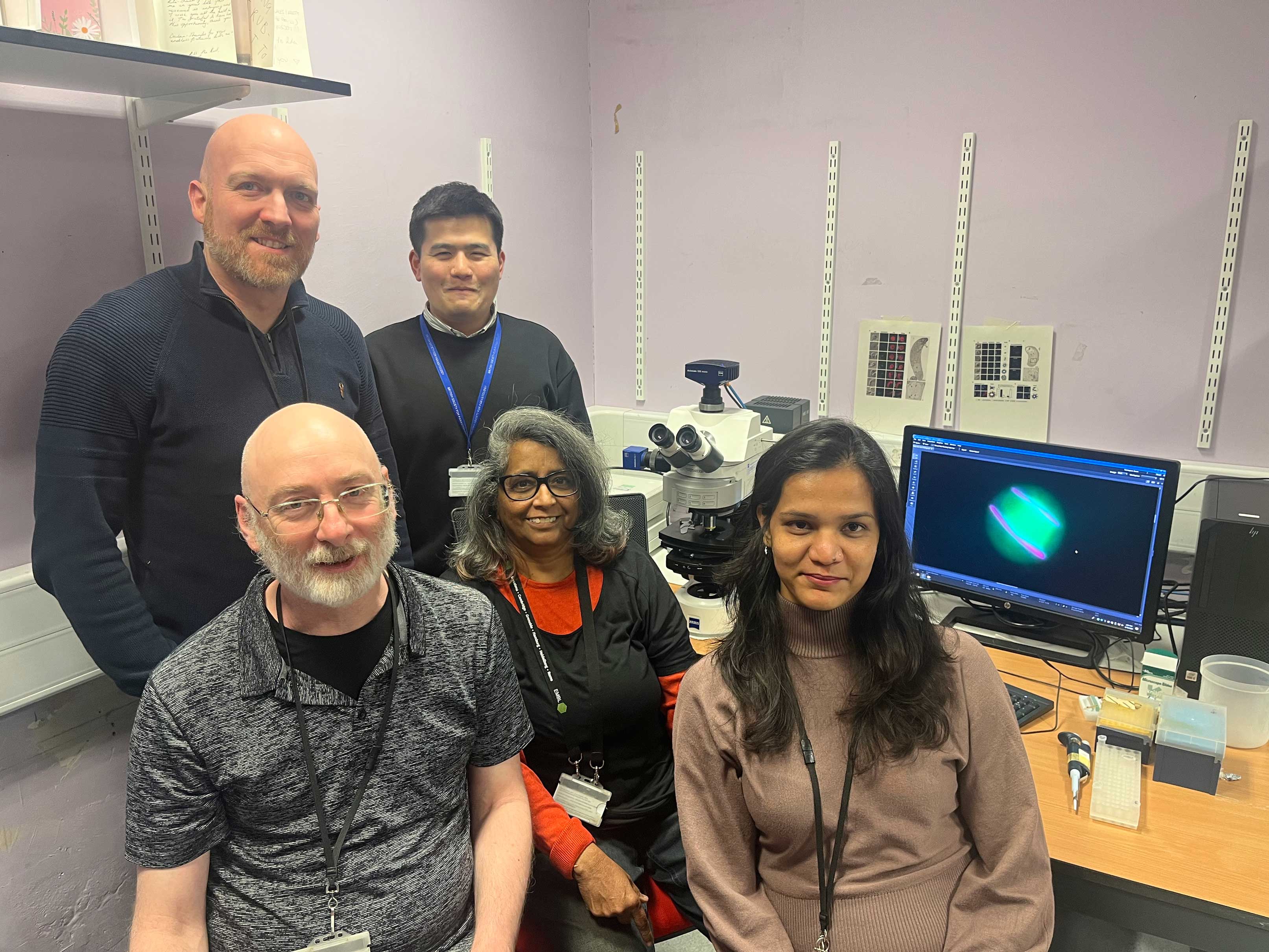 The research team
"Plasmodium divides via distinct processes in the human and mosquito host, it was well and truly a team effort, which allowed us to appreciate the role of ARK1 almost simultaneously in the two hosts and shed light on novel aspects of parasite biology, " said Annu Nagar and Dr Pushkar Sharma from the Biotechnology Research and Innovation Council (BRIC)-NII, New Delhi.
"What makes this discovery so exciting is that the malaria parasite's 'Aurora' complex is very different from the version found in human cells. This divergence is a huge advantage," Professor Tewari added. "It means we can potentially design drugs that target the parasite's ARK1 specifically, turning the lights out on malaria without harming the patient."
This study maps out the unconventional molecular machinery of the parasite, providing a "blueprint" for future drug discovery efforts aimed at breaking the cycle of malaria transmission.
The full study can be found here.
Story credits
More information is available from Professor Rita Tewari from the School of Life Sciences at rita.tewari@nottingham.ac.uk
Notes to editors:
About the University of Nottingham
Ranked 97 in the world and 17th in the UK by the QS World University Rankings, the University of Nottingham is a founding member of Russell Group of research-intensive universities. Studying at the University of Nottingham is a life-changing experience, and we pride ourselves on unlocking the potential of our students. We have a pioneering spirit, expressed in the vision of our founder Sir Jesse Boot, which has seen us lead the way in establishing campuses in China and Malaysia - part of a globally connected network of education, research and industrial engagement.
Nottingham was crowned Sports University of the Year by The Times and Sunday Times Good University Guide 2024 – the third time it has been given the honour since 2018 – and by the Daily Mail University Guide 2024.
The university is among the best universities in the UK for the strength of our research, positioned seventh for research power in the UK according to REF 2021. The birthplace of discoveries such as MRI and ibuprofen, our innovations transform lives and tackle global problems such as sustainable food supplies, ending modern slavery, developing greener transport, and reducing reliance on fossil fuels.
The university is a major employer and industry partner - locally and globally - and our graduates are the third most targeted by the UK's top employers, according to The Graduate Market in 2024 report by High Fliers Research. Alongside Nottingham Trent University, we lead the Universities for Nottingham initiative, a pioneering collaboration between the city’s two world-class institutions to improve levels of prosperity, opportunity, sustainability, health and wellbeing for residents in the city and region we are proud to call home. More news…