Friday, 04 April 2025
A new study has shown how aspects of brain function change with age, revealing that excitatory processes in the brain decrease, while inhibitory processes increase as children get older. The findings are an important step in understanding disorders like autism.
Brain function is based on a delicate balance of excitatory processes (which make brain cells fire) and inhibitory processes (which stop brain cells firing) – this is known as the E-I balance. Usually, to measure this, sensors would need to be placed in the brain (which requires experimental surgery and so cannot be routinely done in humans). In this new study, published today in Imaging Neuroscience, scientists have shown that it can be measured using a novel wearable brain scanner.
Researchers from the School of Physics and Astronomy at the University of Nottingham and The Hospital for Sick Children (SickKids) in Toronto scanned the brains of 101 healthy children and adults between the ages of 2 and 34 years. Using a wearable design of magnetoencephalography (MEG) scanner, the team were able to measure high frequency brain waves (known as gamma waves) that are generated in brain circuits that rely on both excitatory and inhibitory inputs. The researchers showed that gamma waves change significantly with age, with low amplitude broadband waves in children and high amplitude narrowband waves in adults.
Using biophysical models of the measured gamma waves, the research team were then able to translate their findings into measurements of E-I balance, showing that as children get older excitatory processes decrease, while inhibitory processes increase. This trajectory is critical for healthy brain development and is understood to be atypical in older children and adults with psychiatric disorders. This provides a benchmark (in typically developing young children) against which disorders like autism can be understood.
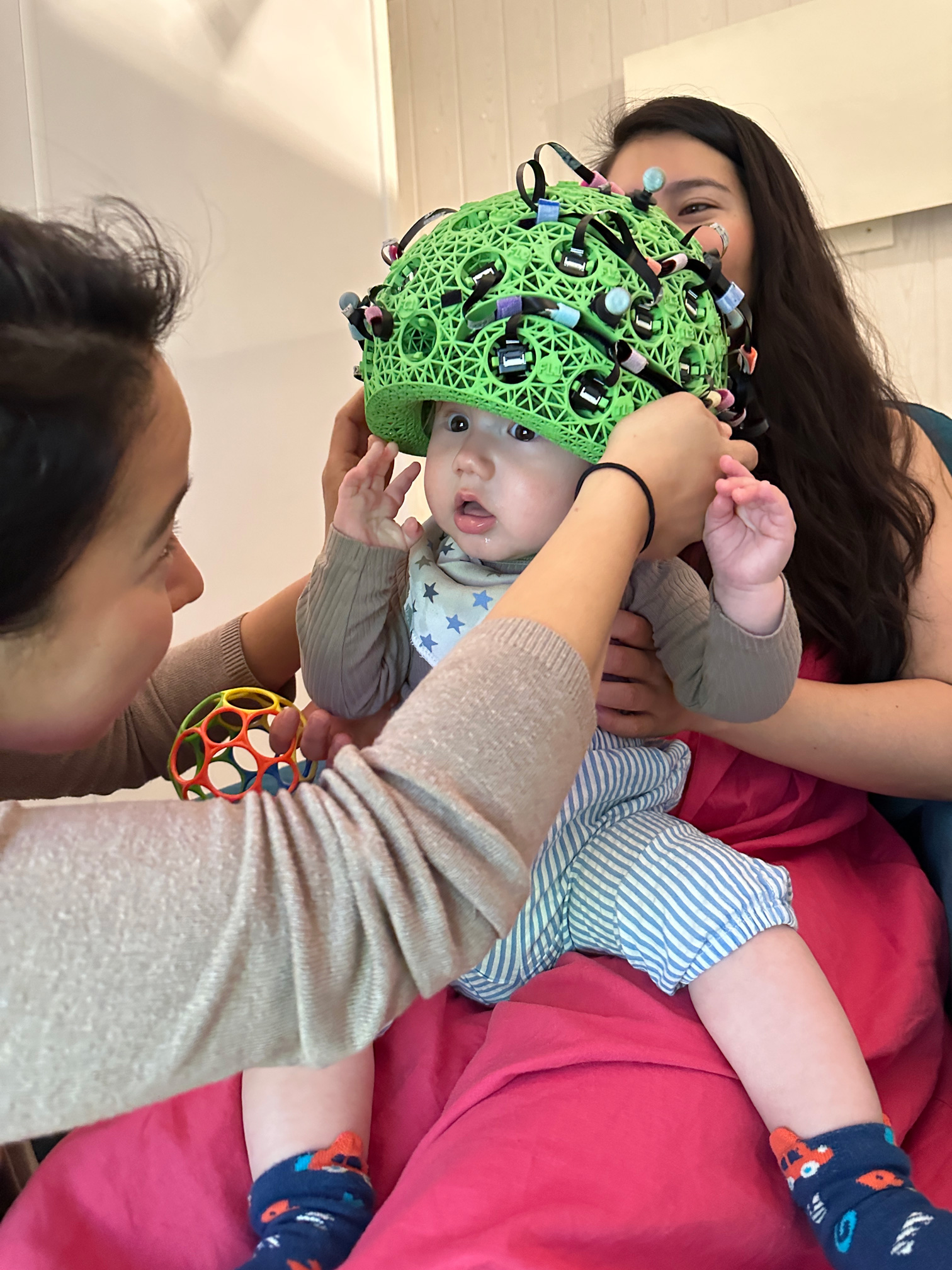 Young infant taking part in study with wearable brain scanner
Psychiatric disorders are due to atypical brain function, which can be measured with a range of brain imaging technologies, such as MRI, EEG and MEG. Childhood disorders, however, can emerge in the early years of life (2-4 years of age), but there are limited ways to investigate the brain function in children who are this young.
The wearable brain scanner is based on quantum technology, and uses LEGO-brick-sized sensors – called optically pumped magnetometers (OPMs) – which are incorporated into a lightweight helmet to measure the magnetic fields generated by brain activity. This unique design means the system can be adapted to fit any age group, including very young children. The system takes only seconds to set up, and children wear it and can move freely during a scan. It is therefore ideally suited to scanning children.
Professor Matthew Brookes from the University of Nottingham’s Sir Peter Mansfield Imaging Centre has led the development of the new technology which is now being installed across the world by Nottingham-based spin-out company Cerca Magnetics, he said: “Quantum technologies have revolutionised what is possible with brain imaging. 10 years ago measuring MEG signals in very young children as they move around freely, whilst wearing what is essentially a hat, seemed like science fiction. Now, it’s possible and it’s opening up new worlds of possibility – particularly related to the developing brain in the early years of life.”
World renowned neuroscientist Dr Margot Taylor – who leads autism research at the Hospital for Sick Children in Toronto – said: “OPM technology allows us to complete studies in young children that were simply not possible otherwise. We are able to obtain fantastic data in one-year-olds; our next frontier is having the same success in infants from birth. We expect that these studies will give us better understanding of the early onset of neurodevelopmental disorders, which will help in the care of the children in the future.”
This study was led by Dr Natalie Rhodes who, following undergraduate and postgraduate study at the University of Nottingham, moved to Toronto to continue her scientific career.
Just like a well-tuned orchestra, our brains rely on a delicate balance of signals. We now have a way to measure how this balance changes from early life to adulthood and can use this to better understand developmental differences in conditions like autism. We know that an imbalance in brain signals is linked to neurodevelopmental conditions, but until now, we haven't had a suitable method to measure it in young children. Using OPM technology, we can now study brain function with unprecedented precision from very young children.
The University of Nottingham launched Cerca Magnetics in 2020 to commercialise OPM-MEG scanners and related technologies. The wearable system has been installed in a number of high profile research institutions across the globe, including at SickKids in Toronto where around half of the volunteers in the current study were scanned. The research teams in both institutions are working together to expand the range and extent of neurodevelopmental data, in both healthy and atypical brain populations.
The study was supported by a healthcare impact partnership grant, awarded by the Engineering and Physical Sciences Research Council (EPSRC) in the UK. The authors have also wish to acknowledge the UK quantum technologies programme and in particular the Quantum Hub for Sensors Imaging and Timing (QuSIT). The work at SickKids was supported by the Simons Foundation Autism Research Initiative (SFARI; 2021) and the Canadian Institutes of Health Research (CIHR).
Story credits
More information is available from Dr Natalie Rhodes on natalie.rhodes@sickkids.ca or Professor Matthew Brookes on Matthew.brookes@nottingham.ac.uk or Dr Margot Taylor on margot.taylor@sickkids.ca
Notes to editors:
About the University of Nottingham
Ranked 97 in the world and 17th in the UK by the QS World University Rankings, the University of Nottingham is a founding member of Russell Group of research-intensive universities. Studying at the University of Nottingham is a life-changing experience, and we pride ourselves on unlocking the potential of our students. We have a pioneering spirit, expressed in the vision of our founder Sir Jesse Boot, which has seen us lead the way in establishing campuses in China and Malaysia - part of a globally connected network of education, research and industrial engagement.
Nottingham was crowned Sports University of the Year by The Times and Sunday Times Good University Guide 2024 – the third time it has been given the honour since 2018 – and by the Daily Mail University Guide 2024.
The university is among the best universities in the UK for the strength of our research, positioned seventh for research power in the UK according to REF 2021. The birthplace of discoveries such as MRI and ibuprofen, our innovations transform lives and tackle global problems such as sustainable food supplies, ending modern slavery, developing greener transport, and reducing reliance on fossil fuels.
The university is a major employer and industry partner - locally and globally - and our graduates are the third most targeted by the UK's top employers, according to The Graduate Market in 2024 report by High Fliers Research. Alongside Nottingham Trent University, we lead the Universities for Nottingham initiative, a pioneering collaboration between the city’s two world-class institutions to improve levels of prosperity, opportunity, sustainability, health and wellbeing for residents in the city and region we are proud to call home. More news…