Thursday, 26 February 2026
A team of scientists have recently returned from a research trip to Antarctica where they were collecting penguin poo ‘guano’ from lake sediment cores. The ancient DNA from these samples will be analysed for pathogens and other microbes to better predict the likely ecological impact of changing climatic conditions and diseases emerging in Antarctica today.
To understand historic penguin faecal microbes and the pathogens that penguin populations have been exposed to, a team consisting of scientists from the School of Biosciences at the University of Nottingham and the University of Hong Kong collected guano-impacted lake sediment from King George Island in Antarctica, which will be sent back to Nottingham to be analysed in the Ancient DNA lab. Samples of fresh guano from present-day penguin colonies will be used as a modern-day comparison.
Antarctic wildlife is under increasing pressure from several interplaying threats, including climate change, anthropogenic pollution and emergent disease. However, little is known about the current and past occurrence of microbial pathogens in Antarctic animals at the population scale, primarily due to limitations in accessibility.
It has often been assumed that the wildlife in Antarctica is protected from diseases due to the isolation and extreme conditions, and the susceptibility of captive penguins to infectious diseases has been cited as an indicator of the immunological naïveté of Antarctic animals and their vulnerability to introduced diseases. However previous studies around Antarctica have detected diverse and novel viruses, suggesting that penguins could constitute an important viral reservoir in Antarctica.
Ancient penguin guano preserved in lake sediments represents a novel and poorly characterised genetic archive of ancient microbes which, when combined with cutting-edge techniques to recover ancient DNA (aDNA) and ancient RNA (aRNA), can facilitate the study of Antarctic microbes dating back hundreds to thousands of years.
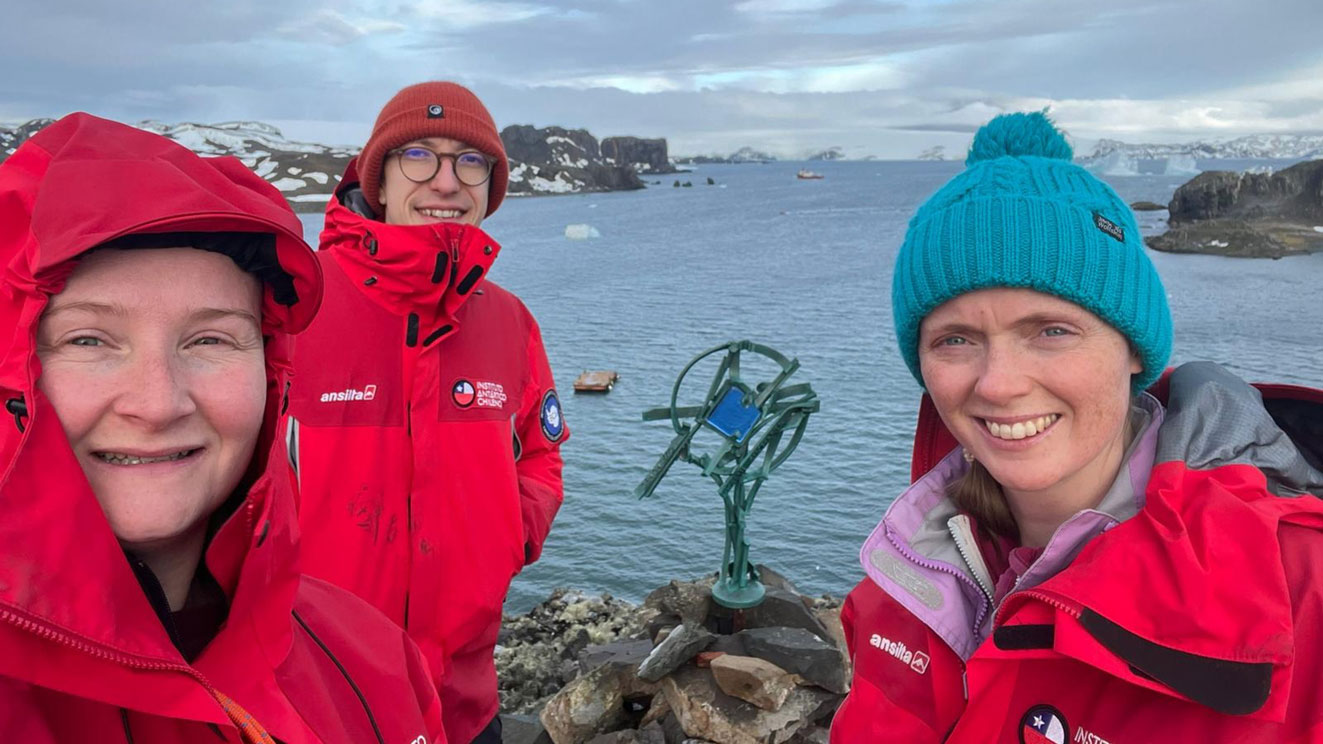 L to R - Dr Martha Ledger, Dr Alexander Williams and Dr Roseanna Mayfield
Dr Alexander Williams from the School of Public Health at the University of Hong Kong is leading the PathoPast project, he said: “It was very exciting to take this trip and get the chance to take samples from this valuable ecological landscape. Penguins are recognised sentinels for the state of Antarctic environments. Many penguin species form dense colonies with thousands of breeding pairs, which may aid the rapid transmission of pathogens making them an interesting target for this study. With excellent support from the Escudero base we were able to make the most of good-weather days and this helped make sure we were able to collect all of our key samples”
Penguin guano also contributes to the formation of Antarctic lake sediment. Lake sediment cores have been highlighted as a valuable resource for reconstructing long-term changes in past avian populations, and are a recognised source of aDNA.
The collection of sediment from the lake was a challenging operation but it’s a vital part of this study as this ancient sediment represents a chronological record of past penguin colonies and environmental conditions from the area. With the data we collect we should be able to see what microbes are present and how the microbial communities have changed over time.
Analysis of the lake sediment samples will be led by Dr Andrew Clarke, Assistant Professor in Archaeogenetics at the University of Nottingham, in the state-of-the-art Ancient DNA lab. The facility allows isolation and analysis of damaged, degraded and low-copy DNA to address research questions across biology, environmental science, geography and archaeology.
The modern guano samples will be analysed by Dr Williams at the University of Hong Kong State Key Laboratory of Emerging Infectious Diseases.
We are all excited to see what the analysis shows when we have collated all the data as it will hold significant value for understanding the background prevalence of Antarctic disease and the possible impact of disease introduction today.
Story credits
More information is available from Jane Icke, Media Relations Manager for the Faculty of Science at the University of Nottingham jane.icke@nottingham.ac.uk
Notes to editors:
About the University of Nottingham
Ranked 97 in the world and 17th in the UK by the QS World University Rankings, the University of Nottingham is a founding member of Russell Group of research-intensive universities. Studying at the University of Nottingham is a life-changing experience, and we pride ourselves on unlocking the potential of our students. We have a pioneering spirit, expressed in the vision of our founder Sir Jesse Boot, which has seen us lead the way in establishing campuses in China and Malaysia - part of a globally connected network of education, research and industrial engagement.
Nottingham was crowned Sports University of the Year by The Times and Sunday Times Good University Guide 2024 – the third time it has been given the honour since 2018 – and by the Daily Mail University Guide 2024.
The university is among the best universities in the UK for the strength of our research, positioned seventh for research power in the UK according to REF 2021. The birthplace of discoveries such as MRI and ibuprofen, our innovations transform lives and tackle global problems such as sustainable food supplies, ending modern slavery, developing greener transport, and reducing reliance on fossil fuels.
The university is a major employer and industry partner - locally and globally - and our graduates are the third most targeted by the UK's top employers, according to The Graduate Market in 2024 report by High Fliers Research. Alongside Nottingham Trent University, we lead the Universities for Nottingham initiative, a pioneering collaboration between the city’s two world-class institutions to improve levels of prosperity, opportunity, sustainability, health and wellbeing for residents in the city and region we are proud to call home. More news…