Thursday, 10 July 2025
A new study from the University of Nottingham has looked at how the anaesthetic gases breathed out by animal patients are released into the atmosphere and contribute to global warming.
The study, an industry first, published in British Journal of Anaesthesia evaluated the capture of gases from anaesthetised dogs and cats to measure the efficiency of a volatile gas capture device. This study team included Mars Linnaeus and Waltham Pet Care Science Institute staff.
The future aim of this technology will be to capture the gases, reprocess and reuse the anaesthetic drugs, moving from a linear (take-make-waste) to a circular (reuse-repair-recycle) economy.
The study demonstrated an efficiency of 65% capture of isoflurane and prevented an average release of 3.75 kgCO2e for each 20-minute anaesthetic period in the study, (equivalent to 14 miles driven in an average UK car).
The study also identified that capture is dependent on multiple factors including blood pressure during anaesthesia.
Medical healthcare has been forward in acknowledging its greenhouse gas emissions, which contribute to the existential risk from climate change.
There is similar concern in veterinary healthcare, with an estimated 21% of the carbon emissions for a canine orthopaedic procedure resulting from volatile anaesthetics.
Reducing the carbon footprint associated with anaesthesia and surgery, in humans or animals, is an important issue, and one way we can do this is to capture the waste gases to prevent environmental damage.
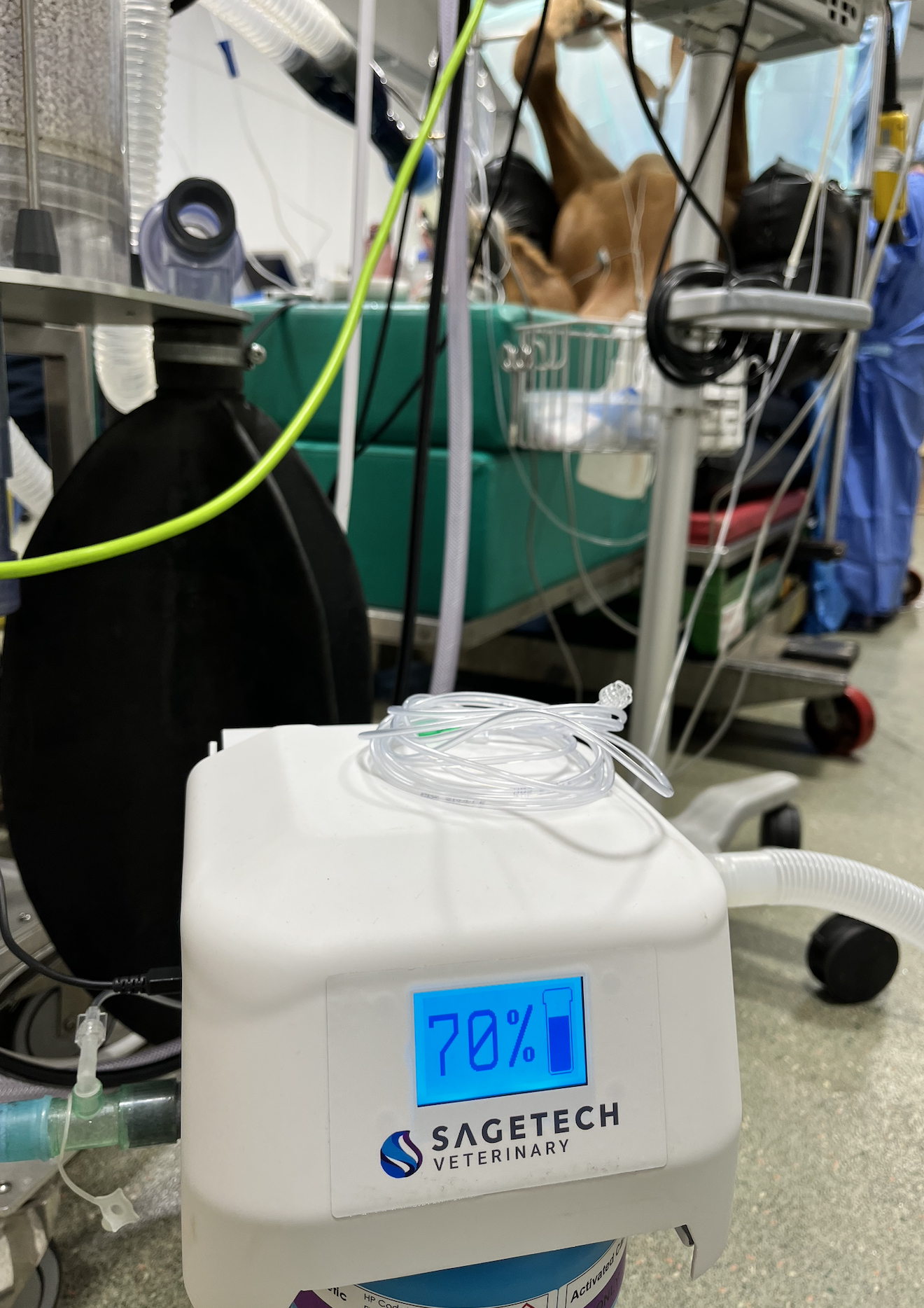 Isoflurane capture from an anaesthetised horse undergoing stifle arthroscopy. Credit: Prof Kate White
“My team have been evaluating the capture of isoflurane, sevoflurane and desflurane using SageTech's technology in dogs, cats, horses, ruminants and even zoo animals and teaching the veterinary students at the University of Nottingham about the concept.
“The technology in combination with interventions such as reducing single use items and low flow anaesthesia offers significant potential as we transition to a low carbon world.”
The full study is available here.
Professor White will be presenting results of 4 further studies using this technology in different species with different volatile agents at the World Congress of Veterinary Anaesthesia and Analgesia in Paris 16-19th September 2025.
Story credits
More information is available from Professor Kate White on kate.white@nottingham.ac.uk
Faith Pring - Media Relations Manager
Email: faith.pring@nottingham.ac.uk
Phone: 0115 748 4411
Location: University of Nottingham, University Park
Notes to editors:
About the University of Nottingham
Ranked 97 in the world and 17th in the UK by the QS World University Rankings, the University of Nottingham is a founding member of Russell Group of research-intensive universities. Studying at the University of Nottingham is a life-changing experience, and we pride ourselves on unlocking the potential of our students. We have a pioneering spirit, expressed in the vision of our founder Sir Jesse Boot, which has seen us lead the way in establishing campuses in China and Malaysia - part of a globally connected network of education, research and industrial engagement.
Nottingham was crowned Sports University of the Year by The Times and Sunday Times Good University Guide 2024 – the third time it has been given the honour since 2018 – and by the Daily Mail University Guide 2024.
The university is among the best universities in the UK for the strength of our research, positioned seventh for research power in the UK according to REF 2021. The birthplace of discoveries such as MRI and ibuprofen, our innovations transform lives and tackle global problems such as sustainable food supplies, ending modern slavery, developing greener transport, and reducing reliance on fossil fuels.
The university is a major employer and industry partner - locally and globally - and our graduates are the third most targeted by the UK's top employers, according to The Graduate Market in 2024 report by High Fliers Research. Alongside Nottingham Trent University, we lead the Universities for Nottingham initiative, a pioneering collaboration between the city’s two world-class institutions to improve levels of prosperity, opportunity, sustainability, health and wellbeing for residents in the city and region we are proud to call home. More news…