Tuesday, 02 December 2025
Scientists from the University of Nottingham will develop the world's first fully mobile magnetoencephalography (MEG) brain scanner capable of measuring the effects of blast exposure on military personnel in real time at training sites.
For the first time ever, researchers will see exactly what happens to brain function within minutes of blast exposure and watch how personnel recover - potentially transforming how those who serve are protected.
The Ministry of Defence has provided more than £3m to create this world first scanner, which is based on a transformational quantum technology. Crucially, the mobile laboratory will deploy directly to military firing ranges, field hospitals and rehabilitation centres, bringing the technology where it is needed most.
This will enable evidence-based decision making to protect service personnel from any potential harmful effects.
The system will be built by University of Nottingham spin-out company Cerca Magnetics and used by the Defence Medical Services, in collaboration with world-leading scientists from the Universities of Nottingham and Birmingham, to understand the effects of blast exposure.
Minister for Veterans and People, Louise Sandher-Jones MP said:
“The safety of our personnel is a top priority. Thanks to technologies like this, even subtle physical changes are now becoming detectable, and we will get crucial insights that simply weren’t possible before, improving decision-making and vital protections for our forces.
“This funding demonstrates our commitment to renewing the nation’s contract with those who serve, but also shows how defence innovation benefits wider society, including those impacted by dementia, epilepsy and concussion.”
This physics breakthrough cements UK’s leadership in defence science and brain imaging, delivering on the Government’s Plan for Change, and has positive implications extending far beyond the military, significantly benefitting research into sports concussion, dementia, and epilepsy.
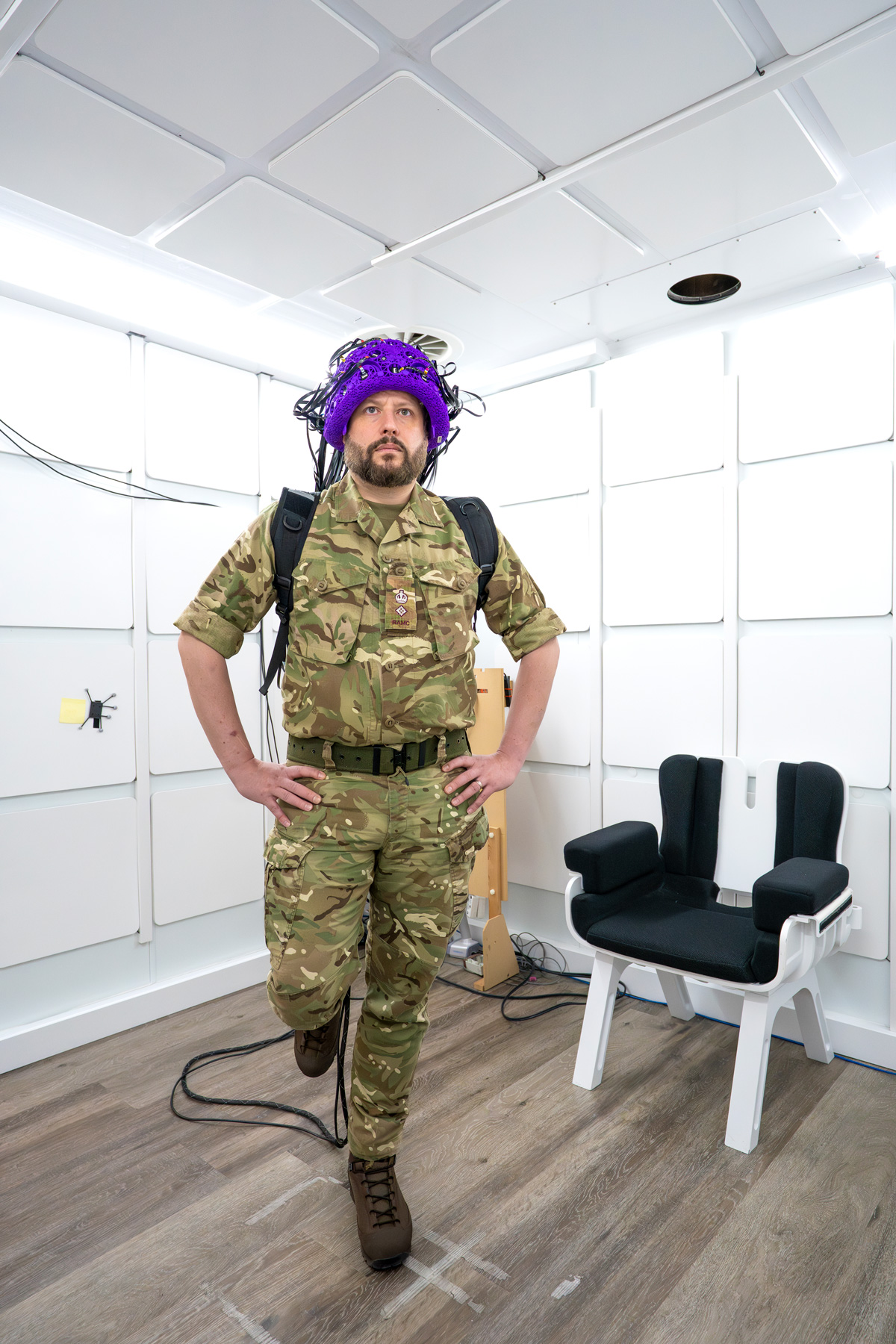 Lt Col James Mitchell taking part in scanning using the MEG system
Lt Col James Mitchell, Consultant Neurologist and Chief Investigator of the UK Military Blast Study at the UK Defence Medical Services, said: "This new system, a world first, will be transformative for research into the effects of blast exposure on our personnel.
“For the first time we will be able to build a time-stamped, accurate picture of exactly what happens to the brain in the minutes and hours after blast exposure and track recovery over time. Ultimately, we expect this system to help provide robust, scientifically informed policy on safe working practices for blast exposure."
The breakthrough addresses a critical defence challenge: repeated exposure to shock waves from high-power weapons might cause subtle changes in brain function, which, over a career, may increase the likelihood of serious brain health conditions.
Yet safe exposure levels remain unknown because the effects are subtle and fleeting – often disappearing within 24-48 hours – making them impossible to capture with conventional laboratory-based scanners.
Professor Matthew Brookes, professor of physics at the University of Nottingham and chairman of Cerca magnetics, has pioneered OPM-MEG technology for a decade. He said: "This new generation of MEG lifts limitations that have historically confined scanners to universities, paving the way for mobile systems that can be taken directly to those who will benefit most. The introduction of mobile systems will likely revolutionise other fields too, whether parked outside hospitals to assess neurological conditions or at sports grounds to scan players following concussion."
The system will enable rapid scans, providing objective assessment of changes in brain function and informing decisions on safe return to duty. By investigating multiple weapon types and tracking recovery patterns, the project will deliver transformative insights into which personnel face greatest risk and establish evidence-based exposure limits.
Professor Karen Mullinger, from the Universities of Nottingham and Birmingham, will co-lead the research programme using the new system.
OPM-MEG is a quantum technology which non-invasively measures electrical brain function with unprecedented precision and sensitivity. This makes it the perfect technology for characterising the acute effects of blast exposure on neural activity. Our unique system will enable us to understand and quantify the effect of blast from specific weaponry in the hours to days after exposure has happened.
The technology underpinning the mobile-MEG scanner has been under development for a decade, supported by the UK National Quantum Technologies Programme – an initiative backed by the Department for Science Innovation and Technology (DSIT) and MOD.
Construction will be undertaken in collaboration with UK-based technology company Magnetic Shields Limited, US-based atomic device company QuSpin and the University of Nottingham School of Physics. The system is expected to be operational by 31 March 2026.
Story credits
More information is available Professor Karen Mullinger, or Professor Matthew Brookes on: Karen.mullinger@nottingham.ac.uk
Notes to editors:
About the University of Nottingham
Ranked 97 in the world and 17th in the UK by the QS World University Rankings, the University of Nottingham is a founding member of Russell Group of research-intensive universities. Studying at the University of Nottingham is a life-changing experience, and we pride ourselves on unlocking the potential of our students. We have a pioneering spirit, expressed in the vision of our founder Sir Jesse Boot, which has seen us lead the way in establishing campuses in China and Malaysia - part of a globally connected network of education, research and industrial engagement.
Nottingham was crowned Sports University of the Year by The Times and Sunday Times Good University Guide 2024 – the third time it has been given the honour since 2018 – and by the Daily Mail University Guide 2024.
The university is among the best universities in the UK for the strength of our research, positioned seventh for research power in the UK according to REF 2021. The birthplace of discoveries such as MRI and ibuprofen, our innovations transform lives and tackle global problems such as sustainable food supplies, ending modern slavery, developing greener transport, and reducing reliance on fossil fuels.
The university is a major employer and industry partner - locally and globally - and our graduates are the third most targeted by the UK's top employers, according to The Graduate Market in 2024 report by High Fliers Research. Alongside Nottingham Trent University, we lead the Universities for Nottingham initiative, a pioneering collaboration between the city’s two world-class institutions to improve levels of prosperity, opportunity, sustainability, health and wellbeing for residents in the city and region we are proud to call home. More news…