Viking for Schools
The School of English invites school groups to visit the University for a morning of Viking-themed fun! Trained student volunteers lead workshops which teach children about the Viking and early medieval world through hands-on and engaging activities. We run four sessions in each workshop, which are explained in more detail below.
The Viking Age is one of the most vibrant periods of our history, and the Vikings had an enormous impact on the British Isles in language, politics, farming practices, art and literature. Our aim in the Vikings for Schools project is to make our research expertise in this area available to schools through carefully-selected, age-appropriate and tailored events. We aim to enthuse and encourage the next generation of experts and support schools in providing National Curriculum-compliant learning opportunities.
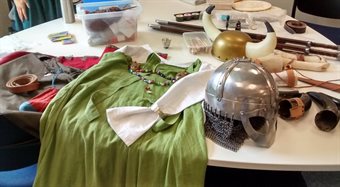
Our items on display for volunteer training © K. Whitehouse
Runes
This was a writing system designed to be cut into stone or wood. We show pictures of runes and reproduction artefacts inscribed with runes.We provide a simplified runic alphabet and encourage the children to translate a runic inscription’
Hoards
A hoard is a collection of valuable objects that were buried in the ground. We discuss why and where people buried their objects, and how hoards were uncovered much later by metal detector hobbyists, members of the public, and archaeologists. Through interactive activities, we get participants to dig for their own hoard, and also plan where they would bury their hoard in the landscape.
Burials
When people died in the Viking Age, they were buried with a variety of interesting objects, including swords, jewellery, and everyday objects like combs. Using items from our replica collection, we aim to answer big questions about the Viking Age. How were the vikings buried? And what can burials tell us about their lives and beliefs? At the end of the activity, participants get to make their own Viking burial chamber and choose which objects to put in it.
Place names
Most of our early place-names were given by Anglo-Saxons and Vikings, but the Nottingham area has other layers of names too. In this session we explore the languages, landscapes and meanings of place-names using place-name jenga.
How the project started.
In March 2010, Dr Sara Pons-Sanz and Dr Christina Lee organised a visit to the university for 60 pupils from a local primary school. The children had been working on Viking projects previously and brought their own work to show academic members of staff. During the day, there was a number of activities organised for the pupils, including short talks from academics about different aspects of Viking life, and activities similar to those we still offer
General Information
- workshops usually run from around 9.00 to 12.00 but we can be flexible with timings if planned in advance
- we accommodate approximately 30 children per visit
- workshop dates for the forthcoming academic year will be made available for booking in September
- schools need to arrange their own transport
Contact and Application
To book a workshop, or for queries, please email us ae-vikings4schools@exmail.nottingham.ac.uk.
Academic Lead: Dr Kate Olley
Owing to demand, we kindly ask schools to make a binding application and inform us at once if unforeseen events impact the workshop. We reserve the right to refuse schools that have failed to attend or cancel in time.
Back to top