1st July 2025
When listening to speech, we often predict what comes next. As we hear “the singer plays the” we begin to predict that the next word is likely to be “guitar.” It’s a process that helps us understand what’s being said - as long as our prediction is correct.
We looked at how younger and older adults predict upcoming words in sentences by tracking which of four images on a screen they looked at while each sentence was spoken. One image was the spoken target (e.g., guitar); two other images were partially related to the sentence (e.g., cards & microphone), and one was completely unrelated (e.g., strawberry).
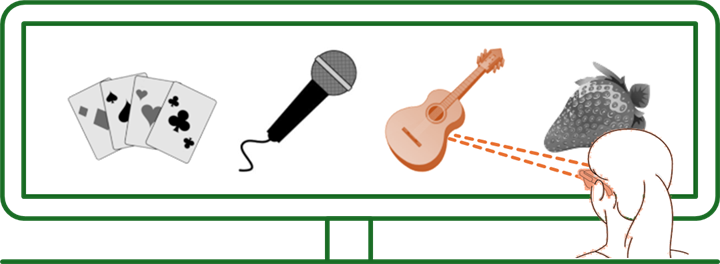
Early in the sentence, older adults were slower than younger adults to attend to any particular image, suggesting a delay in making predictions. However, as the sentence progressed, older adults were faster at focusing on the correct target relative to the merely related images. That is, they were more efficient when refining their predictions. For a longer summary of the study, see: tinyurl.com/predictcontext