Nutrinana
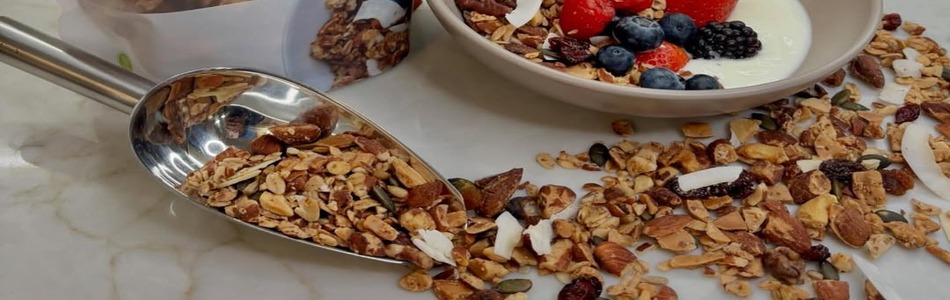
Nutrinana is run by a mother-and-son team, Nana and Ruben Odamo, from their home in Kent. They produce a granola made with activated nuts and seeds, which involves soaking the nuts and seeds in water for an extended period of time. Using HEIF funding, they sought support from the FIC to identify whether activating nuts and seeds provides any nutritional benefits, and to evaluate the safety and repeatability of their process.
Image credit: Nutrinana
Working with the Food Innovation Centre has been such a valuable experience for us at Nutrinana. The team not only helped us understand the science behind what we do but also guided us on how to make our process safer and more efficient. Their support has really helped us bridge the gap between being a small brand and taking steps toward scaling up.
As a young entrepreneur and student from the University of Nottingham, this experience has been incredibly inspiring. It’s shown me how research, innovation, and business can come together to create something meaningful. We’re so grateful for the FIC’s guidance and expertise.
Project brief
- Conduct a literature search to identify whether activating nuts and seeds contributes to nutritional benefits.
- Evaluate the current granola production process to identify areas for improvement from a food safety and repeatability point of view.
- Identify possible routes or facilities for scale-up of this product in the future.
The response
- The FIC technologist evaluated the literature to ascertain the effect of soaking (‘activating’) on the nutritional value of nuts and seeds, to identify whether nutrition or health claims relating to activation could be made on this product. Where this was not possible, suggestions were made for claims which could be made on the product.
- The literature search was also carried out to investigate the advantages and disadvantages of soaking nuts and seeds from a food safety point of view. These findings were used to suggest improvements to Nutrinana’s current process, utilising the technologist’s knowledge of HACCP protocols, to produce a safer, more repeatable process. This will enable a simpler scale-up with co-manufacturers in the future.
- Routes and facilities for scale-up were identified using the FIC’s extensive network of contacts. This included comparing the advantages and disadvantages of sharing or hiring facilities with production through a co-manufacturer and provided contacts for suitable facilities or co-manufacturers in Nutrinana’s local area.
Benefit to the business
- The support from the Food Innovation Centre has been invaluable in helping Nutrinana strengthen its technical and scientific foundations as a food business. The study provided greater clarity on the validity of our activation process. The FIC helped confirm what activation does (and doesn’t) contribute in terms of nutritional benefit, while highlighting its importance as a careful, traditional preparation method rather than a nutritional enhancement.
- The project also gave us evidence-based recommendations for improving the safety, consistency, and repeatability of our process, ensuring that every batch meets high standards as we scale production. By validating key aspects of our method and providing guidance on HACCP protocols, ingredient sourcing, and temperature control, the FIC helped us refine a process that balances tradition with food safety and quality assurance.
- Additionally, the FIC’s insights into potential routes for future scale-up, including shared facilities and co-manufacturing options, have equipped us with the practical knowledge needed to grow Nutrinana sustainably. Overall, this collaboration has strengthened both our product and our confidence in scaling a business built on integrity, science, and care.