Temperament
The earliest signs of our personality are temperamental traits or characteristics. Temperament is the word used to describe different aspects of behaviour in a baby and toddler. Temperament interacts with experience and results in personality. Every child is born with his own individual way of approaching the world. Generally, there are 5 characteristics that describe an individual's temperament:
- Emotional intensity
- Activity level
- Frustration tolerance
- Reaction to new people
- Reaction to change
Chess and Thomas in their 1977 work describe babies as having three main temperaments. Easy, difficult or slow to warm up, meaning they find change difficult.
Although the research was based on mothers own reports, so could be flawed, it seems that recognizing and understanding individual variations means that adults can adapt the care they give. Parents need to get used to their own baby's temperament. Recognising individual differences in babies, and adapting to them, may make the transition to parenthood easier for adults and less stressful for infants. For example a baby who is sensitive to a lot of noise and stimulation may be helped by parents who introduce new experiences slowly. The researchers also had a fourth category, babies who didn't easily fall into one category or another.
Select each section on the diagram below to learn more.
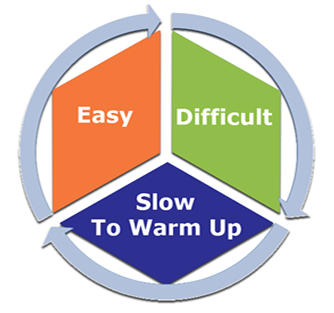
Temperament types
Children with an 'Easy' temperament, are regular and predictable in behaviour, very adaptable and more positive in mood.
Children with a 'Difficult' temperament may be irregular in behaviours such as eating or sleeping and slow to adapt to change. They may be more negative in mood and get more distressed in new situations or around strange people.
Children with a 'Slow to warm up' temperament. These babies also find it hard to adapt to changes in routine, but they express themselves in a quieter way.