Map HPB: Mapping Hepato-pancreato-biliary abnormalities (Cholangiobotics Project)
Cholangiocarcinoma (CCA) affects 3000 people in the UK each year, with dismal prognosis: only 13% of patients survive 3 years. CCA arises in the bile duct, which is a narrow tube with a diameter of about 6mm. As the cancer grows inside, the bile duct is further narrowed, and routine scans cannot confirm if the narrowing is due to inflammation or the cancer. Diagnosis relies on the microscopy of samples taken from the narrowed area, but, when narrowed or blocked, it is even harder to obtain samples.
In addition, CCA tissue within a tumour varies with different areas being genetically different which accounts for resistance of CCA to drug treatment. Moreover, insertion of devices for the diagnosis and mapping of the narrowed bile duct (biliary stricture) must be combined with biliary drainage (stent insertion) to reduce the risk of complications such as infections.
Cholangiocarcinoma (CCA):
Our vision is to bring expertise from multiple disciplines together to develop a new technology with enhanced dexterity to navigate the biliary stricture, develop capabilities for tissue molecular mapping, and create capability to deliver treatment with greater precision. This is expected to then lead to improved survival and quality of life outcomes for patients with CCA.
We aim to (a) develop the first ultra-slender flexible robot with capability to navigate the bile duct and obtain a 3-D image/map (b) develop technology to deliver a nanoparticle based new treatment to the cancer at the narrowed segment and (c) correlate the mapping of the bile duct with the molecular patterns in surgically-removed patient CCA tissue.
What is the purpose of the study?
To address the combination of challenges in both diagnosis and treatment we bring together expertise from many different specialities.
The proposed research will be conducted in 4 interdependent work packages (WP). In WP1, a 'snake-like' robot carrying an imaging device that can navigate to the narrowed bile duct will be developed. This will have capability to be inserted into the narrowed area of the bile duct (in CCA tissue removed from patients during standard surgical cancer treatments) and take 3D pictures.
In WP2, we will create nanoparticles which will be loaded on to the stents that are usually used to open bile ducts blocked due to CCA. These nanoparticles are taken up by the cancer cells. When a wireless electrical field is generated in the vicinity, the nanoparticles stimulate the death of cancer cells.
WP3 involves the clinical characterisation of patients with CCA including assessment of their cancer using different types of imaging and tests. These images will be used by WP1 to inform the design of 3D bile duct models in which we will assess the flexible robot. In addition, samples from the cancer will be used in WP2 laboratory experiments to assess biological properties and process of cell death in CCA cells. We will create a database and tissue bioresource to characterize variability in CCA types. We will also use tissue resected during surgical treatment to evaluate devices designed and developed in WP1and WP2.
WP4 will co-ordinate and integrate activities across disciplines and WPs to maximise shared learning across the team and deliver the work proposed.
Combining snake-like robot with wireless electrical-molecular signalling to tackle cholangiocarcinoma
The project brings together experts in medicine, endoscopy, engineering, robotics, imaging, bioelectrics and genomics to improve survival and quality of life for patients with bile duct cancer.
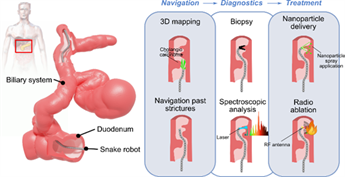
'Cholangiobotics Project '
An ultra-slender flexible robot will navigate the narrowed bile duct and capture images to draw a 3D map of the cancer. Stents placed across the narrowing will be pre-loaded with nanoparticles and activated using wireless electrical fields to stimulate the death of cancer cells.
This project is funded through a UKRI cross-disciplinary research award January 2025-Jan 2027.
Researchers start £1.2 million programme to help patients with lethal form of cancer
Patient information video for the Cholangiobotics study
Important things to know about participating in the study:
What will I be asked to do?
There will not be any change to your clinical care investigations/treatment.
We will ask the hospital pathology lab for any tissue/material that is left over after all the medical tests are complete. This will be used for research and will be labelled with a code so that you cannot be identified.
We will also collect information about your diagnosis, test results (including digital images of tissue and radiological investigations), treatments and follow-up from your medical records over the next 24 months. This will be linked to your samples through a code.
Taking part will not involve any extra visits for you. Samples will be taken during your standard care procedure and, not as extra procedures.
We will also ask you if the doctor can take 1-2 extra samples of tissue during the procedure. This includes collecting a 5 ml sample of any fluids such as bile or cyst fluid if available. This will be used for research experiments unless it is needed for further diagnostic tests by your care team. This surplus tissue or body fluid samples are normally either used for diagnostic purposes and sometimes stored for future need or discarded. After clinical tests are complete, we will request any remaining surplus samples from the laboratory.
What will happen to my samples?
The samples will be analysed and used for research experiments. The research tests/analyses are still being developed so it may not be clear what the results mean. The tests are not the same as tests done by a healthcare provider, however if the tests show something unexpected or suspicious, we will let your clinical team know about the findings. The care team will decide if further tests are needed based on the clinical context.