Hearing Sciences, Scottish Section
Hearing Sciences – Scottish Section is a thriving research group dedicated to understanding and alleviating hearing difficulties, based at Glasgow Royal Infirmary. The section’s research programme includes a broad portfolio of projects to investigate real-life auditory behaviour, further our understanding of the impact of hearing problems on social and emotional well-being, propose innovative solutions for hearing problems, and improve methods of assessing both hearing problems and intervention benefits.
Our research applies a wide variety of different techniques, from qualitative interviews to neural recordings (EEG) and field studies. Our methodological strength is in linking hearing loss to behaviours in real-life situations, especially where verbal communication is challenging.
As an outpost of the University of Nottingham, we collaborate with the Nottingham Biomedical Research Centre – Hearing Theme as well as various other university departments (e.g., Psychology, English). As a research group located in Glasgow, we also have strong links with the University of Glasgow, the University of Edinburgh, Glasgow Caledonian University, University of Strathclyde and NHS Scotland.
Our Research
Our team is made up of around fifteen people including senior researchers, postdoctoral fellows, PhD students and support and operations staff. Our research leads are Dr Lauren V. Hadley, Dr Jack Holman, Prof. Graham Naylor (Section director) and Dr William Whitmer.
We regularly work with industry partners from major hearing device manufacturers such as Demant, WS Audiology, GN Hearing and Sonova. We also have academic collaborations at local, national and international levels.
We have an MRC-funded research programme, 'Understanding and alleviating hearing disability: A cognitive-behavioural model of miscommunication in everyday conversation’, and a UKRI Future Leader Fellowship (Dr Hadley), 'Hearing in a social context: Understanding predictive mechanisms in communicative interaction’. Around this core, other current and recent projects include:
- ‘Effects of prosodic manipulations on turn-end predictions during conversational listening’, 2025-2029, studentship funded by the William Demant Foundation.
- ‘A context-dependent approach to measuring hearing-aid benefit in real-life conversations’, 2025-2027, funded by the Hearing Industry Research Consortium.
- ‘Hearing loss in the social workplace: Understanding critical factors and intervention priorities for improved well-being ’, 2025-2026, funded by the Medical Research Foundation.
- ‘The impact of hearing ability on social participation, and social acclimatisation after hearing aid fitting’, 2024-2028, studentship funded by WS Audiology A/S.
- ‘Conversations in dual-task situations: an under-researched aspect of hearing disability’, 2024-2026, funded by WS Audiology.
- Partner in the ESRC-funded project ‘Predicting language under difficult conditions: Effects of cognitive load, noise, and hearing impairment’, 2023-2026.
- ‘Conversation behaviour in daily life: the effects of situation, hearing loss, and hearing-aid use’, 2022-2025, funded by ESRC and Sonova AG.
- ‘Socioemotional well-being as an individual factor in the assessment and amelioration of hearing loss’, 2022-2024, Medical Research Foundation Fellowship of Dr Jack Holman.
- ‘Incorporating active strategies in speech testing to predict communication performance’, 2021-2026, funded by the Medical Research Foundation.
- ‘Does The Method Matter? Investigating perceptual differences in hearing aid self-adjustment methods’, 2021-2025, funded by GN Hearing A/S.
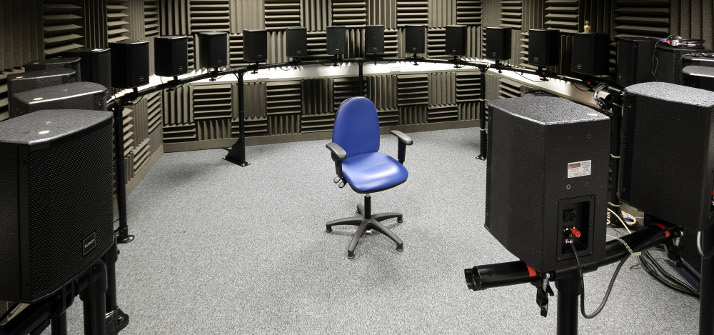
Our Facilities
Our state-of-the-art facilities include two large chambers with loudspeaker arrays, allowing emulating diverse acoustical environments, as well as motion-tracking systems to measure body movement, eye-tracking systems to measure gaze and pupil responses, and EEG systems to measure neural activity. We also have clinical-grade audiological measurement facilities, and a large pool of pre-consented participants. We have a history of expertise in auditory psychophysics and in self-report outcome measures, now including smartphone-based Ecological Momentary Assessment (EMA) methodology.
Get Involved
Would you like to take part in our research? We are recruiting people of all hearing abilities to take part in some of our future online studies and surveys. Please get in touch with us at hs-glasgow@nottingham.ac.uk.
Contact Us
Level 3, New Lister Building
Glasgow Royal Infirmary
16 Alexandra Parade
Glasgow
United Kingdom
G31 2ER
hs-glasgow@nottingham.ac.uk

New Lister Building