Water! – Pipes, Pumps, Floods and Drains in The University of Nottingham's Water Archives
This exhibition ran from Friday 25 January until Sunday 19 May 2013, at the Weston Gallery, Lakeside Arts.
Drought conditions or torrential rain affecting water supply always make headlines. Yet there is much more to the story of water. Our Victorian ancestors built an impressive network of pumping stations, water mains, reservoirs and sewerage pipes, much of which is still in use today, to improve sanitation and provide clean drinking water for all. Earlier generations cut drains to reclaim agricultural land, and built canals, weirs and locks to improve navigation. In the twentieth century, scientists and engineers worked to predict floods and construct flood defences.
This exhibition focused in particular on the city of Nottingham, and the work of the various authorities and public bodies charged with providing reliable water supply, sewerage and water treatment, and flood prevention schemes. It drew on original archives and photographs held by the University’s department of Manuscripts and Special Collections.
Exhibition themes
Six exhibition boards were on display in the Gallery. Each of the boards can be downloaded or viewed online as Adobe PDF.
Further Research
Items from our collections are available to consult in the Manuscripts and Special Collections reading room on King's Meadow Campus.
'Water!' is focused on water-related infrastructure, with a particular focus on Nottingham. Links to collections relating to the themes featuring in the exhibition can be found below.
From the blog
Read our blog about items associated with the exhibition.
Water! is turned on
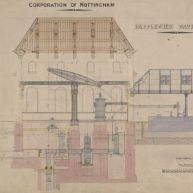
Water is an essential part of our everyday life, but most of us take the ability to turn on taps and flush away waste for granted.
Go to blog post
Water work: the staff of the River Trent Catchment Board
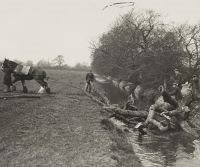
A large leather-bound photograph album gives an introduction to the work of the Engineer’s Department of the River Trent Catchment Board and the significant events that affected its activities in the years 1932-1939.
Go to blog post
Mansfield and the Waste of Water
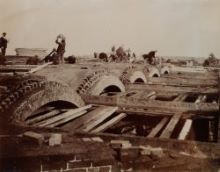
In Nottingham, Sheffield, and Leicester, each resident was using a respectable 20 gallons of water day in 1899. In Mansfield, it was 25 gallons per day. Was there a massive leak somewhere in the water system?
Go to blog post
War work in the water archives
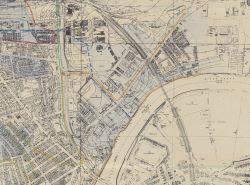
This blog, by placement student Natalia O’Cleirigh, explores how River Trent Catchment Board Engineer's files dating from 1939-1948 show the organisation's contribution to the war effort, ranging from draining land for agricultural use to plans to cause deliberate flooding in the event of an invasion!
Go to blog post
Follow Manuscripts and Special Collections Exhibitions on @mssUniNott to keep up to date with the latest exhibition news, or read the latest issue of our free magazine, Discover.