"A Journey into the Realm of Physics" by Julie Bonnet-Durville, graduating physics student
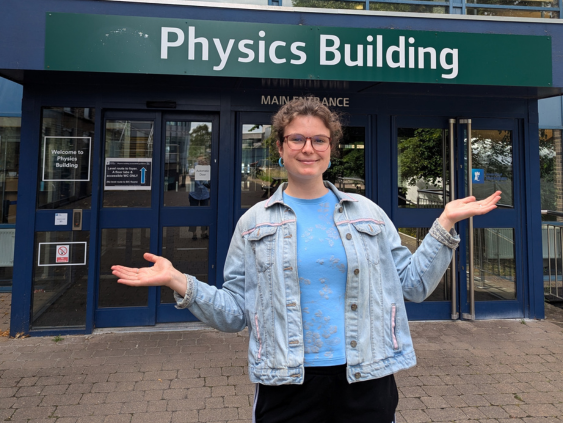
Julie Bonnet-Durville is an MSci Physics student graduating in the summer 2025. In this essay, she is sharing her reflections about what brought her to study physics.
Introduction
Every physicist’s journey will be different even if they all experience the same physical laws. They will all experience the same gravitational pull towards Earth, they will all only see visible light and all only hear certain frequencies. But the path through which every physicist becomes a master of these laws, cannot simply be defined by equations and mathematics. My own journey begins in Manchester, a city considered the birthplace of modern nuclear physics thanks to Rutherford. Below, as a young woman motivated to achieve great things, I would like to share with you the beginnings of my journey in physics.
The realm of physics spreads from the nano to the astronomical scale and may hold the answer to the ultimate existential question of ‘Why are we here?’ There is a plethora of books, TV documentaries, talk shows, amongst many other resources that aim to spread the splendid knowledge and power of physics to the public. I have personally experienced the public’s excitement for the subject. I have stopped counting the number of times I heard ‘That’s so cool!’ in response to me mentioning that I study physics and astronomy. Even though every physicist’s journey is different, a common first step in becoming a physicist is to study the subject at university.
Attending Secondary School in the UK
School and university systems vary from country to country. I consider myself fortunate to have been primarily educated in the England. Born in France, I moved to Manchester at the age of nine. Considering the higher education system in France, if I had stayed there, I am not sure that my journey would have entailed becoming a physicist. If you are not familiar with the English education system, here is a brief overview. At the age of 16, young people sit exams called GCSEs. These are obligatory examinations in subjects which normally include maths, English, three sciences, a language and one of history or geography. After GCSEs, they choose three subjects that they want to study for a further two years. They sit further exams in the three chosen subjects known as A-Levels. GCSEs are obligatory but A Levels are optional, however, to access university education, in most cases, A-Levels are a necessity. The A-Level subjects I chose were maths, chemistry and physics. Why? I enjoyed the logical thought processes involved with science and maths. I attended an all-girls school so there was a strong emphasis on encouraging students to take STEM subjects and become the almighty ‘Women in STEM!’. However, there was only a handful of girls in my physics A-Level class but there were over fifty in the chemistry and biology classes. Evidently, physics was not considered as a popular subject in my school. This demonstrates the importance in promoting physics in schools to motivate students to study it and find their passion in it from an early age.
Whilst studying for A-Levels, I inevitably recieved the infamous question ‘What are you going to study at university?’. I had of course heard of university, but I had never asked myself the question. The answer was rather simple as I could either go study maths, chemistry or physics. Out of the three subjects, I settled on physics as I could see its applications onto the real world the most. My journey in physics did honestly begin because I had to make a choice, which after reflecting, was primarily imposed by my school, not driven by my own passion of the subject.
Medical Physics
Furthermore, my father was hopeful that I choose to study medicine however I never found biology as appealing as physics and I am hopeless with blood so that option was quickly ruled out. I remember going to speak with the school’s career adviser. I came to her with two options: my father wants me to study medicine, and I want to study physics. Her reply was instant, ‘Have you considered studying medical physics?’ I remember saying to myself ‘Oh yes x-rays!’ then agreeing that it was what I was going to study. Easy.
For those who do not know, medical physics is the application of physics within the medical realm. For example, MRI (abbreviation of magnetic resonance imaging) is a well-known imaging technique used in hospitals. MRI images are obtained due to the alignment of spin in hydrogen in a magnetic field. The study of magnetic field spin alignment is studied in quantum mechanics, the famously mythical branch of physics. I want to remind the reader that I decided to study medical physics because other people were telling me that I had to make a choice, not necessarily because I had passion for the subject. When at school full time until 18 years old, required to study subjects shaped by a curriculum, how do young people have the ability and time to find their own curiosity and passion in a subject? How do they know that pursuing further education is the next step that they want to make? As a university student who is very involved in outreach with young people in schools, it has become apparent that many young people consider pursuing higher education because that is the focal advertised route in schools and not necessarily because they all have a desire to study a subject further. For me, also having been shown no other alternative, going to university seemed like the only logical option. Or so I thought at the time. Evidently, there are always twists and turns in every journey.
Enter Covid-19, the biggest twist of them all. Due to the pandemic, I did not sit my A-Levels which would have determined which university I could attend. Teachers assigned the final grades. Unfortunately, for me, these were not good enough to obtain an offer from my chosen university. It looked it I was going to have to take a gap year and resit the exams to achieve better grades. Second twist, two weeks later my grades were changed for the better allowing me to attend my chosen university as planned without a gap year. However, considering that we were in a world pandemic, without telling anyone I decided to defer the offer the university had made me, confirming that I was indeed taking a gap year. Third and final twist.
From Medical Physics to Astrophysics
At the beginning of my gap year, I was fortunate to find a full-time job as an administrative assistant in an hospital. Apart from going to the hospital every weekday nine to five, I had little else to do due to lockdowns. I saw this as an opportunity. I said to myself ‘since I will be going to university to study physics next year, let’s learn some fun facts!’ From that moment, my journey of discovering what I specially found exciting about physics began. Until then, I had always dismissed astronomy. Having gone through an existential crisis at ten-years-old, I had associated distressing thoughts with stars and the universe, so this branch of physics had been brushed under the rug. However, when I started to look for my own interest, I was instantly drawn to astronomy. I listened podcasts, including the StarTalk podcast with the infamous Neil deGrasse Tyson, I watched TV Shows and documentaries and read books about the origins of mankind and the stories behind the constellations. It brings me great comfort knowing that the stars have always been and will continue to be there no matter what. Since the dawn of civilisation, every human who looked up, observed the same celestial objects as me. Celestial objects will forever be a constant in our world. I realised that I wanted to know about the physics of outer space. Looking up at the stars had never felt more exciting. I encourage everyone to look up to the night sky and take a deep breath. If you notice a very bright white object shining, it is most probably the planet Jupiter!
My Undergraduate Degree
As all things do, my gap year came to an end, and it was the time to move to university. Due to the realisations over my gap year, the first thing I did when I arrived at university was to switch from medical physics to astrophysics. I knew the reason why I was at university so my journey could officially properly! I could not be prouder of the effort I have put into my degree over the course of the past few years. Perhaps why so many people say to me, ‘Wow you must be so clever!’ when I tell them what I study is because physics is truly a conceptually challenging subject that requires many hours of hard work and dedication if one wishes to succeed in it. There are many branches of physics, each with their own quirks that I enjoy. My favourite, however, is without a doubt the theory within astrophysics. The fact that I can demonstrate how a star works on a piece of paper with a few equations is one of the most exhilarating things I have gained from my degree.
When I began my degree, I had an understanding that I wanted to work in science communication within physics and astronomy. Four years later, about to complete my degree and as a young adult going to enter the professional world, I know that there is no better place for me to start my journey than with a teaching role in physics. Teaching is a core aspect of science communication and sadly the opportunity to inspire and excite students about physics is often wasted in schools as demonstrated by the handful number of students who chose to study physics at my school.
Future Teaching Aspirations
There are many aspects of a career in teaching which motivate me and using my creativity to find engaging ways to communication scientific concepts to young people certainly stands out. We must change and adapt to the advances in technology and accept that some traditional methods of teaching are becoming outdated. I think that there are many opportunities to incorporate important skills like coding and the ethical use of machine learning within classrooms, especially in a subject like physics where nowadays nothing in the field is done without programming. A young person cannot pursue higher education in physics and not expect to code during their degree. As someone who had no coding knowledge prior to starting a physics degree, coding quickly became my favourite aspect of the course. I have seen how vital it to the subject and I find that coding often helps to understand concepts. Finding ways to incorporate coding within the teaching of KS3 or KS4 physics is one of the ideas I would like to develop as a teacher. For example, using Python to plot and analyse data during the practical lab sessions of A-level physics. Let’s not forget the mind-boggling concept of quantum physics which tends to be advertised as inaccessible to the public. When a year 7 pupil told me that she wished to pursue physics at university, I did not hesitate to encourage her to start learning Dirac Notation, the baseline of quantum mechanics.
After four years of studying physics and astronomy at university, I am very excited to begin my physics teacher training in September 2025. I look forward to hearing what students have to say about physics and I hope I will find creative and engaging ways to convey my passion of physics and astronomy to my own students when I finally begin my journey as a fun, inspiring and exciting physics teacher.
From left to right: the author of the essay Julie Bonnet-Durville, the Head of School of Physics and Astronomy Professor Mark Fromhold, and fellow students Drande Patogu and Clara Gonsalves