This course is closed for home applications for 2026 entry.

-
Study optionsOpen daysCampus informationRelated links
-
About usBrowse by
-
Research impactFacilities and resources
-
Explore news and events

Sport Rehabilitation - U6USPORH
BSc Hons UCAS Code
Course closed for home applications
Course overview
Unlock your potential and join a course that will enable you to become a confident sport rehabilitator, equipped with the knowledge, skills, and flexibility to work independently across a range of sporting, health, rehabilitation and exercise environments.
Accredited by the British Association of Sport Rehabilitators and Trainers (BASRaT), our BSc (Hons) Sport Rehabilitation course develops your clinical neuromusculoskeletal assessment and treatment skills to work with service users of all ages to rehabilitate them following injury and/or illness.
We are committed to developing excellent sport rehabilitators within a supportive, nurturing higher education environment. You will work across key areas of injury prevention, health, wellbeing and sport, designing and implementing exercise and rehabilitation programmes.
Course overview
Unlock your potential and join a course that will enable you to become a confident sport rehabilitator, equipped with the knowledge, skills, and flexibility to work independently across a range of sporting, health, rehabilitation and exercise environments.
Accredited by the British Association of Sport Rehabilitators and Trainers (BASRaT), our BSc (Hons) Sport Rehabilitation course develops your clinical neuromusculoskeletal assessment and treatment skills to work with service users of all ages to rehabilitate them following injury and/or illness.
We are committed to developing excellent sport rehabilitators within a supportive, nurturing higher education environment. You will work across key areas of injury prevention, health, wellbeing and sport, designing and implementing exercise and rehabilitation programmes.
You’ll put your learning into practice by undertaking supervised clinical practice opportunities of at least 400 hours. These will be in a range of environments including high profile sporting environments such as Nottinghamshire County Cricket Club, Nottingham Forest FC, and Leicester Tigers Rugby Club.
And of course, you'll have access to the excellent facilities in our David Ross Sports Village to enhance your learning.
Why choose this course?
- Russell Group excellence: The only BASRaT-accredited Sport Rehabilitation programme at a Russell Group university, combining academic prestige with professional recognition
- Trauma Care certification: Final-year students can complete a recognised pre-hospital immediate trauma care course
- Innovative, practice-based learning: The course uses real-life case studies and diverse teaching methods that mirror real-world sport rehab practice, helping students thrive academically and clinically
- Extensive clinical experience: Complete at least 400 hours of supervised placements in real-world settings like elite sports clubs, NHS clinics, and private practices
- Elite sporting partnerships: Placement opportunities with top organisations such as Nottingham Forest FC, Leicester Tigers, and Nottinghamshire County Cricket Club
- University Sports Injury Clinic: Gain hands-on experience treating real clients on campus
- Diverse career preparation: Train for roles in private practice, NHS, elite sport, and community health
- Integrated interprofessional learning: Collaborate with students from other healthcare disciplines to build teamwork skills
- World-class facilities and support: Study in the £40 million David Ross Sports Village, with access to cutting-edge rehab labs and a supportive, interdisciplinary learning environment
- Innovative teaching approach: Experience varied teaching and assessment methods that reflect real-world practice
- Supportive learning environment: Benefit from close academic and clinical mentorship throughout your studies
- Nottingham Advantage Award: Enhance your CV with this recognised employability and skills development programme
- Nationally ranked for excellence: Ranked 3rd in the UK for sports science subjects (Complete University Guide 2026)
Important information
This online prospectus has been drafted in advance of the academic year to which it applies. Every effort has been made to ensure that the information is accurate at the time of publishing, but changes (for example to course content) are likely to occur given the interval between publishing and commencement of the course. It is therefore very important to check this website for any updates before you apply for the course where there has been an interval between you reading this website and applying.
Teaching and learning
How you will learn
Teaching methods
Teaching is delivered through a mix of in-person and online methods. The majority of your teaching will be in-person.
- Anatomy sessions
- Case-based learning
- Clinical relevance sessions
- Clinical skills sessions
- eLearning
- Lab sessions
- Lectures
- Placements
- Practical classes
- Problem-based learning
- Prosection
- Self-study
- Seminars
- Small group learning
- Tutorials
- Workshops
How you will be assessed
Assessment methods
- Case studies
- Coursework
- Dissertation
- Examinations
- Formative assessments
- Lab reports
- Logbooks
- Portfolio (written/digital)
- Poster presentation
- Practical exams
- Presentation
- Verbal exam
- Workplace-based assessment
Contact time and study hours
During the course, you can expect approximately 12 to 24 hours of contact time per week, along with approximately 12 to 24 hours of independent self-guided study each week.
In order to comply with the requirements of the British Association of Sport Rehabilitators (BASRaT), you're required to complete a minimum of 400 hours of supervised clinical practice during the course. At Nottingham, you'll gain these hours by undertaking 10 weeks of clinical placements plus participation in the massage clinic in year two.
Some placements may be in one 'block' where you should expect to undertake a normal full-time working week. However, you may also be required to undertake a part-time placement that will take place over the course of a full academic year.
Please note you may be required to work unsociable hours, including some weekends and evenings, depending upon the placement.
Modules
Core modules
Year one
Your first year will see you gain the foundational knowledge of sport rehabilitation. Through real-life and simulated case studies you will build your clinical skills on a foundation of anatomy, physiology and theory. Each module lasts a year enabling you to develop your understanding over time to ensure you are prepared for clinical placement in year two.
During year one, you will sometimes be taught alongside the BSc Physiotherapy students, encouraging collaborative learning.
7 modules
Introduction to Leadership in Sport Rehabilitation
This module addresses the concepts of professionalism and citizenship, both nationally and internationally, that are relevant to the Graduate Sport Rehabilitator. You will be introduced to a variety of working environments accessible to Graduate Sport Rehabilitators and identify the unique challenges and opportunities that each present. Consideration will also be made to the larger globalised profession including Athletic Training and Therapy.
Interprofessional Education: Introduction to Collaborative Practice in Health and Social Care
Students will explore professional identity and responsibilities within a multidisciplinary team. They will also form and work in an interprofessional team to understand the complexity of health and social care systems and their role within them, specifically in regards to integrated care systems and collaborative practice more broadly.
Human Anatomy for Rehabilitation
This module will provide students with the underpinning human anatomical knowledge needed by a Graduate Sport Rehabilitator. It will introduce a holistic approach to anatomy covering the whole human body, meeting global educational standards within the field of Sport Rehabilitation, Athletic Training and Therapy.
Human Physiology and Exercise
This module will provide you with the underpinning human physiological knowledge needed by a Graduate Sport Rehabilitator. It will give students a grasp of the concepts and information needed to allow an understanding of physiological functioning of the human body, particularly related to exercise and rehabilitation.
Introduction to Exercise and Rehabilitation Interventions
This module will provide you with an introduction to the use of exercise and other rehabilitative interventions utilised by a Graduate Sport Rehabilitator. You will develop a grasp of the basic concepts of exercise prescription and the uses of other therapeutic interventions related to injury rehabilitation.
Introduction to Research Skills in Rehabilitation
This module will provide an introduction to evidence-based practice. It will give you a grasp of the methods of identification, basic appraisal, and application of suitable published evidence related to rehabilitation.
Neuromusculoskeletal Injury and Assessment
This module will provide underpinning knowledge of common injury aetiology and basic assessment techniques focused primarily on the neuromusculoskeletal system. You will develop a knowledge of the risks and occurrence of common injury, dysfunction, and disease of the human body as well as the basic components of assessment utilised in clinical practise.
Showing 0 - 0 of 0 entries
Core modules
Year two
In your second year you will deepen your knowledge and skills in the management of injuries including key concepts in injury prevention, exercise prescription for rehabilitation, and elements of exercise science relevant to rehabilitation. You will also complete a clinical placement in a sport rehabilitation or exercise-related setting.
7 modules
Applied Criticality in Health
Research underpins all that we do in healthcare. In this module, you’ll apply and analyse concepts of criticality in healthcare research. You’ll learn how to develop your own research proposal, compare research methodologies and methods, develop ethics and governance processes for healthcare research, evaluate data and undertake statistical analysis.
Neuromusculoskeletal Injury Assessment Management
This module develops key Sport Rehabilitator skills in assessment, clinical reasoning, and treatment for neuromusculoskeletal conditions and injuries. You will learn a range of evidence-based assessment and rehabilitation techniques to work with patients from onset of injury through their rehabilitation journey. You will also develop an awareness of the scope of practise of a Graduate Sport Rehabilitator. Teaching is via case scenarios.
This module also includes a five-week (or equivalent) clinical placement.
Exercise Science of Sport Rehabilitation
This module introduces the elements of exercise science relevant to a Graduate Sport Rehabilitator, including sports nutrition, exercise physiology for performance, psychology of injury and biomechanics. An appreciation of the scope of practise of different exercise science disciplines enables you to identify when a patient or client needs to be referred on to another professional. It covers both theoretical and practical applications of the different aspects of exercise science within the context of sport rehabilitation and physical activity.
Fundamentals of Strength Conditioning
Strength and conditioning techniques are another fundamental component of sport rehabilitation practise. This module introduces a range of underpinning strength and conditioning concepts including the use of pre-participation screening processes for health and performance, along with a variety of different strength and conditioning training techniques. You will develop your exercise prescription, periodisation of training and Olympic lifting knowledge to take a clinical reasoning approach to providing an evidence-based justification to strength and conditioning programming.
Manual Therapies in Sport Rehabilitation
The knowledge and ‘hands on’ skills learned in year one are developed further in this module with the introduction of a range of advanced manual therapy techniques. The evidence base for the use of such techniques is investigated and discussed. As part of this module, you will also work in the David Ross Sports Village Injury clinic in the student-led massage clinic to develop your practical skills and increase confidence working with patients prior to clinical placement.
Interprofessional Education: Collaborative Practice
This module will focus on the benefits to patient safety that come from collaborative practice. Participants will attend a three-hour workshop where in small interprofessional teams they will analyse a case study and create a poster that outlines the fundamentals of patient care and takes an in-depth look at where patient safety can be improved using good collaborative practice. They will then present their poster to their peers for feedback.
Rehabilitation in Contemporary Public Health
This module will provide you with the underpinning knowledge of contemporary public health issues a Graduate Sport Rehabilitator may encounter in clinical practice. It will develop your understanding of the risks, occurrence, barriers and clinical presentations associated with these health issues in clinical practice, meeting global educational standards within the field of Sport Rehabilitation, Athletic Training and Therapy.
Showing 0 - 0 of 0 entries
Core modules
Year three
In your final year you will have greater opportunity to develop as an independent learner, completing a dissertation research project and an exciting community-based project to promote sport, exercise, health or wellbeing. We offer a flexible approach to tailor your learning allowing you to choose one from a range of option modules.
4 modules
Sustainable Health
How can we help make healthcare future-proof? This module will evaluate the limitations of current healthcare and consider future-proof, holistic and sustainable healthcare models that can be embedded within rehabilitation practice in both local and global contexts.
Complete Management of Injury Rehabilitation
This module consolidates the knowledge and skills developed over your first two years into a holistic approach to managing an injury. From the immediate/pitch side pre-hospital care of the individual through their full rehabilitation journey. You will also undertake an advanced pre-hospital trauma qualification from a recognised governing body. You will progress your knowledge of the use of exercise as a treatment modality when working with patients and clients with a variety of different health complaints or those from a special population, as well as pre-surgical and post-surgical rehabilitation of common injuries.
This module also includes a five-week (or equivalent) clinical placement.
Physical Activity for Public Health
This module gives an introduction to the concepts of public health and health promotion specifically for sport rehabilitators. Definitions of health and ill-health are introduced with an overview of contemporary health care systems. Models of health promotion to address public health issues in the context of sport and exercise are considered. As part of this module you will undertake a project whilst volunteering in the wider community in a health and wellbeing or rehabilitation setting.
Interprofessional Education: Safeguarding
This module will focus on the interprofessional practice of safeguarding, providing an understanding of professional roles and responsibilities. Participants will attend a three-hour workshop where in small interprofessional teams they will critically analyse a case study, identifying potential safeguarding issues and determining the appropriate next steps. They will then feedback their team analysis to a panel of professional safeguarding experts and have the opportunity to ask questions to clarify their professional roles and responsibilities.
Optional modules
3 modules
Advanced Professional Development
This module will discuss content related to clinical; research; academic; management and clinical academic career pathways. There will also be a significant focus on business management and industry.
Occupational Health and Workplace Wellbeing
This module will focus on work-related health and wellbeing epidemiology and economic burden. Additionally, exploring myths and facts about occupational health and ergonomics. Work closely with The Association of Chartered Physiotherapists in Occupational Health and Ergonomics and the British Association of Sport Rehabilitators and Trainers for support, networking, and learning opportunities; develop work-based assessment and management skills (DSE etc).
Contemporary Challenges in Rehabilitation
This module will include theory and practical elements related to focussed rehabilitation challenges in urgent, contemporary and emerging fields.
Language study as part of this degree
Our Language Centre offers many languages, and you may start as a beginner or at a more advanced level and you may be able to choose to study a language as part of this degree.
Learning another language can open career opportunities around the globe and enriches your CV. It could also help you in your studies by being able to access learning materials in other languages. If you are planning to travel or work abroad it will help you to broaden your cultural understanding.
Find out more about learning a language as part of your degree.
The above is a sample of the typical modules we offer, but is not intended to be construed or relied on as a definitive list of what might be available in any given year. This content was last updated on LASTMODDATE. Due to timetabling availability, there may be restrictions on some module combinations.
Select student type
Entry requirements
Quick glance
All candidates are considered on an individual basis and we accept a broad range of qualifications. The entrance requirements listed apply to 2026 entry.
A levels
ABB
IB
30 points overall
DBS and Occupational Health
See requirements below
A level and GCSE requirements
Required subjects
ABB / AAC / A*BC
A levels must include a biological science or PE.
A pass is required in science practical tests, where these are assessed separately.
Excluded subjects
General studies, critical thinking, citizenship studies, and global perspectives
GCSEs
Minimum of five GCSEs at grade 4 (C) or above, which include maths, English and science.
Please note: you must have achieved the GCSEs at the point of application and not at the point of entry.
IB requirements
IB score
30 points overall or 6,5,5 in three HL certificates
IB requirements
HL5 in biology or sports, health and exercise science
Extended Project Qualification (EPQ) and Core Maths
Extended Project Qualification (EPQ)
If you have already achieved your EPQ at grade A you will automatically be offered one grade lower in a non-mandatory A level subject. If you are still studying for your EPQ you will receive the standard course offer, with a condition of one grade lower in a non-mandatory A level subject if you achieve an A grade in your EPQ.
Please note that if you qualify for an enhanced contextual offer, your EPQ will not be taken into consideration as we are unable to make any further adjustments to your offer.
Level 3 Core Maths
If you have already achieved your Level 3 Core Maths at grade A you will automatically be offered one grade lower in a non-mandatory A level subject. If you are still studying for your Level 3 Core Maths you will receive the standard course offer, and also an alternate offer with a condition of one grade lower in a non-mandatory A level subject if you achieve an A grade in your Level 3 Core Maths.
If you qualify for a contextual offer, your Level 3 Core Maths will be taken into consideration and the appropriate adjustment will be made to your offer.
Please note that if you qualify for an enhanced contextual offer, your Level 3 Core Maths will not be taken into consideration as we are unable to make any further adjustments to your offer.
Alternative qualifications
RQF BTEC Nationals
Applications are assessed on an individual basis.
- RQF Level 3 BTEC National Extended Diploma DDD in the following subjects:
- Sport
- Sport and exercise science
- Applied science (Biomedical pathway only - specific units required*)
Other extended diplomas can be accepted with an additional A level that meets our biology/science requirements*.
- RQF Level 3 BTEC National Diploma DD plus one A level grade B in the following:
- Sport
- Sport and exercise science
Other diplomas equivalent to two A levels will require A level biology/PE or equivalent qualification that meets biology/science requirements*.
- RQF Level 3 BTEC National Extended Certificate D plus two A levels grade BB. The following meet our biology/science requirements:
- Sport
- Applied human biology (specific units required*)
Where alternative extended certificates are taken an additional A level or equivalent in biology/PE will be required.
* Please contact us for further information.
Access to HE Diploma
QAA accredited Access to HE Diploma in Nursing and Midwifery/Health Professions (or equivalent) including 24 Human biology credits at distinction and 21 credits at Merit (all at level 3)
Contextual offers
We make contextual offers to students who may have experienced barriers that have restricted progress at school or college. Our standard contextual offer is usually one grade lower than the advertised entry requirements, and our enhanced contextual offer is usually two grades lower than the advertised entry requirements. To qualify for a contextual offer, you must have Home/UK fee status and meet specific criteria – check if you’re eligible.
Foundation progression options
If you don't meet the requirements for this course and you're a UK student, you might want to consider our one-year Health Sciences with Foundation course.
Mature students
At the University of Nottingham, we have a valuable community of mature students and we appreciate their contribution to the wider student population. You can find lots of useful information on the mature students webpage.
Notes for applicants
Health and criminal records screening
In accordance with Professional and Regulatory Body requirements, all applicants are subject to health screening by Occupational Health, and Disclosure and Barring Service (DBS) checks before they can commence the course.
More information can be found on the School of Health Sciences Occupation Health and DBS page.
Minimum age requirement
We do not consider your application if you will be under 17 years and 9 months on the 1 September of the year you start your course.
Elite athletes
We can make a contextual offer if you're an athlete competing at a high level and are offered a Sports Scholarship. We recommend that you complete the expression of interest form as soon as possible so that your elite athlete status can be confirmed prior to an offer being made. More information and how to apply can be found on the UoN Sport pages.
Part-time working alongside university studies
As a student on a full-time professional training course, it is expected that your primary focus would be your full-time university studies. If you're considering part-time paid employment alongside your university studies it is advised that you discuss your position with your personal tutor before committing.
Work experience
It is desirable to gain work experience prior to applying, to demonstrate that you understand the role of a sport rehabilitator and the demands and challenges of working in a sport or exercise environment. However, we recognise that finding this experience can be challenging so your application will not be negatively affected if you are unable to undertake any. However, we would expect you to have completed thorough research into the role and demonstrate how other activities you participate in (for example, part-time work) have helped you develop some of the key attributes we are looking for in a sport rehabilitator.
3 years full-time
Placements
Placements will be in environments where a sport rehabilitator would be expected to find employment, for example in private clinics and sports clubs.
Placements will be arranged for you, and these will predominantly be within the East Midlands. You may be required to undertake these either in two blocks of full-time work (five weeks each) or part-time over the full academic year. It may be necessary to live out away from your term-time accommodation or travel daily. However, we do our best to ensure that no student does more than their fair share of travelling or living away. Some placement locations may be further afield as we have contacts with several professional sports clubs in other regions.
For the duration of each placement, you are allocated an experienced sport rehabilitator/ exercise professional who will supervise, guide, and support you, aiming to provide the best learning environment possible. You will also receive dedicated support from a university tutor during the placement period.
Placement locations currently include:
- Notts County FC
- Nottingham Forest FC
- Mansfield Town FC
- Leicester Tigers Rugby Club
- Nottinghamshire County Cricket Club
- Private Sports Injury Clinics (including the Sports Injury Clinic on University Park Campus)
Please note that these locations may change.
You may also be allocated to a ‘pod’ working alongside other healthcare students. ‘Pods’ support university sports teams by undertaking pre-season and concussion screening with players and providing pitch-side emergency care, and management of injuries throughout the season.
£9,790 per year
Tuition fees
2026/27 (UK undergraduate students)
This is the UK undergraduate tuition fee for the academic year 26/27. It will increase for the academic year 27/28 to £10,050.
For full details including fees for part-time students and reduced fees during your time studying abroad or on placement (where applicable), please visit our fees page.
Additional costs
As a student on this course, you should factor some additional costs into your budget, alongside your tuition fees and living expenses. This includes the costs of purchasing sport clothing, such as trainers and swimwear, for practical sessions.
You are provided with a uniform to wear in practice placements however you may wish to purchase additional items.
You should be able to access most of the books needed through our libraries, though you may wish to purchase your own copies.
Travel to your placements is self-funded and costs will vary depending on location.
Please note that these figures are approximate and subject to change.
Scholarships and bursaries
The University of Nottingham offers a wide range of bursaries and scholarships. These funds can provide you with an additional source of non-repayable financial help. For up to date information regarding tuition fees, visit our fees and finance pages.
Home students
Over one third of our UK students receive our means-tested core bursary. Full details can be found on our financial support pages.
A 'home' student is one who meets certain UK residence criteria. These are the same criteria as apply to eligibility for home funding from Student Finance.
Sports scholarships
Financial support is available for the brightest and best talents in the sporting world through our sports scholarships.
Entry requirements
Quick glance
All candidates are considered on an individual basis and we accept a broad range of qualifications. The entrance requirements listed apply to 2026 entry.
IB
30 points overall
A levels
ABB
DBS and Occupational Health
See requirements below
IB requirements
IB score
30 points overall or 6,5,5 in three HL certificates
IB requirements
HL5 in biology or sports, health and exercise science
A level and GCSE requirements
Required subjects
ABB / AAC / A*BC
A levels must include a biological science or PE.
A pass is required in science practical tests, where these are assessed separately.
Excluded subjects
General studies, critical thinking, citizenship studies, and global perspectives
GCSEs
Minimum of five GCSEs at grade 4 (C) or above, which include maths, English and science.
Please note: you must have achieved the GCSEs at the point of application and not at the point of entry.
Level 3 Core Maths
If you have already achieved your Level 3 Core Maths at grade A you will automatically be offered one grade lower in a non-mandatory A level subject. If you are still studying for your Level 3 Core Maths you will receive the standard course offer, and also an alternate offer with a condition of one grade lower in a non-mandatory A level subject if you achieve an A grade in your Level 3 Core Maths. If you qualify for a contextual offer, your Level 3 Core Maths will be taken into consideration and the appropriate adjustment will be made to your offer.
Please note that if you qualify for an enhanced contextual offer, your Level 3 Core Maths will not be taken into consideration as we are unable to make any further adjustments to your offer.
Alternative qualifications
RQF BTEC Nationals
Applications are assessed on an individual basis.
- RQF Level 3 BTEC National Extended Diploma DDD in the following subjects:
- Sport
- Sport and exercise science
- Applied science (Biomedical pathway only - specific units required*)
Other extended diplomas can be accepted with an additional A level that meets our biology/science requirements*.
- RQF Level 3 BTEC National Diploma DD plus one A level grade B in the following:
- Sport
- Sport and exercise science
Other diplomas equivalent to two A levels will require A level biology/PE or equivalent qualification that meets biology/science requirements*.
- RQF Level 3 BTEC National Extended Certificate D plus two A levels grade BB. The following meet our biology/science requirements:
- Sport
- Applied human biology (specific units required*)
Where alternative extended certificates are taken an additional A level or equivalent in biology/PE will be required.
* Please contact us for further information.
Access to HE Diploma
QAA accredited Access to HE Diploma in Nursing and Midwifery/Health Professions (or equivalent) including 24 Human biology credits at distinction and 21 credits at Merit (all at level 3)
IELTS/English requirements
IELTS
7.0 overall (7.0 in reading, listening and speaking and 6.5 in writing)
English language requirements
As well as IELTS (listed above), we also accept other English language qualifications. This includes TOEFL iBT, Pearson PTE, GCSE, IB and O level English. Check our English language policies and equivalencies for further details.
For presessional English or one-year foundation courses, you must take IELTS for UKVI to meet visa regulations.
If you need support to meet the required level, you may be able to attend a Presessional English for Academic Purposes (PEAP) course. Our Centre for English Language Education is accredited by the British Council for the teaching of English in the UK.
If you successfully complete your presessional course to the required level, you can then progress to your degree course. This means that you won't need to retake IELTS or equivalent.
High school qualifications
Check our country-specific information for guidance on qualifications from your country.
Visa restrictions
International students must have valid UK immigration permissions for any courses or study period where teaching takes place in the UK. Student route visas can be issued for eligible students studying full-time courses. The University of Nottingham does not sponsor a student visa for students studying part-time courses. The Standard Visitor visa route is not appropriate in all cases. Please contact the university’s Visa and Immigration team if you need advice about your visa options.
Mature students
At the University of Nottingham, we have a valuable community of mature students and we appreciate their contribution to the wider student population. You can find lots of useful information on the mature students webpage.
Notes for applicants
Health and criminal records screening
In accordance with Professional and Regulatory Body requirements, all applicants are subject to health screening by Occupational Health, and Disclosure and Barring Service (DBS) checks before they can commence the course.
More information can be found on the School of Health Sciences Occupation Health and DBS page.
Minimum age requirement
We do not consider your application if you will be under 17 years and 9 months on the 1 September of the year you start your course.
Elite athletes
We can make a contextual offer if you're an athlete competing at a high level and are offered a Sports Scholarship. We recommend that you complete the expression of interest form as soon as possible so that your elite athlete status can be confirmed prior to an offer being made. More information and how to apply can be found on the UoN Sport pages.
Part-time working alongside university studies
As a student on a full-time professional training course, it is expected that your primary focus would be your full-time university studies. If you're considering part-time paid employment alongside your university studies it is advised that you discuss your position with your personal tutor before committing.
Work experience
It is desirable to gain work experience prior to applying, to demonstrate that you understand the role of a sport rehabilitator and the demands and challenges of working in a sport or exercise environment. However, we recognise that finding this experience can be challenging so your application will not be negatively affected if you are unable to undertake any. However, we would expect you to have completed thorough research into the role and demonstrate how other activities you participate in (for example, part-time work) have helped you develop some of the key attributes we are looking for in a sport rehabilitator.
3 years full-time
Placements
Placements will be in environments where a sport rehabilitator would be expected to find employment, for example in private clinics and sports clubs.
Placements will be arranged for you, and these will predominantly be within the East Midlands. You may be required to undertake these either in two blocks of full-time work (five weeks each) or part-time over the full academic year. It may be necessary to live out away from your term-time accommodation or travel daily. However, we do our best to ensure that no student does more than their fair share of travelling or living away. Some placement locations may be further afield as we have contacts with several professional sports clubs in other regions.
For the duration of each placement, you are allocated an experienced sport rehabilitator/ exercise professional who will supervise, guide, and support you, aiming to provide the best learning environment possible. You will also receive dedicated support from a university tutor during the placement period.
Placement locations currently include:
- Notts County FC
- Nottingham Forest FC
- Mansfield Town FC
- Leicester Tigers Rugby Club
- Nottinghamshire County Cricket Club
- Private Sports Injury Clinics (including the Sports Injury Clinic on University Park Campus)
Please note that these locations may change.
You may also be allocated to a ‘pod’ working alongside other healthcare students. ‘Pods’ support university sports teams by undertaking pre-season and concussion screening with players and providing pitch-side emergency care, and management of injuries throughout the season.
£34,000 per year
Tuition fees
If you are a student from the EU, EEA or Switzerland, you may be asked to complete a fee status questionnaire and your answers will be assessed using guidance issued by the UK Council for International Student Affairs (UKCISA).
For full details including fees for part-time students and reduced fees during your time studying abroad or on placement (where applicable), see our fees page.
Additional costs
As a student on this course, you should factor some additional costs into your budget, alongside your tuition fees and living expenses. This includes the costs of purchasing sport clothing, such as trainers and swimwear, for practical sessions.
You are provided with a uniform to wear in practice placements however you may wish to purchase additional items.
You should be able to access most of the books needed through our libraries, though you may wish to purchase your own copies.
Travel to your placements is self-funded and costs will vary depending on location.
Please note that these figures are approximate and subject to change.
Scholarships and bursaries
The University of Nottingham offers a wide range of bursaries and scholarships. These funds can provide you with an additional source of non-repayable financial help. For up to date information regarding tuition fees, visit our fees and finance pages.
International students
We offer a range of international undergraduate scholarships for high-achieving international scholars who can put their Nottingham degree to great use in their careers.
Sports scholarships
Financial support is available for the brightest and best talents in the sporting world through our sports scholarships.

This course provided me with the best start to my professional career as a graduate sport rehabilitator. It gave me excellent placement opportunities with premier league football clubs and private specialist musculoskeletal clinics that allowed me to make professional contacts throughout my time studying. My first clinical role after graduating included working with premier league football club, Nottingham Forest FC (who I still work with now after two years). I have also had the opportunity to work in private clinical practice treating a range of athletes and conditions... This is a great yet challenging course, that readily prepares you for the clinical working world."
Hannah Dent
BSc Sport Rehabilitation, 2020 graduate
Careers
Careers overview
Graduate sport rehabilitators (GSR's) have a sound knowledge of the fundamentals of sport rehabilitation and exercise science, experience of relating theory to practise and utilising practical skills in a rehabilitation setting. GSR’s also have a commitment and responsibility to promote health and wellbeing in society. You will have developed these skills and more including research, and spent considerable time on personal development, and leadership skills for working in a global society.
GSR's are employed in a range of sport, health and occupational settings. Many work in private practise, with professional teams, clubs and the leisure industry, and in the Ministry of Defence. There are also opportunities in research and/or teaching.
Career paths
There are a wide range of roles that graduates can go into these might include:
- Graduate Sport Rehabilitator – working in private clinics, sports clubs, or rehabilitation centres
- Injury Prevention Specialist – designing programmes to reduce injury risk in athletes or active populations
- Rehabilitation Therapist – supporting recovery from musculoskeletal injuries in NHS or private healthcare settings
- Strength and Conditioning Coach – focusing on performance enhancement and injury prevention
- Exercise Rehabilitation Instructor – delivering tailored exercise programmes for clinical populations
- Pitch-Side First Responder – providing immediate care during sports events (with trauma care certification)
- Health and Wellbeing Coach – promoting physical activity and lifestyle changes in community or corporate settings
- Clinical Educator or Lecturer – teaching and mentoring future sport rehabilitation students
- Research Assistant – contributing to studies in sports science, injury prevention, or rehabilitation
Job prospects
Average starting salary and career progression
94% of health sciences undergraduates secured graduate level employment or further study within 15 months of graduation. The average annual starting salary for these graduates was £28,324 (HESA Graduate Outcomes 2021/22-2022/23).
Careers advice
Studying for a degree at the University of Nottingham will provide you with the type of skills and experiences that will prove invaluable in any career, whichever direction you decide to take.
Throughout your time with us, our Careers and Employability Service can work with you to improve your employability skills even further; assisting with job or course applications, searching for appropriate work experience placements and hosting events to bring you closer to a wide range of prospective employers.
Have a look at our careers page for an overview of all the employability support and opportunities that we provide to current students.
The University of Nottingham is consistently named as one of the most targeted universities by Britain's leading graduate employers (Ranked in the top 10 in The Graduate Market in 2013-2024, High Fliers Research).
Accreditation
British Association of Sport Rehabilitators and Trainers
The course is accredited by the British Association of Sport Rehabilitators and Trainers (BASRaT).
Compare this course
Discover life at Nottingham
From financial support to student life and accommodation, discover more about the Nottingham experience.

Welcome to your campus
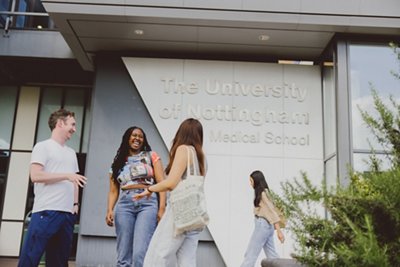
Located at Queen’s Medical Centre, one of the UK's largest and busiest hospitals, the Medical School offers an exceptional learning environment. You’ll have access to cutting-edge facilities and learn from leading clinicians and researchers, enjoying easy access to University Park for a full campus experience.
Ready to help
Head to our Help and Support hub for frequently asked questions and details of how to get in touch.
