When a report has real impact – the Maths Excellence Fund in action
Have you ever written a report and wondered – who is actually going to read it, what impact is it going to have, and ultimately…was it even worth writing in the first place? That pessimistic voice inside your head might respond, no-one, none and no, to such questions, or perhaps the more optimistic voice might say, someone, some and just about.
In this short blog, I highlight a recent report that has already translated into tangible improvements in maths education for students across England.
Maths Pipeline Report
The Maths Pipeline Project (2021-23) culminated in a 66-page report being published in early 2023 – The mathematics pipeline in England: patterns, interventions and excellence.
The report defined the excellence stream as those students who have the potential to remain in the mathematics pipeline into advanced and higher education. A key goal of the report was to ‘better understand and visualise the whole pipeline and to identify areas where well-designed interventions might help to improve flow and diversity within the excellence stream’. Engagement and progression in Key Stage 3 was identified as a core area where real impact must be made.
It was therefore hugely pleasing that later in 2023 the Maths Excellence Fund was launched by founding donors XTX Markets and The Hg Foundation. The Observatory’s Director, Professor Andrew Noyes, also joined the advisory board for the Fund.
Maths Excellence Fund
The first round of funding for the Maths Excellence Fund resulted in £7m being awarded to four delivery partners:
- Co-op Academies Trust will receive £960,000 to support 12 of its schools in the North of England. Co-op Academies will employ maths graduates as Maths Excellence Tutors in a dual academic and pastoral role. The programme will also include training and support for maths teachers, additional maths qualifications for students and the expanded use of technology.
- Inspiration Trust will receive £1,980,000 to support 12 schools in East Anglia, including five of its own schools and seven others. The programme will include a range of enrichment activities and tutoring support delivered in schools and the wider community, including through a partnership with the University of East Anglia.
- Mathematics in Education and Industry (MEI) will receive £2,160,000 to support 10 schools in Birmingham. The programme will develop maths leadership and teaching capacity, and provide a series of student interventions, including tutoring. The programme will be co-ordinated by a Maths Progression Lead in each school.
- United Learning will receive £1,900,000 to support 14 of its schools in five clusters across England. The programme will include an enriched maths curriculum, targeted interventions for students and support for parents. The programme will be co-ordinated by a Leader of Maths Excellence in each school.
One hugely important element of the Maths Excellence Fund is its length, with outline funding to delivery partners for five academic years from September 2024. This brings potential for real transformation to take place and to be embedded. Such long-term funding, like that which the Observatory also benefits from, is unusual, but is particularly valuable when aiming for sustained changes in practices and improved outcomes for learners, as well as for conducting high-quality evaluations.
Maths Progression Programme
The Maths Progression Programme (MPP) recently held a stakeholder event in Birmingham, attended by Observatory staff, bringing together system leaders, school-based Maths Progression Leads and colleagues from across the mathematical education landscape, locally and nationally. The event created a space for shared learning, offering powerful, first-hand insights into what is driving change 18 months into the programme.
Two key features stood out. Firstly, the role of the designated Maths Progression Lead within schools is essential as they provide the momentum and cultural changes. Second, there is the quality of the materials and the sustained support provided by the national delivery team. It was great to see such enthusiasm around the programme’s long-term ambition. Schools were not treating MPP as a short-term initiative, but as a commitment to embedding meaningful, lasting improvement in mathematical education.
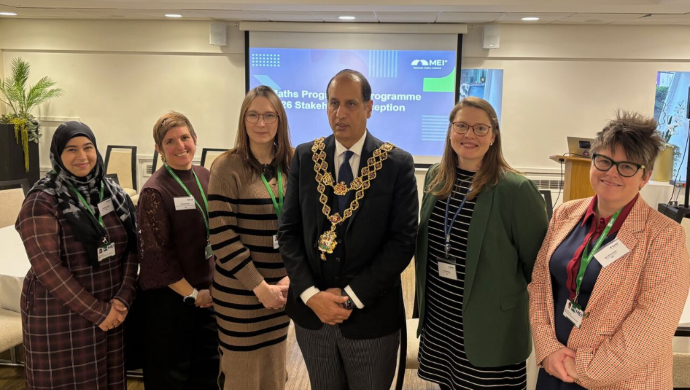
Image: Maths Progression Programme stakeholder event – The Right Worshipful, The Lord Mayor and MPP staff [photograph copyright MEI, reproduced with permission]
Which will be the next report to have impact?
The Observatory remains in the early stages of its development, but momentum is building quickly. Cycle two of data collection is nearly complete, alongside in-depth trend analysis and a growing portfolio of research and evaluation projects.
Findings are published on our publications page and actively shared through a range of channels, including LinkedIn and our mailing list. Examples of some recent reports include:
We continually reflect on how to ensure our work reaches – and resonates with – the audiences who are best placed to act on it. If you have ideas about how we might disseminate our findings more effectively, or if you would like to explore any of our recent publications in more depth, please do get in touch.
When evidence is acted upon, it does not just inform the system – it changes it.
Author information
Stephen is a Senior Research Fellow at the Observatory and has substantial knowledge and expertise in impact, evaluation and authoring reports.
Observatory for Mathematical Education team
Observatory for Mathematical Education on LinkedIn