A moment of transition in mathematical education
January is named in honour of Janus - the ancient Roman god of beginnings, transitions, time, gateways, etc - and so the start of a new year is seen as a time to reflect on the past and look forward to what lies ahead.
A productive 2025
In January 2025, the Observatory had barely commenced data generation on its ambitious longitudinal cohort studies. By June the team had surveyed over 50,000 learners, parents, teachers and curriculum leaders in schools, and tracked hundreds of starting undergraduate mathematicians into their first year at university.
Data generation for Cycle 2 started in earnest in the autumn term and in November we published the inaugural Review of Mathematical Education which highlighted key findings from the initial analysis. One aspect of the Review was the transition from primary to secondary school and since then we have been exploring how prior attainment and social background are associated with differing experiences of this transition. Below are two interesting findings.
Primary-secondary transition
One question asked whether Year 7 pupils understand the maths they are taught. Strikingly, for the lowest 20% of prior attainers in our sample, less than half agree that they understand a topic before the class moves on (Figure 1). These are the pupils at greatest risk of not getting a grade 4 at GCSE. With so many pupils responding this way, it raises questions about how best to support them, and what level of ‘mastery’ they are achieving. We continue to explore the extent to which this response can be explained by grouping and teaching practices and other factors in schools.
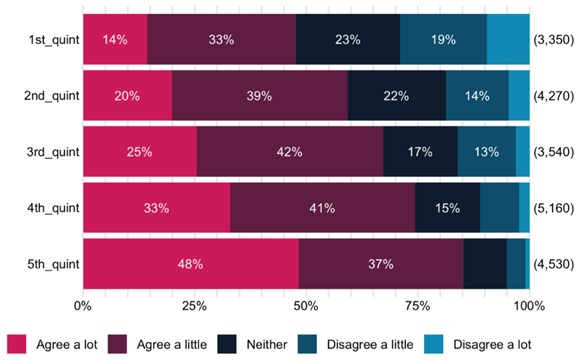
Figure 1: Proportions of Year 7 pupil responses to the question “I understand a topic before we move on” organised by quintiles of prior attainment in 150 schools. The 1st quintile comprises those with the lowest prior attainment.
Given the gender differences in attitudes to mathematics reported in the most recent TIMSS and PISA studies, the team has been keen to explore these issues using the Observatory’s Year 7 data. Reported levels of confidence vary by prior attainment, but also by sex (as recorded in the National Pupil Database) within attainment levels, as seen in Figure 2. Given concerns about the relatively low participation of girls later in the mathematics pipeline, it is important to understand the origins of these attitudes and how they change over time. There is, of course, much to say about these differences from the data, and the team will be writing more about this in due course.
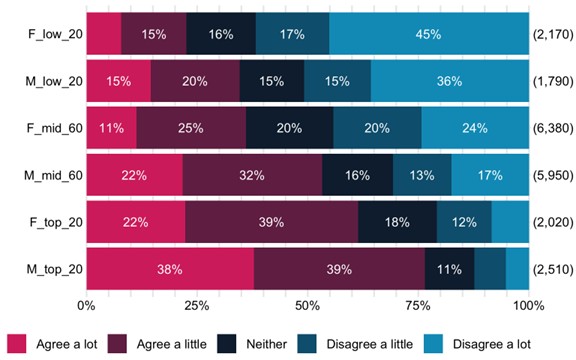
Figure 2: Proportions of Year 7 pupil responses to the question “I am sure that I could do the hardest maths in year 7” organised by quintiles of prior attainment, split by sex, in 150 schools. The 1st quintile comprises those with the lowest prior attainment.
Looking ahead
As for 2026, transitions will continue to feature prominently in the Observatory’s work. By Easter, data generation for Cycle 2 (years 1, 8 and 13) will be complete, and thereafter we will be exploring the Reception-Year 1 transition; the progress of our secondary cohort through Key Stage 2; as well as the experiences and post-18 choices of Year 13 A level Mathematics students.
Yet transitions are merely one area of interest, and with ever-larger and richer datasets it will become increasingly challenging to curate the annual Reviews. Through 2026 the Observatory team will therefore be communicating insights through different channels – including here. We’ve been tremendously encouraged by the feedback from RoME 2025 and are excited about what lies ahead…whatever the research might lead us.
Author information
Andy Noyes is the Director of the Observatory for Mathematical Education and a Professor of Education.
Observatory for Mathematical Education team
Observatory for Mathematical Education on LinkedIn