RoME 2025 - Maths degrees for the future
Chris Brignell, Deputy Director
What should a modern mathematics degree look like? That was the subject of discussion by delegates from across the university maths sector at last week’s conference jointly hosted by the Campaign for Mathematical Sciences, the Isaac Newton Institute and the London Mathematical Society. One argument is that fundamental mathematics is timeless, and there are indeed features of current maths degrees that would be familiar to Isaac Newton himself, so why change? On the other hand, mathematics is always being applied to new problems in business, finance, engineering, medicine and science, and this drives new mathematical discoveries. With algorithms suggesting which programmes I should watch on TV, the optimal route to my destination, the tactics my football team should employ in a crucial match, or keeping my online banking details secure, there isn’t much of daily life where mathematics doesn’t play its part. So why, then, are mathematics departments not bursting with undergraduates seeking the knowledge and skills necessary for this mathematical age?
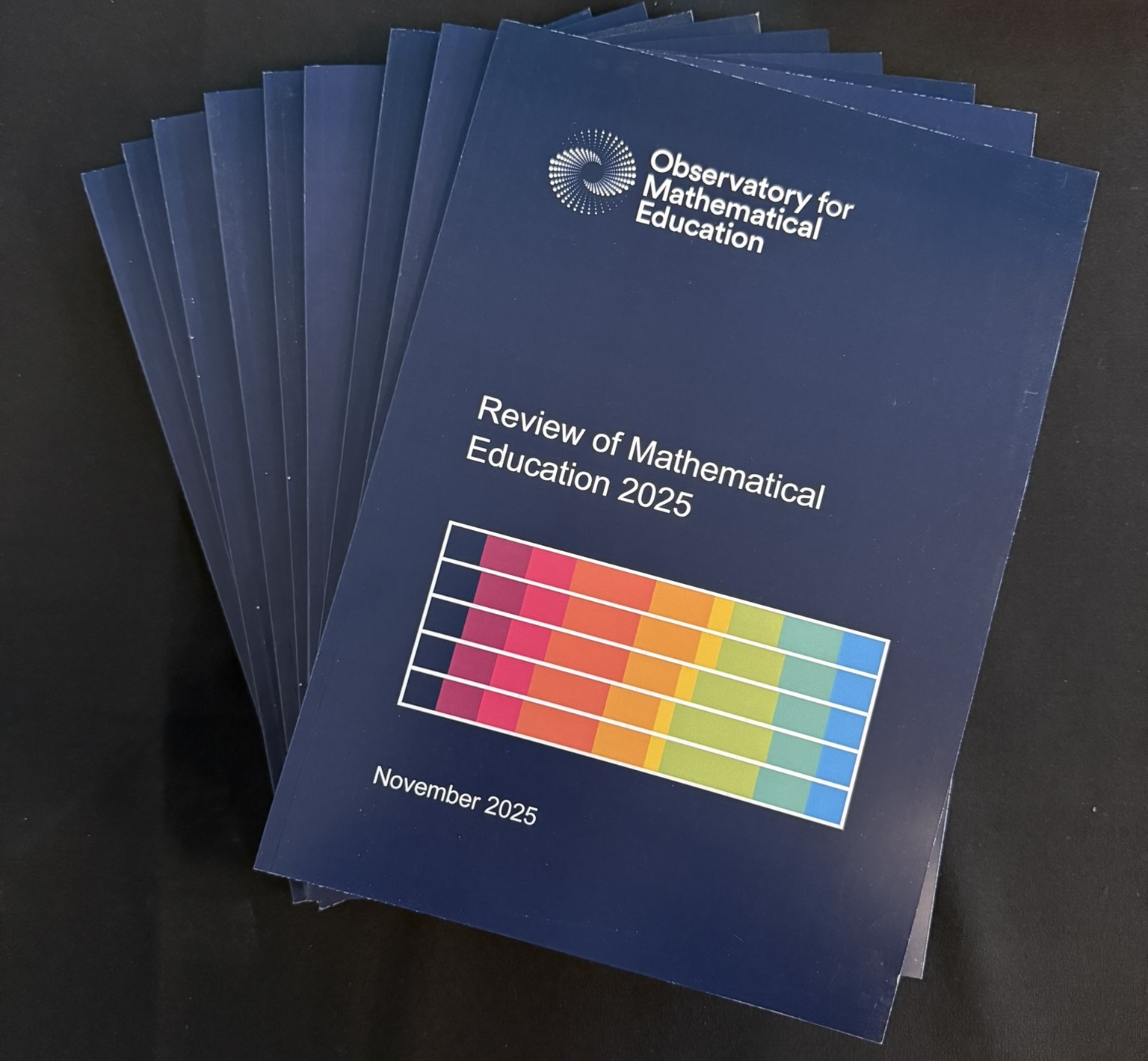
The Observatory’s Review of Mathematical Education 2025 gives us some clues. In truth, the number of students studying undergraduate mathematics has stayed broadly stable for more than a decade (see RoME Figure 3.3). While the number of 18-year-olds has increased this potential growth has been cancelled out by a relative decline in the popularity of maths degrees. With the number of 18-year-olds set to start declining in around 5 years (see RoME Figure 2.1), what fate then awaits enrolment numbers on maths degrees? For some post-92 maths departments it is already too late, with their BSc Mathematics programmes closed due to low student numbers. While Russell Group universities have expanded and increased market share, England’s survival-of-the-fittest approach to Higher Education has squeezed others out.
Who is studying mathematics degrees is also changing. While the subject has always been more popular with male students, the proportion of female students has fallen from over 35% 10 years ago to below 30% (see RoME Figure 3.8). Likewise, the proportion of students with low socio-economic status has fallen from 13% to 9% over the same time period (see RoME Figure 3.11), while students in London are twice as likely to study a mathematics degree as students in North-West England (see RoME Figure 3.18). It seems HE mathematics is suffering from elitism – without action there’s a risk it becomes a niche subject for middle-class male students, while our economy delegates the development of mathematical talent to other quantitative subjects such as computer science, economics, physics and engineering.
So, how do we address this problem? One solution is changing the perception of mathematics itself. The Observatory’s survey of Year 12 A level Mathematics pupils in England shows that more of them think maths is more about using rules and equations than it is about understanding the world; and more of them think it is about memorising definitions, formulas and facts than it is about communication (see RoME Figure 6.5). Of their teachers, 85% have students working on their own in almost all or most lessons, compared to just 17% who report students regularly using maths software to visualise data or plot graphs (see RoME Figure 6.8). Is this the curriculum and pedagogic practice which presents mathematics as a dynamic subject which meets the needs of the modern world?
By the mid-point of Year 12 only 7% of A level Mathematics pupils intend to study a mathematics degree (see RoME page 97). Partly this is a result of poor careers advice, with nearly half of Year 12 A level Mathematics teachers only encouraging those on track for grade A or A* to pursue a mathematics degree and over a quarter believing A level Further Mathematics is essential preparation (see RoME page 86). Both of these statements are false, but help to explain why many lower-tariff universities are struggling to recruit. Left unchecked these misconceptions will, ironically, become a self-fulfilling prophecy.
So, is there room for hope? Well, A level Mathematics (and Further Mathematics) numbers continue to rise year-on-year (see RoME Figure 3.2). The school system is clearly producing ever-increasing numbers of 16-year-olds who value the subject and are mathematically confident (although less so amongst post-16 female students, see RoME Figure 6.2). The Academy for the Mathematical Sciences has also shown there’s a growing need for mathematical skills in a digital economy driven by new technologies. So, there doesn’t seem to be a supply problem, or a limit to the demand for higher mathematical skills.
Which brings us back to the subject of last week’s conference. Can we attract more young people to study maths degrees if we reimagine what they should look like? The Royal Society has put forward bold proposals that would reshape pre-18 mathematical and data education such that A level Mathematics is no longer required to be the one-size-fits-some preparation for dozens of careers and courses. Likewise, the Maths Degrees for the Future grant winners have outlined new routes into HE mathematics, and updated curricula and practices that make use of new technology. One highlight of the conference was the sense of collaboration – representatives from both high- and low-tariff institutions recognising that working together to pilot ideas and share findings benefits everyone, and losing lower-tariff universities cuts off a major route into teaching for those needed to inspire future Isaac Newtons. Of course, government support for the HE sector, crippled by years of below-inflation tuition fee rises and curbs on international student income, would be welcome. In the meantime, though, for maths degrees, necessity is the mother of re-invention.
Read RoME 2025
Author information
Chris Brignell is the Deputy Director of the Observatory for Mathematical Education and a Professor of Statistics and Mathematical Education at the University of Nottingham.
Observatory for Mathematical Education team
Observatory for Mathematical Education on LinkedIn