RoME 2025 - Section 2: An overview of mathematics education in England 2024-25
Stephen Lee, Senior Research Fellow
What have been the key changes in the mathematical education landscape in England over the past year? This isn’t a straightforward question for a single person to answer comprehensively. Any response will be based on an individual’s own area of expertise, knowledge and interest, and likely aligned to the role and job they have. The good news is that the Observatory is here to help!
Section 2 of the Observatory's Review of Mathematical Education 2025 report is dedicated to creating this important overview. The section, together with those in future Reviews, aims to build a national institutional memory for the mathematical education sector. It combines some high-level national statistics about (mathematical) education in England and our synthesis of pertinent decisions and events, in this case from the general election of 2024 to the summer of 2025.
What’s in the ‘overview’ for 2024-25?
The Observatory’s 2024 Introductory Report mapped out the mathematical education organisational landscape and the new overview section builds upon this.
In 2024-25 there were important developments in mathematical education regarding curriculum (e.g. a curriculum and assessment review was commissioned) and the rethinking of budgetary priorities (e.g. Maths Hubs and AMSP), attempts to tackle longstanding problems (e.g. teacher recruitment and retention), and all of this framed by international evidence on educational performance (e.g. TIMSS and PIAAC). The section opens with some observations on these four big themes, before having further sub-sections incorporating:
- Mathematics curriculum and assessment
- Advanced and higher mathematics
- Mathematical skills education
- The mathematics teacher workforce
- Organisations supporting mathematical education
Each sub-section contains a summary box with 6 or 7 key items which are then expanded upon. Taken together, the collection of summary boxes gives an excellent overview of developments in 2024-25, with the opportunity to read further into specific areas as needed.
Selection of national statistics
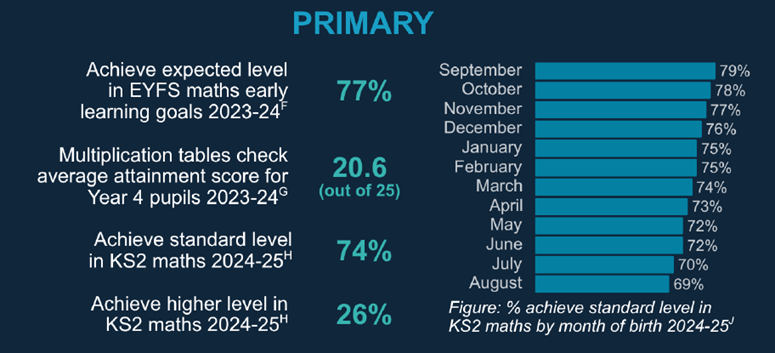
Another piece of the overview jigsaw comprised two infographics of data, tables and charts (see pages 20 and 21 of RoME). These include selected national (mathematical) education statistics, based on most recent data and contain links to the data sources. The image below contains an overview of key metrics from Primary education.
Data links from infographic: Ref
F,
G,
H,
J.
Taking just one example, it is clear from the figure that the percentage of pupils who achieve the standard level in KS2 mathematics reduces the ‘younger’ a pupil is – 79% for September born down to 69% for August born. This data originates from within the governments ‘explore education statistics’ website, but is not necessarily easy to locate. Collating these key national statistics in one place, with links to the data sources and comparable statistics from previous years, is an effective way to draw together relevant information in one easily digestible format.
More RoME content
The recently published Review of Mathematical Education 2025 report celebrated the end of the first cycle of data collection from the Observatory’s longitudinal studies in Primary, Secondary and Advanced/Higher education. It also collated a large amount of trend analysis. Future blogs will look at some of these areas in the coming weeks but in the meantime please do have a read of section 2 and get in touch if you have any comments or feedback.
Author information
Stephen Lee is a Senior Research Fellow at the Observatory for Mathematical Education and has a keen interest in policy research relating to mathematics education.
Observatory for Mathematical Education team
Observatory for Mathematical Education on LinkedIn