Transition is not optional. It is urgent. And it must be collaborative 
When preparing for Futureproof, a major national sustainability forum taking place in Nottingham, I revisited the university’s mission:
To be a university without borders, where we embrace the opportunities presented by a changing world, and where ambitious people and a creative culture enable us to change the world for the better.
And I looked at Futureproof’s vision:
Bringing together industry, innovators, policymakers, capital and communities to accelerate sustainable transformation.
It struck me immediately we share the same DNA. We both believe transition is not optional. It is urgent. And it must be collaborative.
A little about me
I studied Environmental Management at Nottingham 20 years ago. I then spent two decades in London in central and local government leading on climate and sustainability at the Ministry of Justice and at Transport for London, where I helped deliver the Ultra Low Emission Zone, at the time the largest clean air zone in the world.
I returned to Nottingham, my adopted hometown, a year ago to lead sustainability at the university.
Coming back, I realised something powerful: universities are among the few institutions capable of shaping systems, not just responding to them. But only if we are brave enough to align ambition with action.
A world leader in sustainability
The University of Nottingham is globally recognised for sustainability leadership.
We are ranked joint 37th globally in the 2026 QS World University Rankings: Sustainability and 14th in the UK.
We are ranked in the top 200 in the Times Higher Education Impact Rankings, which assess performance against the UN Sustainable Development Goals.
We are ranked 55th globally for SDG 17 Partnership for the Goals.
But rankings are not the goal. Impact is.
Research powering the transition
Our strength in energy and decarbonisation research is world-leading.
Last year, our Zero Carbon Innovation Centre opened with over £5m from East Midlands Freeport and £70m in public and private funding supporting electrification, hydrogen and advanced manufacturing research.
Next door, our Power Electronics and Machines Centre houses a 20 megawatt demonstration capability supporting the UK Electrification of Aerospace Propulsion Facility.
Our Hydrogen Propulsion Lab is being built alongside it.
We are Europe’s leading university for aerospace research working with Airbus, Siemens and Rolls-Royce to advance low-carbon aviation.
This is not theoretical sustainability. This is megawatt-scale infrastructure accelerating real-world transition. And it positions the East Midlands as a global leader in green innovation.
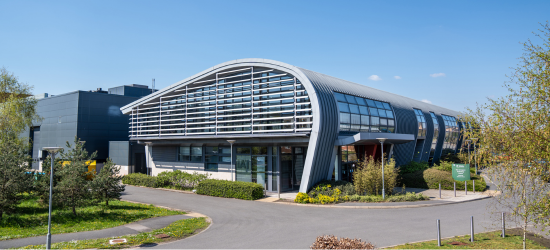 Zero Carbon Innovation Centre
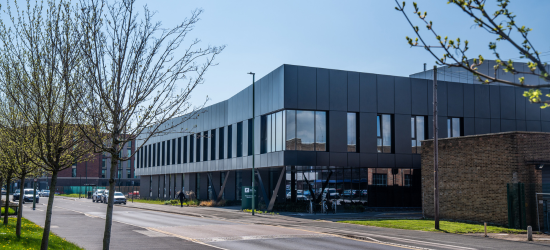 Power Electronics and Machines Centre
Universities as regional anchors
But research alone does not create change.
Universities must be engines of innovation and catalysts for growth.
Through our partnership the East Midlands Combined County Authority (EMCCA) and our role in shaping the region’s response to the £500m Local Innovation Partnership Fund, we are aligning research with place-based growth.
The East Midlands Investment Zone represents a ten-year, £160m commitment to transform this region into an innovation-led growth engine.
Through Midlands Mindforge targeting up to £250m in investment for spin-outs and our expanding portfolio of 40-plus spinout companies, we are translating knowledge into enterprise.
Knowledge Transfer Partnerships have secured over £28m since 2003 delivering sustainable innovation from greener manufacturing to plant-based protein systems.
This is how universities move from knowledge to impact.
Civic partnerships: the City as Lab
Our civic role is equally critical. Through City as Lab and its remarkable Projection Augmented Relief Model we are helping policymakers visualise how decisions shape Nottingham’s development, from green space planning to retrofitting homes.
Through Universities for Nottingham alongside NTU and local authorities we are committed to improving prosperity, sustainability, health and wellbeing for our shared communities.
Through Collaboratory, PhD students and citizen scientists work directly with communities on challenges like household retrofits and river quality.
This is what partnership for the goals looks like in practice.
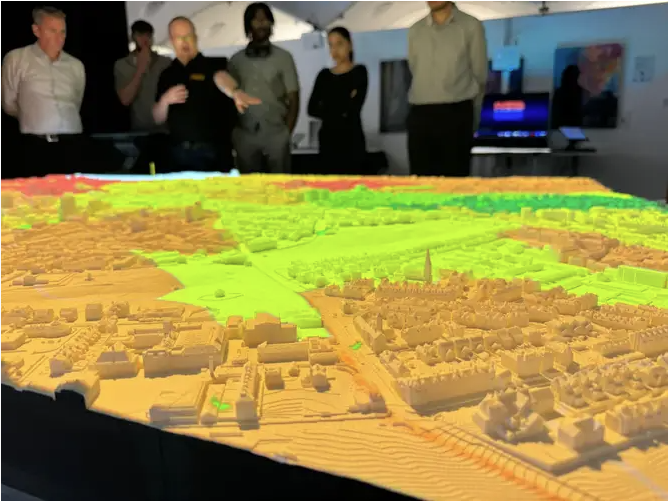 Projection Augmented Relief Model (PARM), a physical 3D map of Nottingham that can visualise place-based data.
Our own house in order
But leadership requires credibility at home.
If universities are going to speak about climate leadership, systems change and planetary responsibility then our own institutions must reflect those values in how we operate, invest and build.
At the University of Nottingham, we have made progress by reducing our carbon emissions by 40% between 2010 and 2020. We remain committed to our net zero by 2050 targets. We have divested from fossil fuels. We prioritise refurbishment over demolition because the greenest building is often the one that already exists.
All new capital projects are designed to achieve BREEAM Excellent as a minimum standard.
Across our campuses, we have reduced mowing by 25%, restored wildflower meadows, planted native hedgerows, and secured more Green Flag awards than any other university in the UK.
But this is not a static achievement. We are currently drafting a new climate change and sustainability plan for the next 10 years - one that moves us beyond incremental improvements and into whole-institution transformation.
The revised plan will focus on:
Because sustainability cannot sit on the margins of the institution.
It has to sit at the centre.
And yet I would be misleading you if I said this journey is simple. There are moments when ambition collides with financial pressure.
Moments when the capital envelope is tight. Moments when student expectations rise and rightly so while the funding model constrains what can be delivered immediately.
The tension is real. But credibility is built not by avoiding that tension -
it is built by confronting it honestly.
The tension: ambition vs affordability
There was a capital planning discussion recently about decarbonisation infrastructure. The environmental case was strong. The financial case was harder.
The question asked was: “Can we afford this right now?”
And that is the moment where sustainability ambition collides with institutional reality.
Across the sector, universities face tightening finances, volatile energy markets, rising expectations and ageing estates. The tension is real.
But here is the deeper truth:
If our financial models cannot value long-term resilience, then the models — not the mission — must evolve.
That is not a criticism. It is an invitation to modernise governance.

Students: the credibility test
Our students are not passive observers. They are asking whether sustainability is central or conditional.
We are mapping every undergraduate programme against the SDGs. We are embedding Education for Sustainable Development across the curriculum. Through initiatives like Foodprint and Enactus Nottingham, students are leading social enterprises, tackling food insecurity and building civic capability.
Our students want more than commitments. They want integrity.
And rightly so. Because sustainability is not an optional extra to their education.
It defines the world they will inherit.
From collaboration to place-based transition alliance
Which brings me to the heart of my message. Transition at this scale is systemic. No single institution can deliver it alone.
Not universities.
Not business.
Not government.
We need to move beyond conversation to long-term delivery partnerships that align capital, skills and innovation We need cross-sector compacts, and long-term, place-based agreements that align:
Three propositions
Futureproof must be more than a conference. It must be a catalyst. Let me leave you with three propositions.
Because if sustainability is conditional when budgets tighten, then it was never embedded.
Universities have shaped society for centuries.
The question is not whether we have the capability to lead this transition. The question is whether we have the courage to align our systems with our ambition.
Futureproof is an opportunity. Let’s use it not only to exchange ideas but to form long-term covenant:
Because sustainability is not a side agenda. It is the defining challenge and opportunity of our time.
Muhammad Ali
Muhammad Ali is Director of Environmental Sustainability at the University of Nottingham