Sustainable industry: visionary future or corporate fairy tale?
To celebrate World Engineering Day, I joined staff and students from the University of Nottingham’s Faculty of Engineering as a panel of experts were asked to wrestle with the question: Sustainable industry: visionary future or corporate fairy tale? This provocative prompt was designed to spark discussion, and judging by the lively debate that unfolded, it achieved exactly that.
As one of the audience, I left the room with something I didn’t entirely expect: guarded optimism - a sense that despite the messy realities there is a credible pathway toward a more sustainable industrial future. But it is a path that requires a great deal more than clever technologies and enthusiastic engineers.
Innovation is essential—but not sufficient
Across the panel, there was broad agreement that the technological solutions required for a sustainable transition either already exist or are well within reach. Whether in low-carbon energy systems, smart buildings, advanced materials, or carbon capture, there is no shortage of transformative innovation happening across universities and industry.
But the uncomfortable truth is: technology alone won’t save us.
We’ve been here before. Ozone layer depletion, sulphur emissions and acid rain weren’t mitigated because industry voluntarily stepped up. They were solved because governments set regulatory frameworks that gave businesses no choice but to innovate. When regulation and industry incentives aligned, progress accelerated.
The panel stressed that this remains as true today as ever. If we want transformative technologies to scale up, industry must be incentivised, regulated and supported to do so.
Without that framework, innovation risks remaining trapped in laboratories or prototype stages, while emissions continue to rise.
People power matters just as much as policy
One recurring idea during our discussion was the power of small behavioural changes, multiplied across populations. Engineers and policymakers often focus on mega tonnes of carbon, gigawatts of energy and multibillion pound transitions but the aggregate impact of household choices is enormous. It’s why social scientists – exploring how people respond to and adopt sustainable technologies and behaviours – join engineers and scientists at the university's Energy Institute as part of multidisciplinary teams working to accelerate the UK’s transition to net zero.
Heating habits, travel decisions, recycling behaviour, lifestyle adjustments, these aren’t trivial. As one panellist noted, small shifts by individuals, households and communities across a global population of 8 billion-plus, add up a transformational, cumulative effect. We can all make a difference.
But that shift won’t happen automatically. It requires:
- trustworthy information (not misinformation)
- meaningful engagement
- a sense of urgency, not doom
- systems that make sustainable choices the easier options
And critically, it requires voters who understand the stakes well enough to demand climate action from their governments.
Which means education at all levels has a role to play. Universities, schools, media, community organisations: we all share responsibility for shaping public understanding and empowering people to act.
Where universities fit in
One of the most energising parts of the debate was recognising the role universities like Nottingham can play in bridging the gaps between technology, policy, and society.
We are uniquely positioned to:
- develop the next generation of engineers and professionals who will design the future
- conduct research that pushes the boundaries of what sustainable industry can look like
- partner with industry to turn early-stage ideas into deployable technologies
- support government by providing evidence, expertise, and clarity on complex systems
- engage students and the public in conversations that build climate literacy and drive social momentum
This aligns powerfully with the United Nations Sustainable Development Goals, particularly SDG 9: Industry, Innovation and Infrastructure. Our work here directly supports SDG 9’s mission to build resilient infrastructure, promote inclusive and sustainable industrialisation, and foster innovation. Every partnership, every research project, every student project contributes a piece of that global puzzle.
And the students we see coming through our doors every year? They give me more hope than anything else.
So, is sustainable industry a visionary future or corporate fairy tale?
If you had asked me before the debate, I might have hesitated. But hearing the arguments laid out not just by experts, but by students. I’m leaning firmly toward a visionary future, albeit with realism.
We are not on track yet. We do not have time to waste. But we do know what needs to be done:
- Regulation that levels the playing field and drives industry to act
- Investment and incentives that accelerate innovation and deployment
- Education and communication that build public support and informed voters
- Behavioural shifts that collectively make a gigantic difference
- Collaboration across academia, industry, and government
Sustainable industry isn’t a fairy tale, but neither is it guaranteed. It is a future we will have to build deliberately, intelligently, and together.
Event panel
The panel was chaired by Nick Ebbs, Honorary Professor of Sustainable Development, Deputy Lieutenant for Nottinghamshire and Chair of West Northamptonshire Housing Delivery Board. He was formerly Vice Chair of igloo Regeneration Ltd (specialists in the development of sustainable places) and Chief Executive of Blueprint Regeneration.
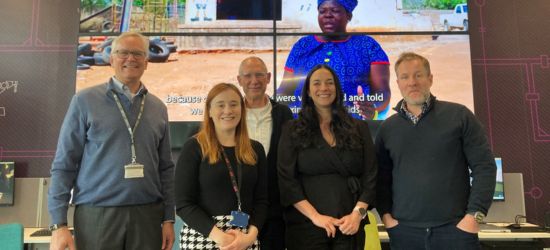
The image above shows the event panel from left to right: Professor Henner Wapenhan, Dr Orla Williams, Nick Ebbs, Professor Lucelia Rodrigues and Professor Ed Lester.
Responding to Nick’s question were:
Professor Lucelia Rodrigues: Professor of Sustainable and Resilient Cities, Head of Department for Architecture and Built Environment and Deputy Director of University of Nottingham Energy Institute.
Dr Orla Williams: Assistant Professor in the Department of Mechanical, Materials and Manufacturing, sitting within the Advanced Materials Research Group.
Professor Ed Lester: Lady Trent Professor and Associate Pro-Vice-Chancellor for Knowledge, Exchange and Innovation for UoN.
Professor Henner Wapenhans: Professor of Innovation for Zero Carbon Technologies.