The brick and the medal: what the Queen Elizabeth Prize means for the Rights Lab
The University of Nottingham holds the Queen Elizabeth Prize for Education, in recognition of the pioneering research of its Rights Lab in tackling the global scourge of modern slavery and forced labour. This week, members of the Rights Lab attended a ceremony at St James’s Palace to receive the award from King Charles.
Rights Lab Director Professor Zoe Trodd reflects on receiving the UK’s highest honour for universities and what it means to the world’s leading, largest group of modern slavery researchers.
This week, I had the honour of receiving the Queen Elizabeth Prize for Education on behalf of the University of Nottingham and the Rights Lab. Standing at St James’s Palace and then at the Guildhall with colleagues and partners, I felt two things at once: pride in what our team has built, and a renewed sense of responsibility for what comes next.
The prize recognises our work to understand and tackle modern slavery and forced labour through rigorous, interdisciplinary research, bringing together colleagues across Social Sciences — from Geography and Politics to Business, Law, Sociology and Social Policy — to address a complex global problem.
A brick in Highfield House
In my office in the Rights Lab, in Highfield House, I keep a single brick clearly on display. It was sent to us by Volunteers for Social Justice, one of our NGO partners in India. They use data generated by our Slavery from Space programme to identify brick kilns where families are trapped in debt bondage. The brick was removed from a kiln during a liberation operation, wrapped in newspaper, and posted to Nottingham.
Modern slavery and forced labour affect millions of people worldwide, generate an estimated US$236bn in illegal profits annually, and distort economies, depress wages, damage the environment and weaken governance. The scale can feel overwhelming. It can also feel invisible.
One of the Rights Lab’s core insights is that slavery is not as hidden as we once thought. We can identify signals of forced labour, and trace underlying vulnerabilities to exploitation, from space.
Modern slavery and forced labour are not inevitable features of the global economy. They are measurable, analysable and preventable.
Identifying slavery at scale
Through Earth Observation — satellite imagery analysed using remote sensing and machine learning — we identify the physical traces left by industries with high levels of exploitation, from brick kilns across South Asia to sites of illegal mining and deforestation across Africa, Asia and the Americas. We combine AI and geospatial analysis with crowd-sourced data from new citizen science approaches to support the identification of slavery sites at unprecedented scale.
In South Asia alone, our team identified over 66,000 brick kilns across the so-called “Brick Belt”, far exceeding previous estimates. We have used that data to support local civil society and government in the work of prevention and protection.
Our work also extends to prevalence estimation. In partnership with International Justice Mission in the Philippines, we contributed to the first robust national estimate of trafficking for the online sexual exploitation of children. The study found that approximately one in 100 Filipino children had experienced this form of abuse. Mapping geographic patterns and risk factors enabled more targeted law enforcement and policy responses.
Across our programmes — from Slavery from Space to prevalence estimation, to the newly established Leverhulme Centre for Research on Slavery in War with King’s College London — we ask a consistent question: what does rigorous evidence make possible?
We have developed new methods for prevalence estimation even where data are scarce. We have shown how forced labour is entangled with environmental destruction and economic systems. Businesses are integrating forced labour risk assessment into decision-making, including through tools we have developed with Moody’s, a global leader in risk and data analysis. NGOs translate robust research findings into effective operations.
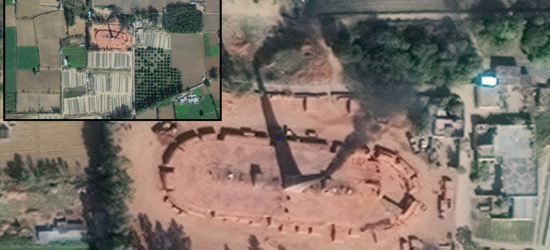
An example of a fixed chimney 'Bull’s trench' brick kiln in India. This technology in widely used in South Asia, and features a sunken oval or rectangular trench where bricks are fired as the flame moves through them
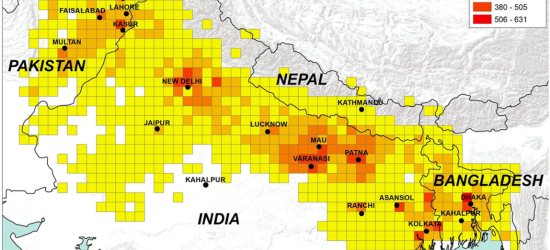 The first rigorous mapping of all Bull’s trench brick kilns across the 1.5 million km2 ‘Brick Belt’ region, presented as density. In total the research team identified and mapped 66,455 kilns from satellite data.
Recognition and responsibility
The Queen Elizabeth Prize recognises innovation in education and research. For us, it also affirms something larger: that modern slavery and forced labour are not inevitable features of the global economy. They are measurable, analysable and preventable.
At St James’s Palace, we received the prize medal from the King. We were also pleased to be joined in London by colleagues from Moody’s and the International Justice Mission, whose partnership has been central to translating research into practice. Like the brick, the medal marks a moment when evidence moved beyond analysis and into action.
The medal will take its place within the life of the university – and the brick reminds me why the medal matters: recognition strengthens our commitment to the work ahead.