Building Climate-resilient livestock feed systems in semi-arid Africa
Posted on 11 February 2026
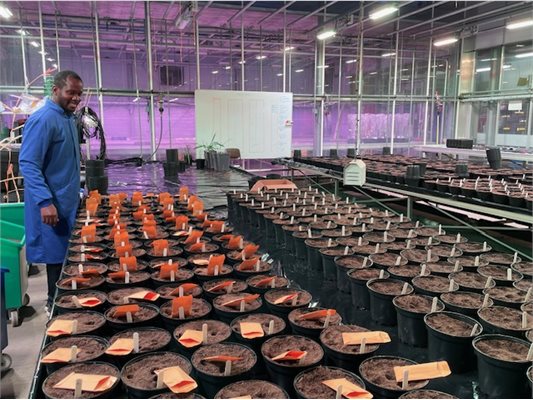
Prof Ansah at University of Nottingham glasshouse facility
Partnership between the University of Nottingham Food Systems Institute and University Development Studies Ghana has been launched to promote growth and address challenges within the livestock feed value chain in Ghana.
In northern Ghana, livestock are central to livelihoods, nutrition, and household resilience. Northern Ghana lies within a semi-arid agro-ecological zone, characterized by a prolonged dry season, erratic rainfall, and recurrent droughts. These conditions severely limit the availability and quality of livestock feed, leading to low productivity, high animal losses, and reduced farmer incomes.
Researchers at the University of Nottingham Food Systems Institute have been part of an international trilateral innovation grant addressing this challenge. The work directly involves identification, testing, and promotion of high-yielding, drought-tolerant, and nutritionally superior forage species suitable for smallholder livestock production in semi-arid systems. These new species are then integrated into crop–livestock systems, with developed practical feed innovations such as forage pellets and total mixed rations.
Dr. Mendiondo (PI) and Dr. Atkinson are leading partners for the project, along with Dr. Rauch, in close collaboration with the University of Development Studies (Ghana) and Papalotla (Brazil).
The Trilateral Innovation for Climate-Smart Forages: Strengthening Livestock Resilience in Ghana research integrates forage agronomy, animal nutrition, climate adaptation, and agribusiness development in real smallholder settings. It moves beyond productivity to demonstrate scalable, climate-smart feed solutions with measurable livelihood and enterprise outcomes.
The work combines on-farm trials, farmer training, and feed value-chain development, and addresses chronic livestock feed shortages, poor forage quality, and climate vulnerability, particularly during prolonged dry seasons. These constraints limit animal productivity, farmer incomes, and the reliability of animal-source foods.
In December 2025, Professor Terry Ansah from University for Development Studies (UDS), Ghana visited the University of Nottingham. During his visit, Prof Ansah said: “We anticipate that the promising approaches around climate-smart forages, feed processing technologies, and data-driven livestock nutrition will be valued and applied across research and farming innovation.”
The impact the project solutions will have on farming communities and economies is significant. By improving year-round feed availability, the project strengthens livestock productivity, reduces vulnerability to climate shocks, and enhances household resilience. In addition, the work supports the development of forage-based enterprises and value chains, creating income opportunities and employment.
At local and community levels, improved feed availability enhances livestock productivity, stabilizes incomes, and strengthens livelihood resilience among smallholder farmers. At a national level, the work contributes to country-wide livestock development, supports climate-smart agriculture goals, and emerging feed and forage industries, therefore reducing dependence on expensive commercial feeds.
“The approaches and lessons are also transferable to other semi-arid and drought-prone regions in Africa and beyond, contributing to global efforts on climate adaptation, food security, and sustainable livestock systems.” Professor Ansah, UDS Ghana
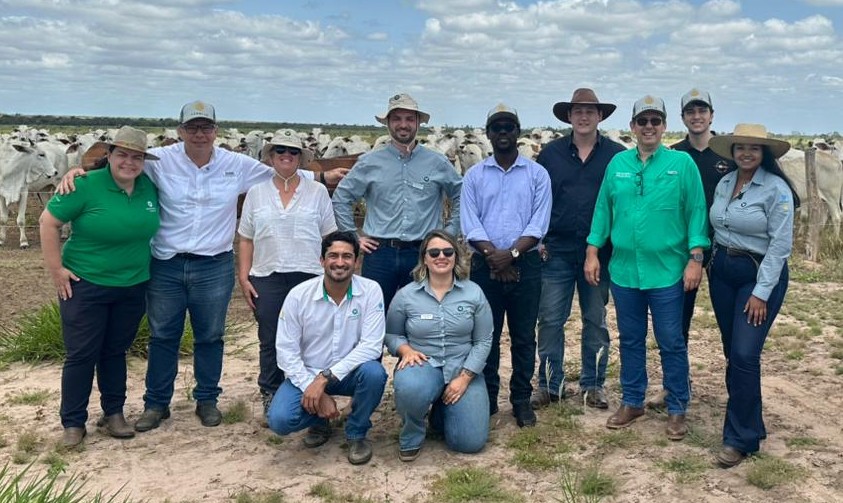
The research also offers an exciting integration of science, innovation, and delivery of practical impact. The work goes beyond field trials to link forage improvement, livestock nutrition, climate resilience, and agribusiness development. By combining research with farmer engagement and private-sector opportunities, the research demonstrates a scalable model that transforms climate challenges into opportunities for resilient food systems and rural enterprise development.
Professor Ansah said: “What’s exciting is that the research links farmers, feed producers, students, researchers, and local markets, strengthening entire livestock feed ecosystems.”
The project was also deliberately designed around smallholder farmers, with strong emphasis on women and youth participation in forage production, feed processing, and marketing. Through training, access to improved planting materials, and enterprise development, the work lowers entry barriers for marginalized groups and promotes inclusive growth along the livestock feed value chain.
As part of this wider work, the team successfully held two workshops in Brazil and the UK to gather data for the phenotyping of the forage crops, being done at our state-of-the-art plant and crop phenotyping technologies.
“Through training, access to improved planting materials, and enterprise development, this work lowers entry barriers for marginalized groups and promotes inclusive growth along the livestock feed value chain.” Dr Guillermina Mendiondo
By improving the nutritional quality of livestock diets through better forages, the project contributes indirectly to improved animal health, productivity, and the availability of quality animal-source foods. This supports better household nutrition and food security, particularly in rural communities where livestock are a critical source of income and dietary protein.
Dr Guillermina Mendiondo is an Assistant Professor in Translational Agriculture at the University of Nottingham School of Biosciences, Plant and Crop Sciences Division, Faculty of Science. She is also an associate of the Food Systems Institute at UoN, and an expert at the Centre for Sustainable Agricultural Systems.
Professor Terry Ansah is a Professor in the Department of Animal Science, and Dean of the Faculty of Agriculture, Food and Consumer Sciences at the University for Development Studies (UDS), Ghana.