Establishing a New Framework for the Food Systems Institute
Posted on 09 September 2025
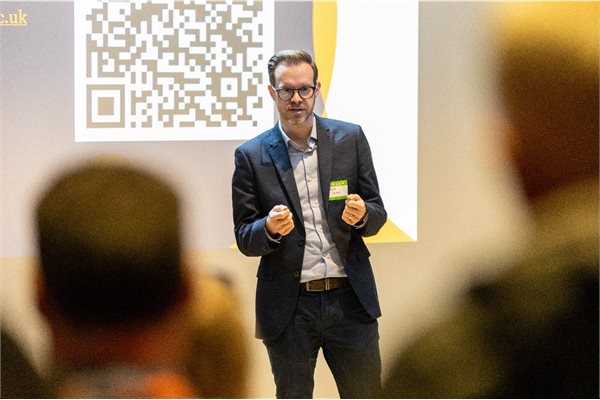
Pete photographed at the Nourish Conference in March 2025. Photographed by Ilian Teles Do Bonfim
Over the last 6 months, I have been reflecting on the progress that we have made across the Food Systems Institute at the University of Nottingham and have started to develop a working framework for the Institute. Alongside this I have refined the mission and pillars of the Institute to reflect the key societal challenges that face our future food system and the world-class research that is being pioneered across the University of Nottingham to tackle these challenges. We started from a solid foundation and so my role has been to refine these priorities and continue to push our mission forward.
FSI Mission - our driving force
Our mission is to facilitate a just transition to a more sustainable and nutritious food system, through transdisciplinary research and innovation, translation of high-quality research knowledge to real-world scenarios, coordination of multi-stakeholder partnerships and stimulating sector change through thought-leadership and foresight.
Our mission statement is a call to action, for university stakeholders and worldwide cross-disciplinary partnerships we’ve established over many decades. It brings academic colleagues whose research interests span the entire food system to come together and continue to advance knowledge and drive innovation that enable a just transition toward a more sustainable and nutritious food system. This is also reflected in our three pillars, and it’s embodied in my new vision for FSI.
Cross-cutting pillars for global impact
Our pillars have always reflected the impact our research has on key priorities for action in the food system. We started out with Sustainable and resilient food systems, Food, Community and Society, and Food, Nutrition and Health. These pillars reflected the impact of our world-class research and captured our ambition to transform our future food systems through evidenced-based research across these key areas.
Now we are looking to refine these to emphasise three key outcomes that align with our mission - Sustainability, Equity and Nutrition:
- Sustainable and resilient food systems
- Equitable and inclusive food systems
- Healthy and nutritious food systems
In particular, we have altered the second pillar to focus on equity and this now reflects that equity and inclusivity of individuals in the food system is as urgent now as it is fundamental to basic human rights and dignity. 10 years ago, the world was making great progress towards eliminating hunger and malnutrition with positive action to eradicate these issues and demonstrable progress on key metrics, with the goal of bringing a basic quality of food and nutrition to all. Today that progress is receding, new conflicts, breakdown of international cooperation towards shared goals and isolationism has taken us away from these noble ambitions. This is why as part of our refinement we are highlighting equity as a key goal to renew vigour into this mission. This was also a shared vision when Beth Bechdol, Deputy Director-General at FAO spoke at our Food Futures Seminar earlier this year. Beth named the acute number of people experiencing food insecurity globally as a critical issue impacting our food system, and how cross sector collaborations can help us achieve a transformational food system that works for people everywhere.
These three new pillars are also emphasising the systems element. Achieving our desired outcomes will only be successful through accepting that we are developing knowledge and solutions to tackle complex systems that contain positive and negative feedback loops that can behave in unpredictable ways. Therefore, the wider systems context is critical when developing solutions and adapting research knowledge to make an impact on our food systems.
Shaping what’s next for FSI: Our Framework and future
We have renewed the focus of FSI, centred around three key elements that we consider as pathways to a sustainable, equitable and nutritious food systems.
- Leadership – We will do this through the coordination and co-development of transdisciplinary applied-research programmes.
- Partnerships – Our aim is to develop networks that stimulate collaboration and community building, with key food system stakeholders.
- Engagement - Of publics and stakeholders through the lens of our pillars to reflect the mission of the institute
Leadership across FSI will be driven through four FSI Translational Centres. Each of these Centres have been created so we can achieve the highest impact across our three pillars mentioned above. They will drive a programme of new transdisciplinary research knowledge across communities, co-develop applied-research activities with key food systems stakeholders and undertake knowledge exchange activities to translate evidence-based research into practice. Our Centres are led by at least one academic Director, and we are building teams around them to support the delivery programmes.
- Centre for Food Policy and Foresight
- Centre for Sustainable Agricultural Systems
- Centre for Food, Drink and Nutrition Innovation (combining and expanding upon the Food Innovation Centre and Future Protein Hub)
- Centre for Equitable and Inclusive Food Systems (a new Centre that we will launch in October this year)
Partnerships and engagement are critical to the success of transdisciplinary research initiatives and FSI is open to collaboration with all food system stakeholders and knowledge producers. To date our activities have embraced diverse communities from local food system activists to sector working groups (farmers, manufacturers and innovators), to university academics. We will continue to bring these communities together to co-create, problem solve and debate food systems issues. We will foster new networks and communities, whilst communicating our research through the lens of sustainable, equitable and nutritious food systems.
FSI will continue to evolve. Our food systems are complex and changing and so, the knowledge and approach we take to tackling them will need to be agile. With these refined foundations in place, we can now go forward and deliver across our Centres, driving towards the goal of our mission.