By Isabel Ilett
In this blog post, Isabel Ilett recounts our placement visit to, and tour of, the Cobot Maker Space (CMS) in the School of Computer Science on Jubilee Campus at the University of Nottingham on the afternoon of Wednesday 12 November 2025. The tour took place in the context of a new student placement.
 Isabel Ilett is a finalist studying a Music and Music Technology Studies BA in the Department of Music within the School of Humanities. Isabel expects to graduate in the summer of 2026.
- My name is Isabel Ilett.
- I am a third-year Music and Music Technology Studies BA student who loves being creative and exploring new pieces of technology.
- I am looking forward to being a part of this placement because I will be able to try something new!
CMS is a vibrant hub that facilitates the exploration of the future of collaborative robotics.
Launched in 2021, CMS was created to help understand how people interact and work with collaborative robots in various settings including homes, workplaces, and public spaces among others.
CMS has partnered with the Visioning a Creative and Cultural County (VCCC) research-policy impact project to deliver a student placement titled 3D Printing Museum Handling Objects.
The 3D Printing Museum Handling Objects Placement (3DPP) is piloting a small selection of 3D-printed museum handling objects to complement the Villiers Revealed Virtual Exhibition (see URL link at the bottom of this blog post) at Culture Leicestershire and Leicestershire Museum Collections, Leicestershire County Council.
3DPP is also undertaking research on the practical use and value of 3D printing objects for museum handling sessions both for Leicestershire Museum Collections at Leicestershire County Council and the wider museum and heritage sector nationally.
In addition to offering students distinctive professional development competencies and skills coveted by graduate job employers, 3DPP is also providing students with first-hand experience of working on an exciting and real-world project.
This real-life project is nestled at the intersection of collaborative robotics, the heritage sector, the digital media industries, and local government context.
On Wednesday 12 November 2025 the 3D Printing Museum Handling Objects Placement group attended a training and induction session in the use of a 3D printer on Jubilee Campus in the Cobot Maker Space (CMS).
We were given a tour around the CMS lab by Dominic Price who is a Research Fellow and Manager of the lab. Dominic has expertise in computer science, programming and interactive artworks.
During the tour, we were introduced to several robots that are operated in real-life environments.
The robots and the tasks they carried out exemplified human-machine interaction at the intersection of multiple disciplines: business studies; psychology; engineering; and computer science among others.
We heard about how robots have been introduced in social care – giving rise to a new field of study and practice commonly known as ‘care robotics’.
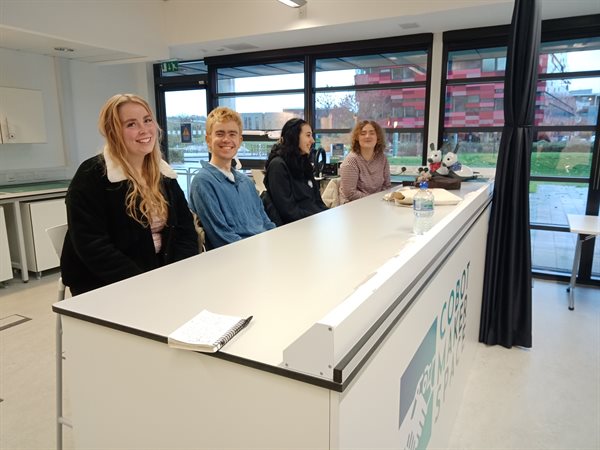 A group of students on the 3D Printing Museum Handling Objects Placement in the CMS lab. From left to right: Myself, Conrad Padgett, Sophie Baggaley and Martha Sheehy.
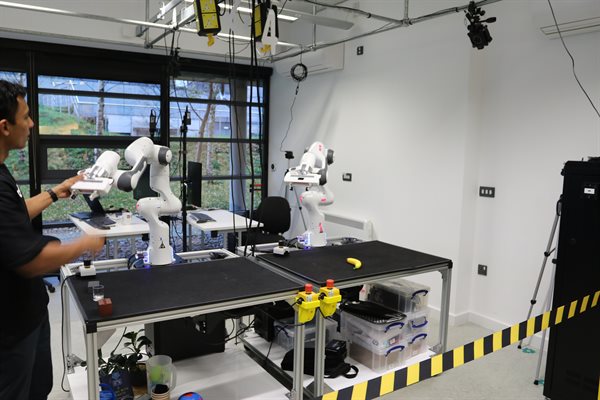 A student based in the School of Computer Science holds a demonstration of a robot in action in the CMS lab. The robot is equipped with arms that stretch out to perform various functions. We learnt that some of the robots in the lab are taken to schools for demonstration purposes - as a way to demystify robotics and enthuse pupils for this subject.
One interesting learning point was the importance of introducing robots in a non-threatening way and understanding how people respond to robots both in public and private spaces.
Another interesting point concerned just how the latest innovations and advancements in technology have signiticantly transformed 'care robotics' and its ever-growing list of new applications and uses.
We then explored 3 various environments including the Living Space, the Care Room and the Museum Room, which implemented various pieces of robot-automated technology to research how it could positively impact people in their everyday lives.
The Living Space was designed as a real-life environment in which a robot assisted with chores with the help of sensors.
The Care Room featured a ‘telepresence’ robot that is controlled remotely to enable two-way video communication, movement and interaction. In undertaking these tasks, we learned that this robot allows for various activities to take place for which physical presence is not possible. In doing so, this robot saves travel time and cost. Generally, however, we heard that robots are very expensive.
The Museum Room provides a library of museum-style furniture and audio-visual equipment enabling users to move around and customise the environment.
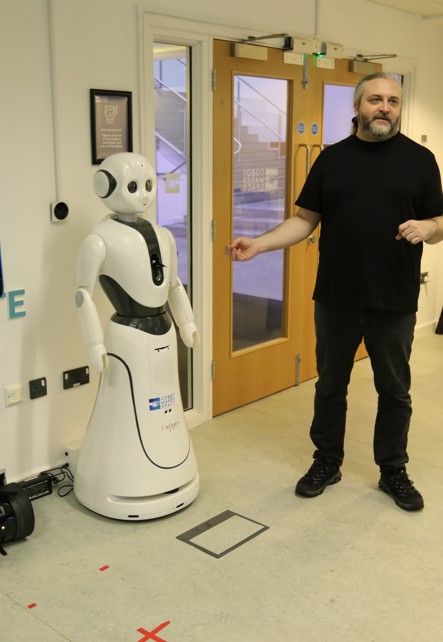 Dominic Price introducing placement students to the different types of robots in the CMS lab. The robot in the image solicits interactions of different kinds.
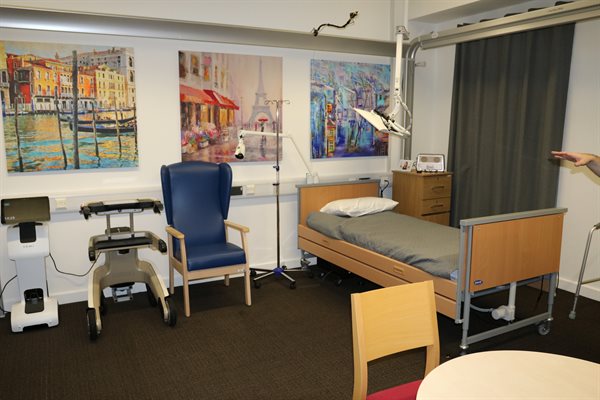 This image shows the Care Room in the CMS lab. To the left of the image is a robot whose mobility is powered by walking sensors.
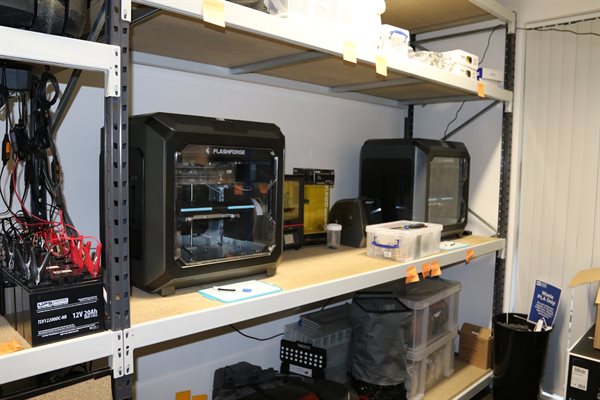 This image shows 3D printers in the CMS lab. We learnt that these printers print in two colours, that they are very expensive, and that 3D printing is generally not quick.
A video was then shown to us explaining an experiment which involved cats interacting with robots in a monitored environment to explore how animals as well as humans may benefit from different technologies, including artificial intelligence (AI).
The video can be accessed at the end of this blog post. This was thought-provoking as technology is gradually becoming more of a greater element in our everyday activities, and much easier to access.
We were then introduced to two different 3D printers with one of them using resin to form objects rather than plastic, which we are unlikely to be using as we were told that it can be quite hard to clean.
It was also interesting to find out that the process of 3D printing an object can take up to several days depending on its size and complexity.
Here are the two URL links mentioned in this blog post above:
Villiers Revealed Virtual Exhibition - https://villiers.digital-exhibition.uk/
Cat Royale Video - https://www.blasttheory.co.uk/projects/cat-royale/