By Daniel H. Mutibwa
Launching VCCC's First Student Placement
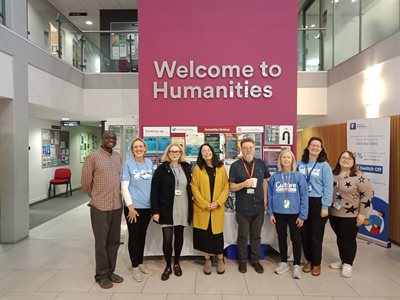 The Placement Team before the launch of the 'Curating, Researching, Digitising and Exhibiting Leicestershire Museum Collections in Co-production' placement.
In efforts to continue to deepen the research-policy engagement partnership between Leicestershire County Council (LCC) and the University of Nottingham (UoN), the VCCC project co-developed and co-promoted its first student placement for the academic year 2024-2025 with Matt Davies (Manager, the Digital Transformations Hub, Faculty of Arts), Hayley Revill (Faculty of Arts Placements Manager), and Deborah Till and Caroline Nolan (Senior Careers Advisors, Careers and Employability Service, UoN).
In this configuration, we constituted the Placement Team. The placement was launched under the title Curating, Researching, Digitising and Exhibiting Leicestershire Museum Collections in Co-production and was designed to run from October 2024 to June 2025. 75 students from within the Faculty of Arts and across both undergraduate and postgraduate levels expressed enthusiastic interest in participating, something that was very impressive to see.
The Placement Team hosted an Info Session on Wednesday 16 October 2024 to give students the opportunity to learn more about the placement in person, ask questions, and meet the Placement Team.
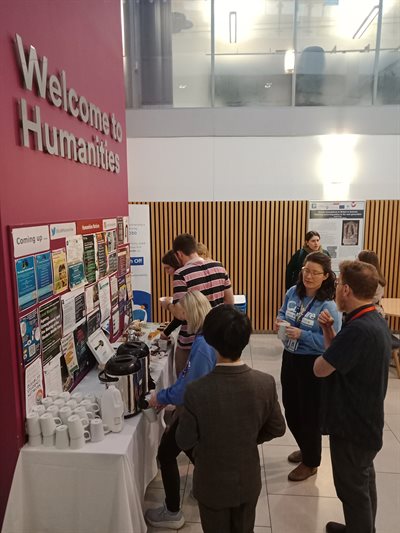 Selected event attendees enjoying refreshments made possible by the brilliant support provided by the School of Cultures, Languages, and Area Studies (CLAS) and the Education and Student Experience (ESE) Team.
Courtesy of excellent support from the School of Cultures, Languages and Area Studies (CLAS) and the Education and Student Experience (ESE) Team, tea, coffee, and cake were served both before the event and at the midway point.
Before the Info Session, the Placement Team advised that the placement was of interest and relevance to students who were:
- looking to learn new competencies and skills relevant to graduate careers in sectors such as the creative industries, heritage industries, digital media industries, and local government;
- interested in gaining first-hand experience of working on an exciting and real-world project with tangible outcomes; and
- passionate about interacting with professionals from the above-named industries and gaining deep insights into their work.
The following members of the Placement Team spoke at the event:
- Daniel H. Mutibwa (Associate Professor of Creative Industries and Digital Culture, UoN);
- Amanda Hanton (Cultural Participation Team Manager, LCC);
- Jemma Atkin-Barrett (Community Participation Worker, LCC);
- Alison Clague (Senior Curator, LCC);
- Esther Shaw (Community Participation Worker, LCC);
- Pippa Vidal Davies (Volunteering Manager, LCC);
- Matt Davies (Manager, Digital Transformations Hub, DTH, UoN);
- Hayley Revill (Faculty of Arts Placements Manager, UoN); and
- Deborah Till (Senior Careers Advisor, Careers and Employability Service, UoN).
Daniel introduced the placement — explaining that it arose from the VCCC project which is developing a Cultural Strategy for LCC. This, Daniel explained further, involves facilitating broader engagement with the arts, culture, heritage, and the creative industries in Leicestershire and beyond and connecting people with their material culture through the provision of a range of high-quality cultural experiences that enrich people’s lives. This placement is designed to contribute to achieving these overarching objectives. Students learnt that the placement comprises 4 strands, namely
- Research;
- Photogrammetry;
- Marketing and Promotion; and
- Virtual/Immersive Exhibition Space.
Leicestershire Museum Collections Visits, Co-curating, Learning, and Training
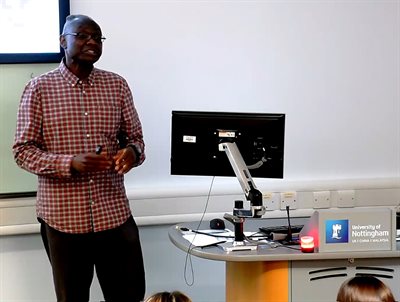 Daniel H. Mutibwa introducing the placement — including an explanation of its overarching objectives and a description of its timeline and planned activities between October 2024 and May/June 2025.
Students heard that they would select objects of interest from Leicestershire Museum Collections in an exercise of co-curation and undertake research on them. Following training in photogrammetry — a method of producing high resolution digital 3D versions of objects using studio photography, students would digitise curated objects and produce 3D versions in the DTH on campus. Part of this would involve contributing personal responses to the curated and digitised objects — and inviting peers to do the same. Selected responses are scheduled to form part of the interpretation of the objects.
Students heard further that placement activities would be promoted via blog posts and other content circulated via the appropriate social media platforms maintained by Culture Leicestershire (CuL) at LCC, DTH, Faculty of Arts Placements, and the Careers and Employability Service. To this end, students would receive training in marketing and promoting events.
With newly gained competencies and skills in photogrammetry, students would be well-equipped to design, test, build, and roll out a Virtual/Immersive Exhibition Space in close collaboration with a Nottingham-based digital artist. With the Space in place, students would also gather feedback on its functionality — and continue to work with the digital artist to improve the usability of the Space before its launch.
 Attendees listening intently.
Students were told about two student trips that would be made to two different Leicestershire Museum Collections facilities during November. The first one would be to the Collections Resources Centre (Barrow-upon-Soar) on Wednesday 13 November 2024, and the second one, to the Carnegie Museum (Melton) on Wednesday 20 November 2024.
During the student trips, some basic professional training would be delivered by heritage and museum industry professionals as follows:
- a training session around LGBTQIA+ work (minimum 1 hour);
- a training session around object handling and collections care (minimum 1 hour);
- a training session on the co-curation approach used by Culture Leicestershire (CuL) at LCC;
- a training session on LCC’s approach to online showcasing; and
- a Q&A session with key CuL heritage and museum professionals.
Culture Leicestershire: 'Creating Space to Spark Imagination, Celebrate Communities, and Enhance Wellbeing'
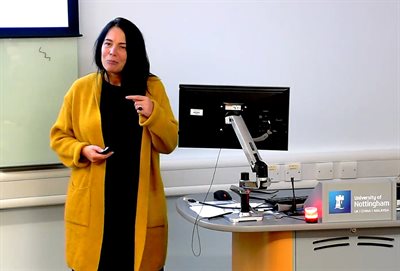 Amanda Hanton introducing Culture Leicestershire, its mission, staff, and multifaceted arts, cultural, and heritage projects.
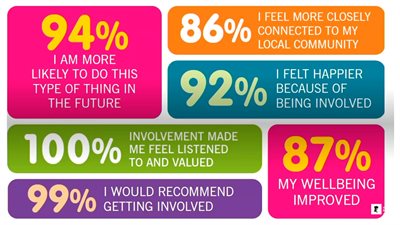
Figures showcasing the impact and value that Culture Leicestershire's work has generated for individuals, families, local communities, and visitors across the county and beyond.
Following the introduction of the placement, Amanda Hanton (Cultural Participation Team Manager, LCC) introduced Culture Leicestershire (CuL) as the unit responsible for administering and managing LCC’s Library, Collections and Learning, Heritage, and Cultural Participation services. Citing CuL’s mission as ‘creating space to spark imagination, celebrate communities, and enhance wellbeing’, Amanda explained that CuL’s remit is to deliver a diverse, inclusive, accessible, and engaging cultural offer with a focus on health and wellbeing, building great communities, improving opportunities, and helping to build a strong local economy. For example, the Library service aims to provide family-friendly spaces to encourage all children to fulfil their potential. The Library service currently supports a network of 34 Community Managed Libraries (CMLs) — the majority of which are entirely run by volunteers. Collectively, CMLs provide nearly 600 hours of access to library venues per week. Where the Collections and Learning Services (CLS) provide learning opportunities for young people across all key stages — giving them access to inspiring collections and supporting all learning needs and abilities, the Heritage and Museum Collections services put together several programmes and events to inspire creativity, encourage research, and develop skills needed within the creative economy and beyond for people of all ages.
My Books, My Story (MBMS) Project
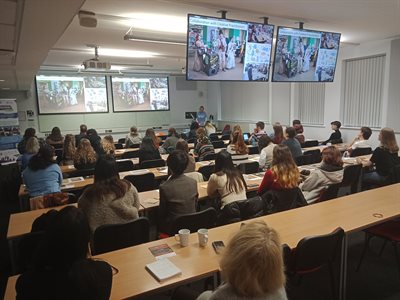 Jemma Atkin-Barrett talks about the My Books, My Story (MBMS) project which involved reading and artistic work by and with children in care.
To give students in attendance a flavour of some of CuL’s programmes and projects — and how they enrich people’s lives across Leicestershire and beyond, several fascinating projects and events were presented by LCC staff.
For instance, Jemma Atkin-Barrett (Community Participation Worker) spoke about My Books, My Story (MBMS). Utilising the arts and culture to enhance emotional wellbeing and to cultivate the habit of reading for pleasure, Jemma explained that MBMS targeted children in care across Leicestershire. Students heard that the 50 children that participated in MBMS responded to the challenge of choosing a book that had had an impact on them and creating a piece of art that expressed the nature of that impact. The importance of MBMS, Jemma noted, was three-fold:
- to encourage children in care to explore personal interests in the arts and literature;
- to highlight the value of the cultural assets offered by Leicestershire County Council (LCC); and
- to promote reading as a tool for cognitive growth and well-being, especially when considered in the context of growing evidence that suggests that engagement with culture fosters good health.
MBMS, Jemma noted further, was delivered in creative workshops held in libraries with professional artists who worked closely with different teams within LCC. MBMS activities were also promoted via pop-up exhibitions across Leicestershire, and a virtual exhibition. In terms of the overall impact and legacy of MBMS, Jemma commented that the project not only increased confidence and cultural engagement among children in care while enhancing the visibility of their voices through artworks and virtual exhibitions, but it also attracted recognition and awards which is testament to the significance of this distinctive work.
Revealing Villiers: The Darling of the Stuart Court
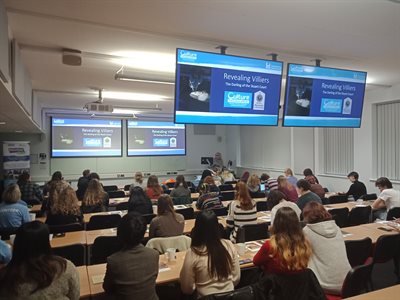 Alison Clague talks about the Revealing Villiers project — charting its beginnings right through to ongoing work.
Revealing Villiers: The Darling of the Stuart Court was the next project introduced by Alison Clague (Senior Curator). Alison recounted how George Villiers, 1st Duke of Buckingham, was one of the most famous figures of early 17th century Europe.
Born at Brooksby Hall in Leicestershire, Villiers became the 'favourite' of King James I — triggering intense speculation as to the nature of his relationship with King James I. Students heard that historical evidence details an intense closeness between the two men in a way that might be described as 'queer' today.
Alison talked about the fascinating process of restoring a valuable portrait of Villiers and undertaking research to identify LGBTQ+ connections in Leicestershire Museum Collections with a view to potentially interpreting them in new ways with new audiences.
LCC undertook this work in close collaboration with Jon Sleigh — an Arts Educator, Learning Officer, and Learning Curator who also co-curated the exhibition that emerged from this work.
The exhibition is titled George Villiers – Darling of the Stuart Court Revealed and is currently on display at Melton Carnegie Museum until the end of June 2025.
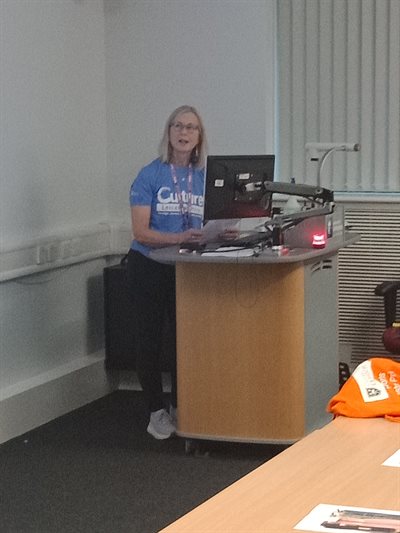 Esther Shaw discussing how the placement will support the Revealing Villiers project through photogrammetry, research, and interpretation among other things.
It is at this point that Esther Shaw (Community Participation Worker) took the floor and discussed how the Curating, Researching, Digitising and Exhibiting Leicestershire Museum Collections in Co-production placement would contribute to, and support, LCC’s work to identify LGBTQ+ connections and links in Leicestershire Museum Collections and offer new and alternative interpretations of them in ways that give voice to multi-vocal accounts and perspectives not represented in collections and mainstream discourses.
To this end, LCC has invited a range of local community groups to respond to George Villiers – Darling of the Stuart Court Revealed exhibition. The idea, Esther explained, is for community responses — drawing on the support of a creative practitioner — to culminate in the creation of new portraits which will serve as a further component of the exhibition.
The portraits could be of celebrities, local people, or self-portraits exploring themes on and around power, wealth, race, class, identity, and sexuality. Students heard that the Villers exhibition will also feature an online version.
This work will involve digital engagement with diverse audiences who cannot access Leicestershire Museum Collections due to several barriers. This is where placement students’ photogrammetry work, research on co-curated objects and beyond, and responses to the objects will be showcased.
Esther highlighted how artefacts and objects in Leicestershire Museum Collections — such as those relating to law enforcement, power and privilege, specimens of different kinds, and articles of clothing — can generate personal and collective conversations and discussions around which stories get told and which ones do not, and who gets to tell those stories and who does not.
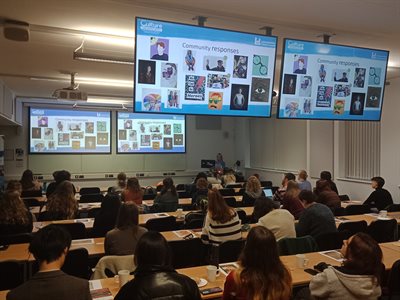 Esther Shaw explaining what multiple and diverse responses to the George Villiers – Darling of the Stuart Court Revealed exhibition are shaping up to become.
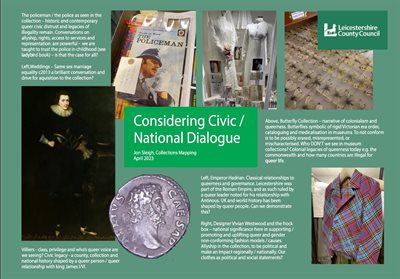 A selection of objects in Leicestershire Museum Collections identified by Jon Sleigh as holding potential to spark conversations and discussion on and around hidden and/or erased LGBTQIA+ (hi)stories. The objects range from law enforcement paraphernalia and acts to power and privilege to specimens to fashion wear.
The Value of Volunteering in the Heritage Sector and at LCC Cultural and Museum Sites
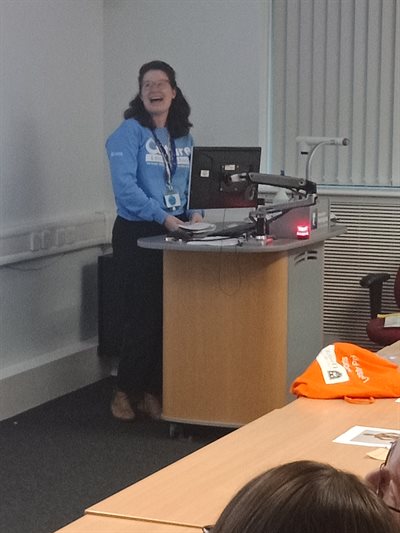 Pippa Vidal Davies explaining the value of volunteering in the heritage sector and being a Culture Leicestershire volunteer.
Pippa Vidal Davies (Volunteering Manager) then spoke about the value of volunteering in the museum and heritage sector in general, and within CuL services in particular. Pippa noted that CuL volunteering roles extend beyond LCC’s museum sites into libraries, collections, and community hubs. Such roles range from community curation and outreach to shared reading groups and the home library service to digital engagement opportunities for people of all ages.
Among other roles, she outlined who the typical CuL volunteer is and what they do:
- those that garden to create an experience for the senses;
- those that do research to support the creation of temporary exhibitions; and
- those that offer language interpretation during guided tours. What all these volunteers have in common is their enthusiasm and passion for helping to bring history to life and to enhance the visitor and/or user experience.
Pippa then posed a stimulating question — asking how many volunteering hours in total students thought might have been given by CuL’s volunteers in 2024. The figures provided ranged from 1,000 to 10,000 hours. The answer was astonishing: 15,106 hours were given by CuL’s volunteers between January and October 2024.
Pippa spoke further about the benefits of becoming a CuL volunteer via this placement:
- being involved in exciting arts, cultural, and heritage projects;
- feeling inspired through connecting with others, (3) gaining more knowledge — including a wide range of transferable and/or soft skills;
- enhancing own creativity; and
- engaging with new ideas and ways of thinking and seeing among many other things.
As the placement required students to apply through the CuL online volunteering system, Pippa explained how this worked and reassured students that there would be support for those who felt they needed it.
Photogrammetry and Other Techniques of 3D Digital Capture
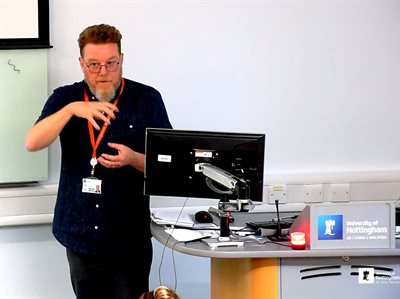 Matt Davies introduces the DTH and its offerings to Faculty of Arts students and staff and explains what photogrammetry training and other 3D digital capture techniques in the DTH will involve — including associated timelines and activities.
Pippa’s talk was followed by a presentation by Matt Davies (Manager, the Digital Transformations Hub, DTH). Matt described the DTH as a space open to students and staff within the Faculty of Arts who want to use a range of digital equipment, software, and support either for their studies or research or digital-related projects. DTH staff, Postgraduate Research Associates, student volunteers, and other partners (internal and external) work together on a range of digital projects.
This placement would be among those digital projects this academic year. Matt discussed an ongoing project with the University of Nottingham Museum that is using photogrammetry in a way similar to how placement students would be working.
Explaining that photogrammetry is one of several methods for producing 3D digital models of objects, this particular method involves placing the objects on a turntable that is synchronised with a Digital Single-Lens Reflex (DSLR) camera on a tripod which captures images as the objects turn.
Proceeding this way, Matt explained further, not only removes the step of walking around objects and photographing them, as is commonly done, but also provides a photography studio-like environment that allows full control over lighting and camera settings providing better quality images.
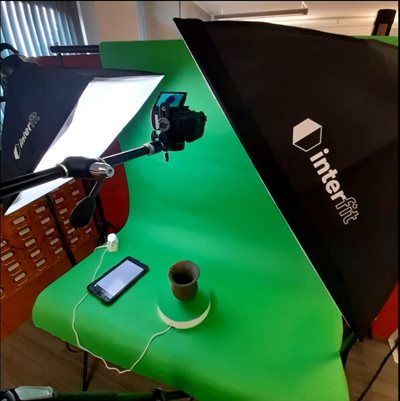
A ceramic object from the University of Nottingham Museum undergoing 3D digital capture in the DTH using photogrammetry.
Where photogrammetry may not be best suited for digitisation, students would have the opportunity to work with the new 3D laser scanners instead located in the Archaeology Labs in the Department of Classics and Archaeology. Students would be trained and supervised by Archaeology Labs Technician — Dr Susie Sherwin.
By the end of the placement, Matt remarked, students will not only have learnt key photography skills and valuable 3D digital capture competencies but also have been exposed to different ways of being creative and thinking ‘outside the box’ when digitally capturing and handling objects that may pose different kinds of challenges during the digitisation process.
This, Matt remarked further, is particularly the case with ancient, fragile archive and museum objects. Matt explained that over 100 digital photographs are typically captured of each object, which is then run through a software called Agisoft Metashape which uses the camera's EXIF information to position where the photographs are in 3D space.
Students heard that they would then upload their 3D models to the popular 3D platform Sketchfab, and annotate them with research information and other appropriate commentary.
Reflecting on, Recording, and Evidencing Placement Experiences
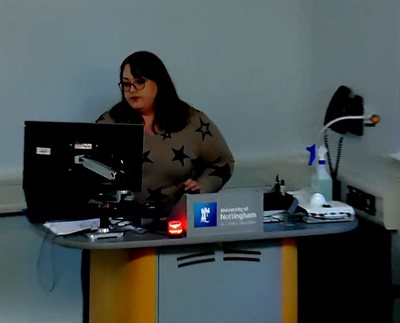 Hayley Revill discussing the bespoke support that her team provides Faculty of Arts students undertaking placements.
Matt’s presentation was followed by a comfort break after which Hayley Revill (Faculty of Arts Placements Manager) spoke about the support available to students before, during, and after the placement. Hayley centred her talk on three main aspects:
- the importance of reflecting on an ongoing basis;
- the significance of recording and/or documenting, and
- the value of internalising the STAR technique which is short for Situation, Task, Action, and Result.
Hayley impressed upon students to undertake a skills audit. She encouraged students to complete a skills audit at the start of the placement, and then at the end. Doing so would enable students to take stock of their intellectual and professional development — including identifying areas for iterative improvement.
Hayley remarked that this course of action is part and parcel of demonstrating professionalism — always remembering that (1) students’ conduct reflects the University and themselves, (2) it is important how students are remembered by the placement host, and (3) how students respond to instances where things do not work out as envisioned is extremely important.
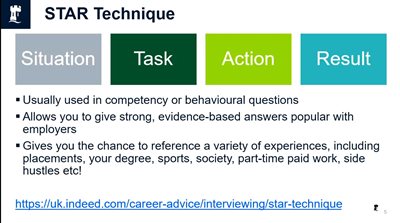
Students were encouraged to internalise the STAR technique as a valuable tool for preparing effectively for future graduate jobs.
Hayley further encouraged students to keep a log of their placement experiences. She advised documenting these either in a blog, or journal, or spreadsheet.
She added that recording how students felt during those experiences is as important as the events themselves.
She noted that networking is a critical part of the placement experience. That networking allows students to meet and connect with industry professionals and other people that they would like to keep in touch with.
Beyond that, Hayley observed, effective networking requires ensuring that students build a professional presence for themselves via which they can be reached but also reach out to others.
Creating a professional profile on LinkedIn was given as a good step to start.
The Value of Internalising the STAR Technique
Keeping in touch with industry professionals can be valuable, especially when students need an appropriate person to write them a letter of reference for a job application in future. Hayley highlighted that reflecting and recording placement experiences meticulously and regularly can help students to plan their responses effectively to questions asked in a job interview setting using the STAR technique mentioned above. Students can also use this technique to showcase newly gained skills and placement experiences on their CVs or application forms for other placement opportunities. In the context of this placement, students could utilise the STAR technique as follows:
- Situation — describing the situation students had to deal with;
- Task — describing the task students were given to do;
- Action — describing the action students took; and
- Result — describing what happened as a result of the action students took, and what students learnt from the experience.
 Debbie Till talking about the comprehensive support that her team provides to students — including some of the central comptencies that students should active look to develop during the placement and beyond.
The last presentation by Deborah Till (Senior Careers Advisor, Careers and Employability Service) followed in the same vein as Hayley’s.
Deborah introduced the impressive and wide-ranging support offered to students by her team — including how to:
- stand out with work experience;
- get part-time work;
- prepare for job interviews;
- write a personal statement;
- get the most from a careers event;
- decide if further study is right for one;
- create an effective LinkedIn profile; and
- write CVs and applications.
Developing Essential Skills and Competencies Coveted by Employers
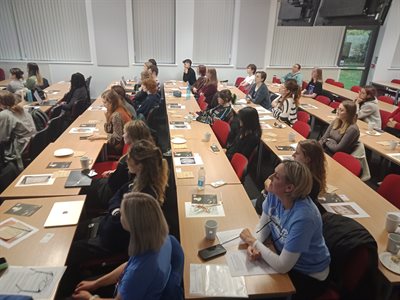 Attendees listening intently.
Deborah helpfully spoke to some of the essential skills and competencies that employers look for in job applicants — and many of which students will have the opportunity to develop and hone during this placement:
- working in collaboration;
- adaptability;
- communicating online and in person;
- IT skills;
- self-motivation;
- career management;
- relationship-building;
- resilience; and
- initiative.
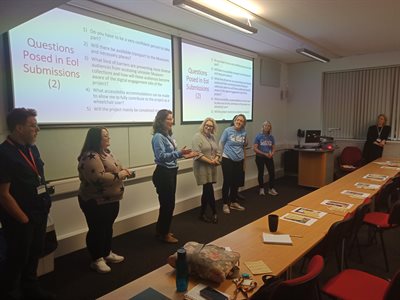 Members of the Placement Team fielding questions from students following all the presentations.
Deborah commented interestingly that students typically have more of these skills and competencies than they realise. She noted that her team supports students to understand, develop, reflect on, and evidence these skills and competencies to employers in an accessible and persuasive way.
For students looking to develop their professional profile beyond this placement, Deborah pointed them to the following exclusive opportunities across UoN:
- Nottingham Internship Scheme;
- Nottingham Consultancy Challenge;
- Digital Marketing Academy; and
- Nottingham Advantage Award.
Following Deborah’s presentation, students made use of the opportunity to ask questions, speak to the Placement Team, and to take part in a guided tour of the DTH. All in all, it was an excellent afternoon for students and the Placement Team alike.