By Daniel H. Mutibwa, Christy Hsu, Bryony Reeves and Kate Ratcliff
The Leicestershire Museum Collections (LMC) Planning Day at the Eastern Annexe, County Hall, Glenfield
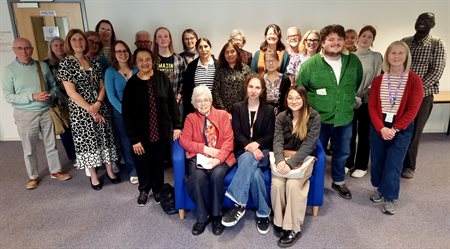 LCC staff and local community representatives in attendance at the Collections Day Planning Event at the Eastern Annexe, County Hall, Glenfield.
On Thursday 22 May 2025, Culture Leicestershire (CuL) — which comprises Heritage, Libraries, Collections, Learning and Participation Services at Leicestershire County Council (LCC) — invited representatives from the diverse publics it serves across Leicestershire and beyond to feed into its Collections Development Policy which was due for a refresh after five years.
The event took place at the Eastern Annexe, County Hall, Glenfield to which Christy Hsu, Bryony Reeves, Kate Ratcliff and Daniel H. Mutibwa were invited to represent the Curating, Researching, Digitising and Exhibiting (CRDE) Leicestershire Museum Collections in Co-production Placement based at the University of Nottingham.
To enable attendees to contribute meaningfully and to make the most of the event, the day was structured as outlined below.
The purpose of the Collections Development Policy — henceforth referred to as The Policy — was explained before a detailed overview of the Leicestershire Museum Collections (LMC) was provided. This was followed by a showcase of themes and stories — an approach to thinking about how collections can be used to tell stories before the first comfort break was held. Thereafter, attendees were invited to participate in the first set of workshop group discussions in which they were asked to think about the kinds of objects they could use to represent their childhoods, and to share the key themes emerging from discussion in a plenary session. Lunch was then served followed by a tour of the massive collections stored at the Eastern Annexe facility. Attendees then heard about how LMC’s future priorities were informed, in part, by learning from past projects followed by the second comfort break. Thereafter, the second set of workshop group discussions organised around selected themes were held. Key points of discussion were again shared in a plenary session before the event concluded with a group photo shoot.
Background and Context to the Leicestershire Museum Collections (LMC)
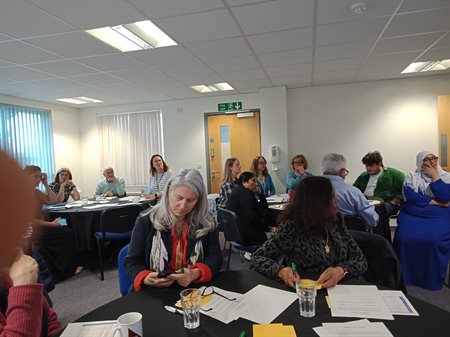 A section of the attendees listening to introductory remarks by Philip Warren (Collections and Learning Manager).
Philip Warren (Collections and Learning Manager) explained the purpose of The Policy — noting that it sets out what LMC collects and why and how LMC manages the development of the collections in its care responsibly. Like all LCC policies, The Policy specifies the priorities of the wider Council throughout its lifetime, typically around five years.
Again, like all LCC policies, The Policy goes through various processes before it is formalised. These include going through the Council’s Scrutiny and Oversight Group and the Council’s Cabinet before final approval is given.
While these processes and procedures may take time, they are important because having a formal policy is not only good practice, but also a requirement for being an Accredited Museum — which the museums and heritage sites under LCC’s stewardship are.
For LMC, however, good practice goes beyond processes, procedures and infrastructure. LMC is keen to get people’s ideas about what it should be collecting for the future.
This is important for two reasons. First, it clearly aligns with current ideas and thinking on and around wider trends surrounding the future of cultural devolution across local, regional and national levels in places. Second — and building on the first point, empowering diverse publics and local communities to shape their cultural landscape places them at the heart of cultural decision-making, thereby enabling culture to thrive meaningfully and sustainably in places as has been persuasively argued by Anne Torreggiani and Patrick Towell (2024) and Culture Commons (2024).
Leicestershire Museum Collections: The Team and Sites
Alison Clague (Senior Curator) and Caroline Lockwood (Collections and Conservation Manager) then previewed what LMC’s collections consist of and how they work before providing a brief overview of the team that looks after the collections and where team members work and/or are based. The team comprises:
- Claire Wells-Cole (Collections Documentation Officer);
- David Johnstone (Technical Officer);
- Dan Poxon (Technical Assistant);
- Helen Sharp (Curator, Archaeology);
- Karenna Fry (Conservation Officer);
- Lynsey Swift (Curatorial Assistant); and
- Sarah Nicol, (Curator, Engaging Collections).
These team members work at different sites across the county of Leicestershire including:
- Collections Resources Centre, Barrow upon Soar;
- Eastern Annexe, County Hall, Glenfield;
- Snibston, Coalville — Main Store, Boiler House, Locomotive Shed, Sheepy Magna Wheelwright’s, Mining Library, Kane Close Compound, and Wood Shop;
- Unit 1, Coalville;
- Unit 8, Measham;
- Record Office; and
- Heritage sites.
Leicestershire Museum Collections: Acquisition, Care and Management Procedures and Processes
Attendees learnt that the objects under LMC’s stewardship are acquired through different means including by donation. Before acquisition, LMC staff consider (a) the Collecting Policy (i.e., compliance with the criteria for acquiring new objects), (b) the condition of the objects, and (c) the need for the objects. Following acquisition, each object is (a) given a unique number and documented — including details of ownership, (b) photographed, labelled and added to LMC’s electronic catalogue, (c) given a home location based on object type or condition need(s), and (d) packed using archival materials. In some instances, the procedure may vary slightly depending on object type. For example, archaeological collections — understood as collections which relate to archaeological excavations in the county of Leicestershire but also further afield if a connection to Leicestershire is established — typically have their archive repositories generated by county archaeological contractors working within the processes of the planning system. Each archive repository is assessed by LMC staff alongside specialists from outside LCC. LMC sometimes purchases items through the Treasure Act that have been found by members of the public and occasionally accepts donations.
We learnt about how collections are cared for to ensure that they remained well-maintained and in good condition during storage. This involves:
- Housekeeping;
- Pest management;
- Environmental monitoring and control;
- Object cleaning;
- Object restoration;
- Conservation treatments;
- Commissioning external conservators (e.g., mould removal on vehicles); and
- Emergency planning.
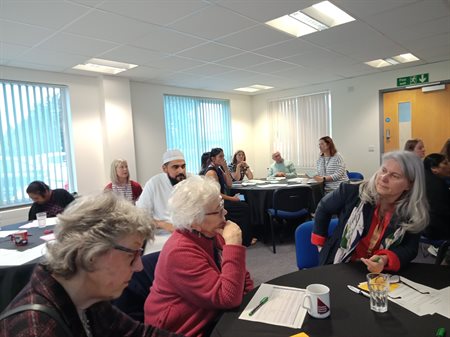 Attendees in view listening to Alison Clague (Senior Curator) and Caroline Lockwood (Collections and Conservation Manager).
We learnt further that effective collections care happens alongside methodical collections management which encompasses how (a) objects are moved from one place to another, (b) object storage is controlled — including the regulation of temperature conditions, (c) object information is handled and processed in compliance with General Data Protection Regulation (GDPR), and (d) objects are loaned out — including the terms and conditions under which this happens.
It was interesting to learn that because of overzealous collecting in the past, LMC staff have been systematically reviewing and slimming down collections — particularly archaeological ones in light of critical structural and practical considerations such as limited storage space among other factors.
It was illuminating to learn about the behind-the-scenes activities that are undertaken before objects are loaned out — if selected to form part of exhibitions and displays of different kinds. The condition of the objects is checked followed by documentation and research. The objects are then cleaned, mounted, and packed for transit.
Objects are typically used by several stakeholders including (a) students in higher and further education, (b) researchers, (c) local community groups, (d) artists, (e) schools via creative learning programmes, and (f) organisations such as other museums and heritage sites across the country.
Leicestershire Museum Collections: Collecting Themes and Related Storytelling
Attendees were then introduced to LMC’s seven collecting themes:
- Natural Life (comprises specimens and information which reflect the landscape, flora and fauna of Leicestershire);
- Archaeology (encompasses objects and records relating to thousands of years of human activity);
- Home and Family Life (reflects domestic life through the ages);o Working Life (documents the breadth of local trades and industries);
- Cultural Life — Costume, Fine Art, Sporting Life (showcases changes in fashion from the 1750s to the present day and artistic portrayals of the changing landscape and places of Leicestershire — including some of its people, their working and social lives, and sporting activities);
- Harborough collection (documents the local history of, and local trades and commerce in, Harborough — including the influence that the town has had on its surrounding area over time); and
- The ‘Reserve’ collection (consists of original historic objects originally collected for use by community groups and schools, and therefore does not necessarily have a direct connection to Leicestershire. It is now used as part of the main LMC).
In what followed, we learnt about how LMC staff use the different collections outlined above to tell stories organised around collecting themes.
Taking the collections as base material, stories are pieced together that reflect
- moments from history;
- people’s different experiences;
- changes over time; and
- local stories that capture lived experiences.
To this end, exhibitions and displays as well as digital media are used to support themed storytelling in its many different facets. Several examples were given for illustration. These are now presented below.
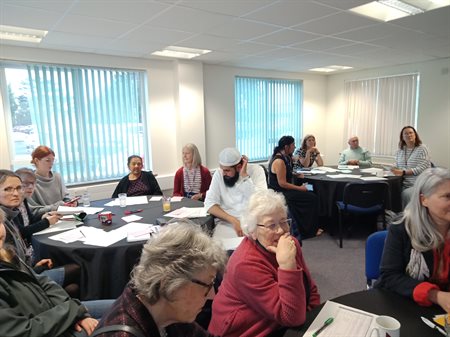 A section of attendees listening intently.
‘Eating In’ was one such example of a theme that drew on selected domestic objects to tell ‘the story of cooking and eating at home’.
To this end, a wide range of selected accessories were showcased to highlight the raft of culinary diversity at given times in the past.
Another fascinating thematic example related to the COVID-19 pandemic. Here, an array of artefacts generated during the pandemic were showcased to convey people’s lived realities as experienced at the time.
Some of these included:
- drawings of clapping hands that expressed strong support for, and solidarity with, the National Health Service (NHS);
- images of the initial ‘Flowflex’ rapid tests that were used to detect COVID-19 infection; and
- photographs taken of people lining up to shop for groceries in supermarkets while observing social distancing.
One of the key points that resonated well here was that museums cannot collect feelings. This is because, it was noted, objects in museum storage are distanced from people’s feelings, emotions, and sentiments. Such objects are detached from the contexts within which they were generated. That said, it was noted further, museum collections can affect how we feel. And to capture how people feel effectively, museums have been increasingly listening to the diverse publics they serve and working with those publics to ensure that their interests and stories are represented and told within museum offerings.
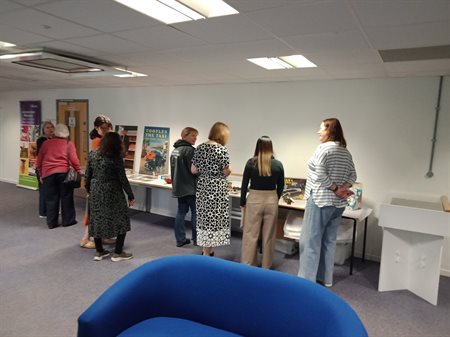 Some attendees interacting with one another during the first comfort break.
Our first comfort break was held at this point followed by the first set of workshop group discussions.
Taking place under the title ‘What’s Your Story: Thinking about Childhood’, these discussions invited attendees to think about, discuss, and write down:
- three things that represented their childhood;
- one object that reminded them the most of their childhood;
- either their favourite toy or a sport they enjoyed playing or an arts activity that they cherished doing or indeed any other hobby they had; and
- any toy or game they wanted as a child. All these were written on Post-it notes and pinned on a board for all attendees to share and reflect upon.
As expected during the plenary session, the objects, activities, and hobbies shared and written up were as diverse and wide-ranging as the cultural backgrounds and generations of the attendees at the event.
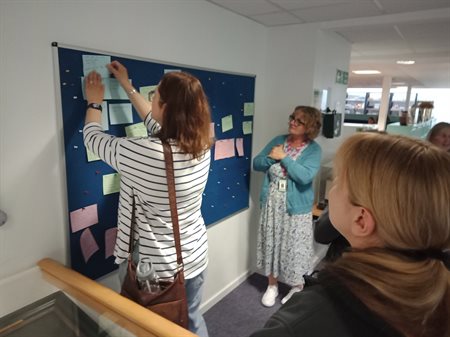 Post-it notes with attendees' responses to the task given being pinned on a board.
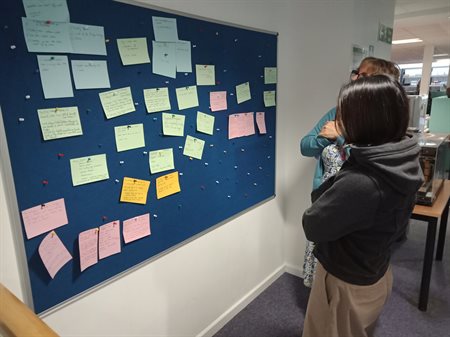 Two attendees pictured reading and reflecting on input shared by fellow attendees in response to the 'What's Your Story' task.
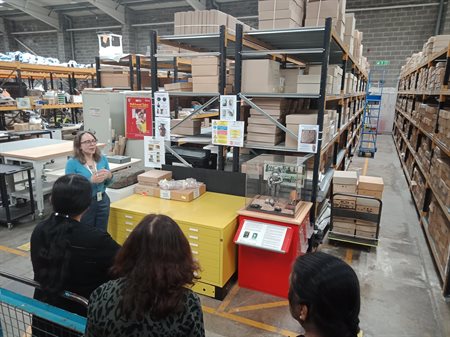
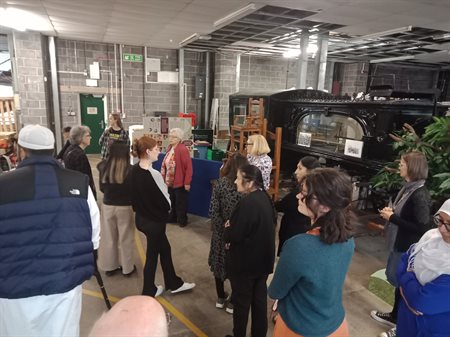
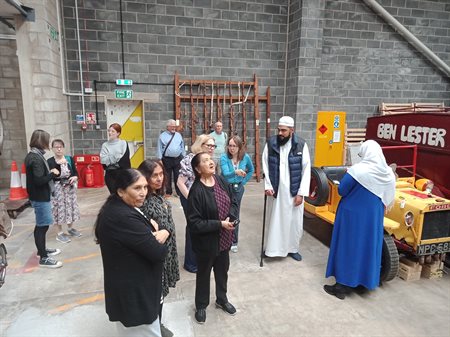
Lunch was served followed by a tour of the diverse and massive collections stored in the Eastern Annexe facility. During the tour,
Alison Clague,
Caroline Lockwood, and
Helen Sharp introduced attendees to the vast collections and, where applicable, highlighted which objects had been used to tell what kinds of stories and where.
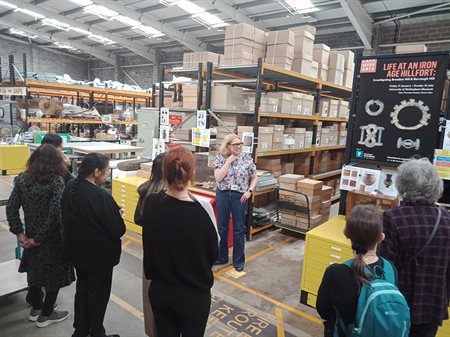 Alison Clague leading a stage of the tour of the collections stored at Eastern Annexe facility.
 Helen Sharp leading a stage of the tour of the collections stored at the Eastern Annexe facility.
 Alison and Caroline Lockwood leading a stage of the tour of the collections stored at Eastern Annexe facility.
 Alison, Caroline and Helen leading a stage of the tour of the collections stored at Eastern Annexe facility.
The presentations that followed revolved around four past projects and how the learning from those projects was going to be leveraged to inform future planning.
Learning from Past Projects and Developing Future Plans
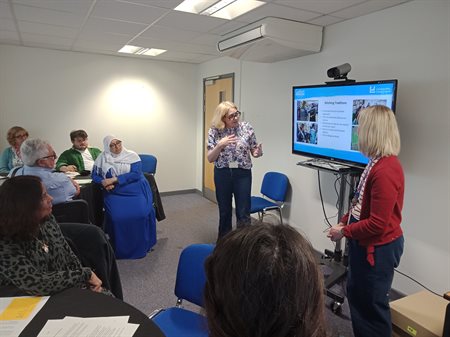 Esther Shaw and Alison Clague discussing the 'Stitching Traditions' project and highlighting the key learning points.
The four projects and the staff who presented them were:
- The Millennium Collection (Philip Warren);
- Stitching Traditions (Esther Shaw and Alison Clague);
- An Archaeology Story (Helen Sharp); and
- Migration Stories (Amanda Hanton and Philip Warren).
We learnt that The Millenium Collection was funded by a grant from the Millennium Commission and the National Lottery.
This funding supported families, community groups, local businesses, faith groups, charities, schools, clubs, societies and organisations to choose and donate an object which they felt was important to them.
This is the last major collecting project that LMC undertook. LMC is revisiting this collection in 2025 with an exhibition at Melton Carnegie Museum.
Stitching Traditions partnered with the Migrant Memory and the Postcolonial Imagination research project at Loughborough University (2017-2022) and the Anand Mangal Ladies Group to explore how wider lived experiences of the Indian diaspora are remembered by people of South Asian heritage in the UK. Taking a co-curation approach, Stitching Traditions featured visits to different LMC facilities by the Anand Mangal Ladies Group to learn about how to:
- use objects to tell stories;
- display and interpret objects; and
- hone existing crafting and stitching skills under the tutelage of a performance textile artist. Alongside new items created, and family objects brought along, by-products included singing and reminiscing — all of which informed a display at Charnwood Museum, Loughborough among other things.
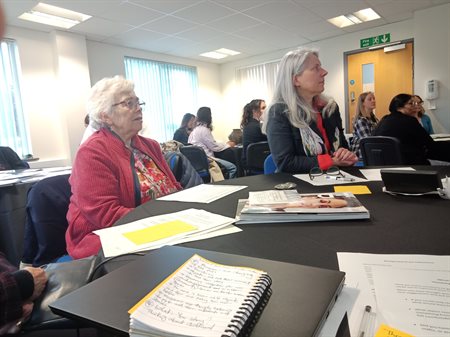 Attendees listening intently.
An Archaeology Story introduced attendees to the artefacts that people leave behind — either through deliberate acts or in the course of their daily lives.
We learnt that humans have migrated to Leicestershire over hundreds of thousands of years — and that the reasons for moving may not always be straightforward just as certain material cultures may not appear as obvious as others.
It was fascinating to learn of the suggestion that the people who initially came to Leicestershire in the 5th and 6th centuries were Anglians — from the Angeln area of northern Germany — who brought with them distinct objects and everyday life practices such as funerary monuments and burial arrangements among other things.
We learnt further that this offers interesting future opportunities for exploring storytelling around migration informed by the archaeological collections, something that is the focus of the Migration Stories project.
In the context of the Migrations Stories project, one such future opportunity could involve investigating stories of actual people via human remains from burial sites through scientific analysis. Another opportunity could involve determining ancestry through studying dental remains to reveal where people grew up and when they moved to Leicestershire to make the county their home. We heard that the Francis Crick Institute based in London — a biomedical discovery institute that researches the biology underlying human health — is working with LCC to analyse the ancient DNA of some of the human remains within LMC.
The rationale behind this is to uncover information about genetic sex, ancestry, disease and familial relationships. This sounded like very exciting times ahead not only for the archaeological collections, but also for CuL’s audience development work. The thinking is that such work will bring the public closer to cultural decision-making processes going forward and support the public to participate in storytelling on the themes that matter to them the most (e.g., ancestry and familial relationships) and doing so on their own terms.
Public Invitation to Co-shape LMC’s Future Collecting Priorities
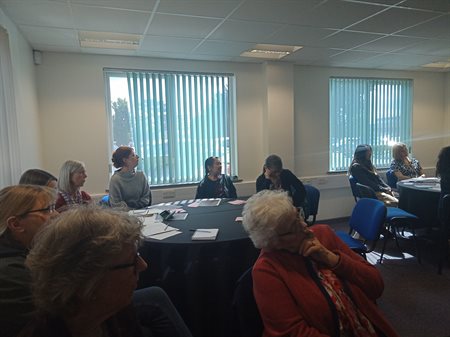 Attendees listening intently.
Before the second set of workshops commenced, some useful background information was provided for important context.
It was explained to attendees that LMC’s last Collections Development Policy (2015-2019) committed to focusing particularly on the following three collecting themes:
- Home and Family Life;
- Cultural Life — Costume, Fine Art, Sporting Life; and
- Working Life.
Three central aspects characterise LMC’s commitment to prioritising collecting across these themes:
- prominently featuring currently under-represented communities, groups, and publics in LMC collections, including LGBTQ+ people, people living with disabilities, and people of Black and Minority Ethnic (BAME) heritage;
- adopting appropriate co-curation and/or community engagement approaches to redressing underrepresentation in LMC collections in ways that the outlined communities, groups, and publics can relate to and identify with; and
- commissioning local artists to co-produce works that record, reflect or comment on specific aspects of daily life in the county of Leicestershire.
With this useful background and contextual information in mind, attendees were split into workshop groups and asked to discuss the following overarching questions in relation to one of the three collecting priority themes named above:
- What does Leicestershire look like today?
- Think about Migration Stories — Who could be involved?
- What would people need to get involved?
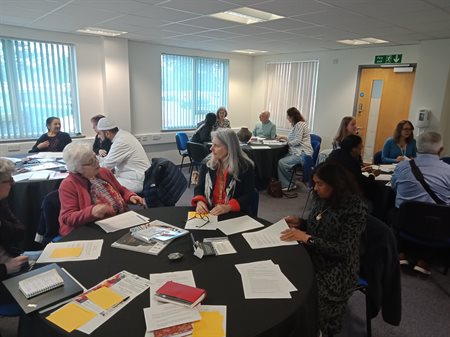 Attendees exchanging ideas during workshop group discussion.
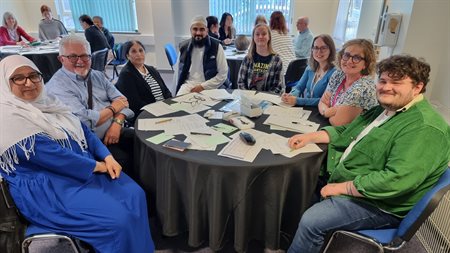 Attendees posing for a photograph during workshop group discussion.
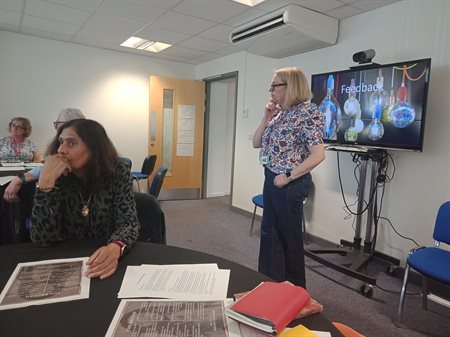 Alison leading the plenary session during which attendees fed back their contributions.
Contributions from the workshop group discussions were fed back during the plenary session. Attendee input was as rich and intriguing as it was wide-ranging and constructive. There is no space here to cover that input. Doing that input justice would require a separate blog post.
That said, one common and important theme was that telling appropriate and comprehensive stories about what Leicestershire looks like today in relation to family, cultural, and working lives would require involvement from a wide range of people:
- people currently living and working in the county;
- those that have lived and worked in the county but have emigrated elsewhere over time; and
- those that have neither lived nor worked in the county but have important connections and relations to Leicestershire and its surroundings.
In their different ways, all these people would have critical experiences and views to contribute to storytelling from their variously situated positions.
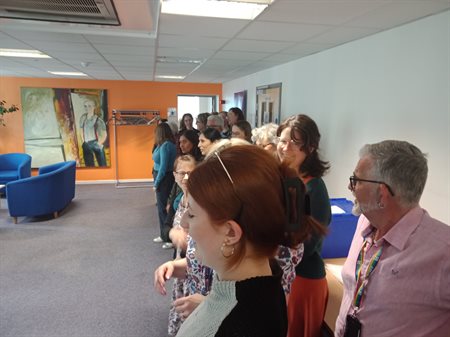 Attendees preparing for a group photo shoot at the end of what was a lively and productive event.
CuL and LMC staff committed to sharing an update on progress at an appropriate time.
Franne Wills — Head of CuL — concluded the event — reiterating the importance of involving the public in cultural decision-making at LCC to ensure that culture thrived across the county and that people (residents and visitors alike) benefitted from it in equitable ways.
All in all, this was a richly informative and productive event that clearly demonstrated LCC’s approach to empowering diverse publics and local communities to co-shape and co-manage creative and heritage activity in Leicestershire.
Putting those publics and communities at the centre of cultural decision-making in alignment with the broader, national trend of cultural devolution promises to provide people in Leicestershire with a much greater sense of belonging, identity, local pride, local agency, and opportunities of different kinds.