By Bryony Reeves
In this blog post, Bryony Reeves introduces ‘Care Bears’ and discusses the pivotal role they can play in enabling people of a young age and those in the LGBTQA+ community to engage meaningfully and safely with perceived, contentious issues on and around identity, gender, sexuality, self-awareness, self-expression, and self-representation in this day and age.
This research was motivated by the collection of Care Bears that Bryony photographed and digitised using 3D digitisation techniques in the context of the Curating, Researching, Digitising and Exhibiting Leicestershire Museum Collections Placement.
In addition to offering students distinctive professional development competencies and skills coveted by graduate job employers, the Placement is also providing students with first-hand experience of working on an exciting and real-world project at the intersection of the heritage sector, the digital media industries, and local government context.
 Bryony Reeves is a postgraduate student pursuing an MA degree in Classics. Bryony expects to graduate in 2025.
- My name is Bryony Reeves, a Masters student studying Classics.
- I graduated from the University of Nottingham in 2024, with a first-class degree in Ancient history.
- The focus of my undergraduate dissertation was on underrepresented women in the ancient world, specifically women of the East. This is a line of enquiry I am continuing to pursue for my MA dissertation.
- Volunteering on this project has already given me the passion and inspiration of those within the culture sphere, something that I wish to share.
- After my studies, I aspire to become a curator, where I will apply the skills, I have learnt in both my volunteer role and degree.
- I am a proactive, positive individual with experience in hospitality with more than five years of frontline customer service experience.
- I am not afraid of hard work or taking the initiative - or cracking the occasional joke!
Seeing a Care bear evokes a strong sense of nostalgia for many of us.
Known for their rainbow of colours, to their different personalities which are depicted as an image on their belly, these bears have been adorning bedrooms since 1981 (Anonymous, 2016).
Care bears have been an icon of the toy industry with high sales around the globe as well as numerous movies, TV shows, comics and video games (Villarreal, 2021).
Yet they started out as ten original characters for a greetings card created for American Greetings (Anonymous, 2016).
By 1983 in collaboration with Kenner [a Hasbro subsidiary], the characters became toys, and the long-term success of the Care bears was born.
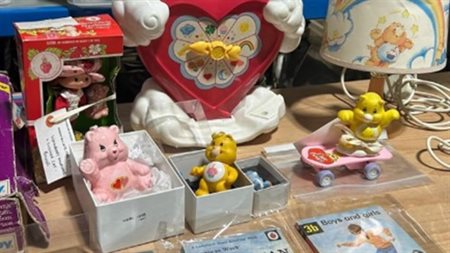 Care Bear items in Leicestershire Museum Collections. Image taken by Author.
But why were they so popular?
Being related to teddy bears gives these colourful creatures an essence of the classic children's toy that at its conception had ‘been around for 81 years [123 years today]’ (Carson, 1983, n.p).
Teddy bears for many of us were a toy given as a child, a toy that we grew up with, loved and cared for deeply. A quote in a 1983 news article by Dr Nathan Wiseboard states that people have a passion for teddy bears because 'they represent security and safety' (Carson, 1983, n.p).
Because of this security and love for teddy bears, they took up forty percent of the toy market (Smitek, 2017), something that Kenner wanted to capitalise on.
According to Dave Polter (Bullard, 2016, n.p), an illustrator for American Greetings and helped design the bears, had stated that ‘bears are the ultimate anthropomorphic character’ (Bullard, 2016, n.p) and you cannot help but agree with him.
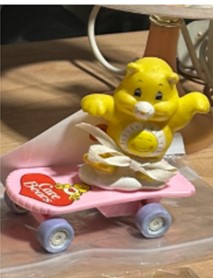 Funshine Bear figurine on a skateboard. Image taken by Author
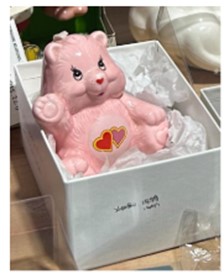
Love-A-Lot Bear figurine. Image taken by Author
The Start of the Care Bears
Illustrated by Elena Kucharik and Dave Polter (Bullard, 2016), Care bears were ‘an instant hit with the marketing firms’ (Bullard, 2016) and slowly dominated the scene. In an interview with the co-presidents of the characters Jack Chojnacki and Ralph Shaffer, they explained how these lovable bears were created. Shaffer explained how ‘something in my head just took those graphics and flopped them over on the bear’s stomach.’ (Smitek, 2017, n.p) and these characters were born.
![Toy Bear Figure [Birthday Bear] Patent](/CLAS/Images-Multimedia/Visioning-and-Creative-and-Cultural-County/VCCC-Project-Images/Blog-Posts/Care-Bears/6a.-Shaffer-et-al-Patent-1985.jpg)
Credit: Shaffer R. and Davidson W., (1985) Toy Bear Figure [Birthday Bear], United States Patent, US-D277122-S. https://tinyurl.com/4y6j2fwa [Accessed 25/03/2025]
![Toy Bear Figure [Funshine Bear] Patent](/CLAS/Images-Multimedia/Visioning-and-Creative-and-Cultural-County/VCCC-Project-Images/Blog-Posts/Care-Bears/6b.-Shaffer-et-al-Patent-1986.jpg) Credit: Shaffer R. and Davidson W., (1986) Toy Bear Figure [Funshine Bear], United States Patent, US-D282948-S. https://tinyurl.com/4ju5ny55 [Accessed 25/03/2025]
Credit: Shaffer R. and Davidson W., (1986) Toy Bear Figure [Funshine Bear], United States Patent, US-D282948-S. https://tinyurl.com/4ju5ny55 [Accessed 25/03/2025]
The patents for these bears, filed in 1982, 1983 and 1984 [for our bears] all show the bears in their original design: the patents were granted for ‘the application of putting graphics on a bear’s stomach. Nobody had ever done that before.’ (Smitek, 2017, n.p). The simple but revolutionary idea for these bears had sparked something for the toy industry, and would never be the same again.
![Toy Bear Figure [Love-A-Lot]](/CLAS/Images-Multimedia/Visioning-and-Creative-and-Cultural-County/VCCC-Project-Images/Blog-Posts/Care-Bears/6c.-Shaffer-et-al-Patent-1986..jpg) Credit: Shaffer R. and Davidson W., (1986) Toy Bear Figure [Love-A-Lot], United States Patent, US-D282946-S. https://tinyurl.com/y4fuc5wk [Accessed 25/03/2025]
Credit: Shaffer R. and Davidson W., (1986) Toy Bear Figure [Love-A-Lot], United States Patent, US-D282946-S. https://tinyurl.com/y4fuc5wk [Accessed 25/03/2025]
![Toy Bear Figure [Baby Tugs Bear] Patent](/CLAS/Images-Multimedia/Visioning-and-Creative-and-Cultural-County/VCCC-Project-Images/Blog-Posts/Care-Bears/6d.-Shaffer-et-al-Patent-1986.jpg) Credit: Shaffer R. and Davidson W., (1986) Toy Bear Figure [Baby Tugs Bear], United States Patent, US-D283526-S. https://tinyurl.com/3apvex3z [Accessed 25/03/2025]
Credit: Shaffer R. and Davidson W., (1986) Toy Bear Figure [Baby Tugs Bear], United States Patent, US-D283526-S. https://tinyurl.com/3apvex3z [Accessed 25/03/2025]
Looking at these patents shows that the idea originally was clearly perfect, with minimal changes in design over the years. The recognisable design features the tuft of hair as well as the icon in the centre of the belly! ‘It’s really important to note the incredible detail’ (Smitek, 2017, n.p) especially to see the noses and paw pads for their feet as little hearts.
These bears had become extremely popular, ‘in the first year, they sold $40 million worth of greeting cards’ (Smitek, 2017, n.p). Adorable bears ‘graced greeting cards as far as the eye could see’ (Bullard, 2016, n.p) and were later taken by Kenner to create the ‘first in a line of very successful bears based on the Care Bears’ (Anonymous, 2016, n.p).
Kenner had made the right decision, within the first 5 years 'merchandise racked up $2 billion in retail sales’ (Smitek, 2017, n.p).
After this success of the greeting’s cards and the toys ‘four different animation studios would go on to produce television specials, three silver screen movies and two different Saturday morning cartoon shows (Bullard, 2016), and we are still seeing these cute and lovable bears on screens to this day.
Their first animated appearance was in the TV show The Care Bears in the Land without Feelings (1983), where the bears end up in this land and have to save children who have been turned into careless monsters from the evil ruler Professor Cold Heart.
A hit with the children of the 80’s, a film was created. The first movie, The Care Bears Movie (1985), featured the 10 original bears (see the image capturing the Care Bear Index from 2011 below) as well as some of their cousins who again must save some children from evil.
This film was a massive success, making in its opening $3,725,001 (Box Office Mojo, Unknown), and overall, $22,934,622 (Box Office Mojo, Unknown)!
The ‘little creature that represented human emotions. It helped parents talk to their kids about their emotions, and friendship and love,’ (Smitek, 2017, n.p) something that in a growing world of hate and prejudice is so important, and the media surrounding the bears only helped further their message of care.
Ralph Shaffer, who came up with the design of the bears, joked; ‘When The Care Bears Movie came out, Disney people were talking about how they were being beaten by people who were really new to this game’ (Smitek, 2017, n.p).
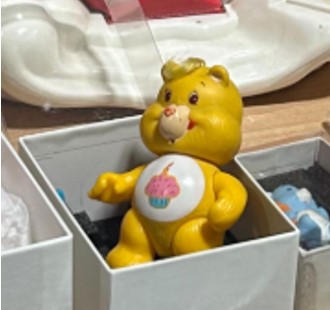 Birthday Bear posable figurine. Image taken by Author.
Collections
Within the collection at the Leicestershire Museum Collections, there are four bears: Birthday Bear, Funshine bear, True Love Bear, and Baby Tugs bear!
These bears within the collection are plastic figurines, both Birthday bear and Funshine bear have movable parts which make the toy more exciting. Each of these bears symbolise the true ethos of the Care Bears - children’s toys full of fun, love and (it's in the name) care!
The Birthday Bear depicted above, a yellow bear with a cupcake on its tummy, is an early 1980s toy and was a part of a collection in 1983 with other Care Bears (@guardiancardshop, 2025).
These items were possible and included an object that was held in the right hand of the bear. In this instance, the Birthday Bear has a flag (see image below) reading 'Happy Birthday' on both sides. For this set of toys ‘each Care Bear came with one accessory which they could hold, although they were also sold with no accessories.’ (Anonymous, 2016, n.p). On the box that came with this poseable bear, which is unfortunately not within the collection at Leicester, we are able to see that these bears were important for children's emotions.
Writing that says, '[t]hey are always keeping an eye on things and whenever you want to share your feelings with others, they come down to help!' (Kenner, 1982, n.p) and '[o]ne look at their tummies helps you understand why they're so good at helping you express your feelings!' (Kenner, 1982, n.p) are on the box. This was done to help emphasise to children that this toy has value, and so do you.
For a young child, or even an adult, going through a tough time with their identity and expression, having an outlet that validates how you feel is incredibly important. Young queer individuals and communities need to feel this to truly be themselves. The Care bears help to understand emotions, and express them in a positive way, which would, and has, supported people in the LGBTQA+ community.
Birthday bear in media was one character that was voiced ambiguously (Villarreal, 2021) representing to young children that there are no gender norms, you can be authentically yourself regardless of your sex. While it is the case that ‘lots of animated cartoons have their male characters voiced by women’ (Villarreal, 2021, n.p), it also reinforces the idea that expression and identity are genderless, to be who you are is enough.
This is a strong idea that holds meaning in the LGBTQA+ community, for many they were not allowed or even discouraged to be themselves which has harmed them, but this prejudice has blossomed into a supportive, uplifting and caring community, one that is reflected in the Care Bears.
Funshine Bear (our yellow bear with a smiling sun on its belly), rides a pink skateboard, surfing a cloud in a representation of his spirit. As described on the Care Bears website he is ‘Blissfully sure everything’ll be fine’ (Care Bears ™, 2025, n.p) and is always trying to be cool. The skateboard was also available in blue (@9257alder, 2025), however it is undetermined which colour was available first.
This bear was ‘originally conceived as a female character but is now listed as male’ (Villarreal, 2021, n.p), and is considered to be transgender or gender fluid. In early versions of Funshine, they were presented as female (Villarreal, 2021), then after 2004 they were depicted as male (Bullard, 2016).
His ‘gender seems to have shifted from female to male over his film and TV appearances’ (Villarreal, 2021, n.p), and was mostly ‘ambiguous about gender’ (Bullard, 2016, n.p).
Clearly Funshine was an early (possible accidental) positive representation of transgender individuals.
In a world where the topic of trans people in the media is a broadly negative one (characters who go through immense pain or are widely disliked just for being trans), it is nice to have a character like Funshine.
In no instance is his identity made to feel abnormal or different, he just is who he is, a lovable and fun ray of sunshine.
Funshine is a symbol for the LGBTQA+ community; having a character like Funshine who transitions, with a positive characterisation, sends a strong message to those going through a similar change.
You are loved and cared for.
Bears like True Love Bear (see the Love-A-Lot Bear Figure above), the pink bear with hearts, and others, disrupt gender norms through their expression of their true selves but are accepted regardless (Bullard, 2016). This enables children and adults to realise that regardless of their identity, sexuality or self-expression - they are loved.
This message of love and acceptance is integral to those not only within the LGBTQA+ community but to all.
Baby Tubs Bear (see above), the blue small bear with a star in a diaper, is a minifigure and holds a bucket and spade, instead of being at the beach, he shovels clouds into his bucket. He has a twin sister Baby Hugs Bear, and they are rarely apart!
These two twins are lovable and connect to the youthful innocence of the Care Bears. It is clear that ‘the original Care Bears cartoons normalized gender-neutrality before that became a popular thing’ (Bullard, 2016, n.p) and it must be continued to help the young and vulnerable understand their emotions and feelings in order to create a society of love and understanding, something that the LGBTQA+ communities strive to achieve.
Across the years of the Care Bears' existence, many other bears ‘have all switched from being male to female, vice versa and back again without any explanation or acknowledgment from the rest of the cast’ (Bullard, 2016, n.p).
This is significant as it presents that ‘perhaps there’s more than just one trans Care Bear’ (Villarreal, 2021, n.p) or more than one bear who was gender fluid.
It has been suggested that individuals on social media have only attributed some Care Bears as trans or non-binary as ‘a way of noting the characters’ shifting gender throughout their existence and as a way of acknowledging genderfluidity while increasing trans visibility in a children’s cartoon’. (Villarreal, 2021, n.p).
All of this is important to the LGBTQA+ community through the strong notion that everyone is equal.
Care Bears of ‘all characters have similar personalities, similar voices, and nobody is treated as greater or lesser than the plush next to him’ (Bullard, 2016, n.p).
This normalises and validates those within the LGBTQA+ community, whilst telling children that fluctuations in expression or individuals between genders/ transitioning are not something to be made fun of, and to ‘still treat them the same as anybody else’ (Bullard, 2016, n.p).
In turn, this also secures their own feelings about themselves and their identities.
The media surrounding the Care Bears is significant as each adventure the bears went on was created to ‘make children emotionally stronger and the environment a little less messy’ (Bullard, 2016, n.p).
The land of Care-A-Lot (land where the bears resided) was a strong community where prejudice and hate were ‘not allowed’ (Bullard, 2016, n.p), reflecting not only the queer communities, but also the society in which we should live.
The world we live in is a beautiful place, full of laughter, love and life, but is also incredibly scary, especially for children, teenagers and adults who are coming to terms with their sexuality or gender.
But by looking at characters like the Care Bears, maybe we too can make the world a better place for all who live.
To conclude, here is a quote that neatly summarises the Care Bears and their importance to young people and the LGBTQA+ community;
here we had a gang of transgender teddy bears and stuffed animals, whose sole purpose was to make the world a less scary place (Bullard, 2016, n.p).
Bibliography
- Anonymous (2016) Care bears: Posable https://ghostofthedoll.co.uk/carebears.php [Accessed 25/03/2025]
- Bullard K, (2016) ‘How the Care Bears Prepped Us For A Post-Gender World’, Phoenix https://phoenixbt.weebly.com/entertainment/how-the-care-bears-prepped-us-for-a-post-gender-world [Accessed 25/03/2025]
- Box Office Mojo (Unknown) Francise: Care Bears, https://www.boxofficemojo.com/franchise/fr3309801221/ [Accessed 25/03/2025]
- Care Bears TM (2025) ’Funshine Bear’, Care Bears Home Page, https://www.carebears.com/kids/ [Accessed 25/03/2025]
- Carson S (1983) ‘Todays the day teddy bears stage a comeback’, The Gazette, 8th February, p A-7. https://news.google.com/newspapers?id=SxgiAAAAIBAJ&pg=1508,943772&dq=care-bears&hl=en [Accessed 25/03/2025]
- Smitek C., (2017) ‘The Bear Truth’, Cleveland Magazine, https://clevelandmagazine.com/in-the-cle/the-read/articles/the-bear-truth [Accessed 22/03/2025]
- Villarreal D. (2021) ‘The Internet Loves to Speculate: Is One of the Care Bears Genderqueer?’, Hornet https://hornet.com/stories/funshine-bear-trans-care-bear/ [Accessed 22/03/2025]
- @9257alder (2025). eBay. https://www.ebay.com.my/usr/9257alder?_trksid=p4429486.m3561.l49544 [Accessed 25/03/2025]
- @guardiancardshop (2025). eBay. https://www.ebay.com/usr/guardiancardshop?_trksid=p4429486.m3561.l49544 [Accessed 25/03/2025]