By Daniel H. Mutibwa
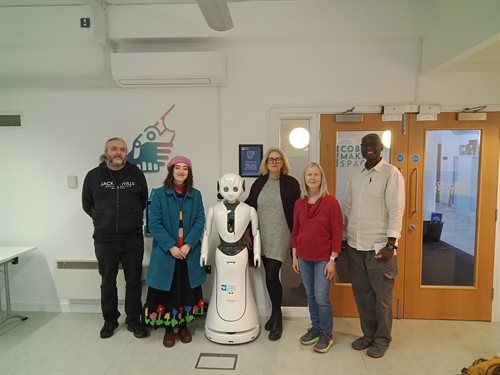 Group photo. From left to right: Dominic Price (Cobot Maker Space Lab Manager and Research Fellow, University of Nottingham), Eliza Gilbert (Volunteering Co-ordinator, Culture Leicestershire, CuL), Robina (The Robot), Alison Clague (Senior Curator, Leicestershire Museum Collections), Esther Shaw (Community Participation Worker, CuL), and Daniel H. Mutibwa (VCCC Lead, University of Nottingham). Pippa Vidal Davies (Volunteering Manager, CuL) does not appear in the group photo — unfortunately but was in attendance during the tour. Eliza, Alison, Esther, and Pippa were our visitors and are based at Culture Leicestershire (CuL) and Leicestershire Museum Collections at Leicestershire County Council.
The Visioning a Creative and Cultural County (VCCC) research-policy impact project is delivering a placement titled 3D Printing Museum Handling Objects (abbreviated to 3DPP).
Running from October 2025 – April 2026, 3DPP is piloting a small selection of 3D-printed museum handling objects to complement the Villiers Revealed Virtual Exhibition (see URL link at the bottom of this post) at Culture Leicestershire (CuL) and Leicestershire Museum Collections, Leicestershire County Council.
3DPP is also undertaking research on the practical use and value of 3D printing objects for museum handling sessions both for Leicestershire Museum Collections at Leicestershire County Council and the wider museum and heritage sectors nationally.
In addition to offering placement students distinctive professional development competencies and skills coveted by graduate job employers, 3DPP is also equipping students with first-hand experience of working on an exciting and real-world project.
This real-life project is nestled at the intersection of collaborative robotics, the heritage sector, the digital media industries, and local government context.
On Thursday 22 January 2026, Esther Shaw, Alison Clague, Pippa Vidal-Davies, and Eliza Gilbert visited the Cobot Maker Space (CMS) on Jubilee Campus, University of Nottingham.
CMS has partnered with VCCC to deliver 3DPP. The visit included a tour of the CMS lab space followed by lunch in the Atrium Restaurant.
Dominic Price guided our CuL visitors through the tour — focussing on three settings that included the Living Room or Living Space, the Care Room or Ward Room, and the Museum Room.
Each of these settings experiments with different pieces of robot-automated technology to investigate how robotics can be leveraged to support people in the conduct of their everyday routines.
Images of the settings can be viewed below.
Here is a summary of some of the central points that were made during the tour:
- The subject of robotics thrives on interdisciplinarity to be able to facilitate transformative change in society. To this end, robotics draws on subjects that range from medicine and psychology to business and engineering to computer science and the arts and humanities broadly considered among others.
- Robotics is increasingly being applied in a wide range of areas outside of established entities such as manufacturing factories. For example, robotics has gradually been introduced into social care — creating a new field of study and practice called ‘care robotics’.
- In ‘care robotics’, people experiencing vulnerabilities of different kinds (e.g., senior citizens, children and adults with physical and learning disabilities as well as mental health conditions) can be supported to navigate their daily lives as smoothly as possible. Here, robots are equipped with sensors to help vulnerable people with feeding, dressing, and even detecting dangers and accidents such as bed falls.
- Telepresence robots — which have mobility and allow for two-way (video) communication and interaction — can be deployed remotely to complete a range of tasks. For instance, they can be used to guide visitors around different exhibits in museums.
- Other robots such as robotic walking frames offer stability and support to senior citizens with walking difficulties or users recovering from serious physical injury. As practical and useful as these robots can be, they are very expensive. There is clearly a need for them, but no market.
- To tailor robots to actual and/or specific user needs effectively as a way of improving ‘care robotics’, there has been a shift towards collaborative design whereby patients and members of the public are invited to shape, design, and influence the trajectory of study and practice in this space. This is occurring under the Patient and Public Involvement and Engagement (PPIE) research approach.
- To learn about interactions between animals and Artificial Intelligence (AI) — including associated matters of ethics, the link to a fascinating Cat Royale video can be accessed at the bottom of this post.
- To learn about the ways in which people and robots explore how to embrace together in the context of a live, interactive experience — including asking whether robots can care for us the way humans can among other questions, the link to a captivating Embrace Angels video can be accessed at the bottom of this post.
- 3D printing takes time. The printing of the Emperor Hadrian coins (see related URL link below), for example, took six hours. At the time of this visit, the butterflies (see Exploring Queer Histories Through Digital Heritage below) had been undergoing printing for sixteen hours.
Here are some images taken from the tour:
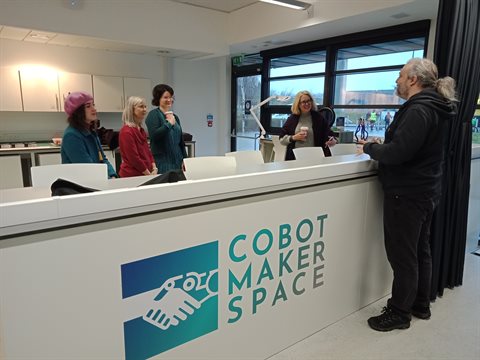 Dominic Price (right) offers introductory remarks at the start of the tour. From left to right: Eliza Gilbert, Esther Shaw, Pippa Vidal Davies, and Alison Clague.
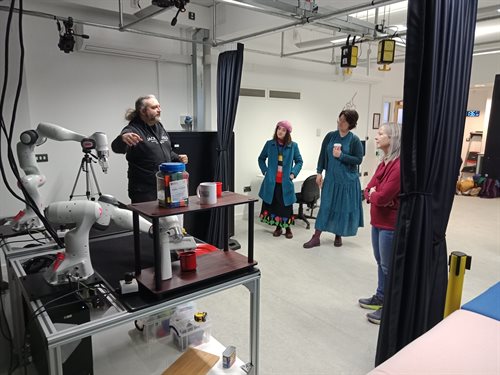 Dominic explains the functionality of the robot to the left of the image. Robots have been deployed to perform various tasks — including taking nasal swab tests during the COVID-19 pandemic in China.
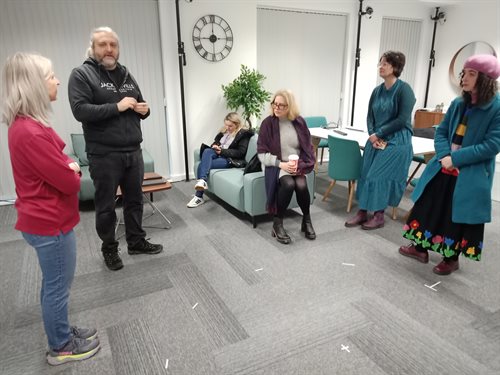 All the furniture in this Living Room or Living Space is fitted with sensors that help track routine activity. Collection and analysis of the data from such activity is a rich area of scholary exploration whose ultimate goal is to contribute to developing healthier, happier, and more sustainable life styles.
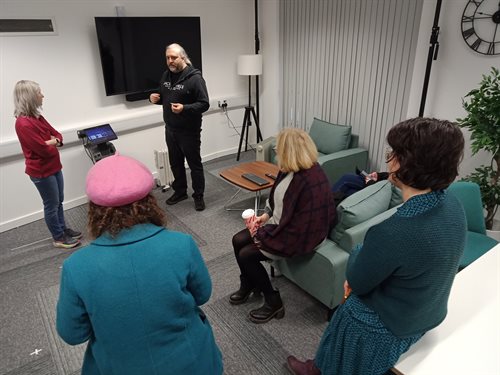 The Living Space is furnished with a 'telepresence' robot that is remote-controlled and mobile and equipped with a camera, screen, and microphone — all of which allow for physical movement, communication, and interaction with human users.
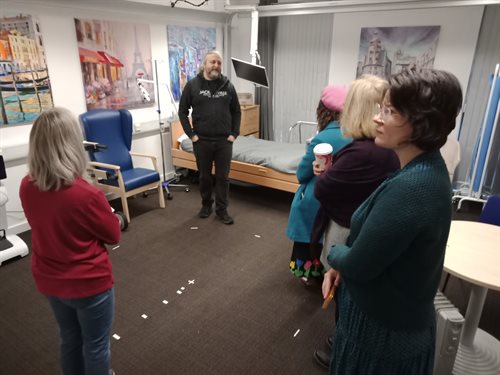 A view of the Care Room or Ward Room. Out of full view is a robotic walking frame whose bottom edge is slightly visible to the left of the image.
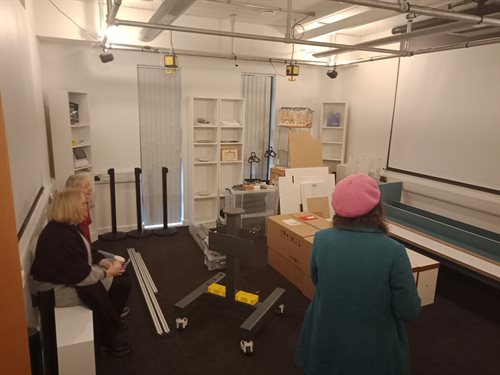 A view of the Museum-style Room whose furniture can be moved around. Two videos were played here: (1) Cat Royale, and (2) Embrace Angels.The latter involved working with female dance artists experiencing physical disability in a way that pushed the boundaries of what was possible.
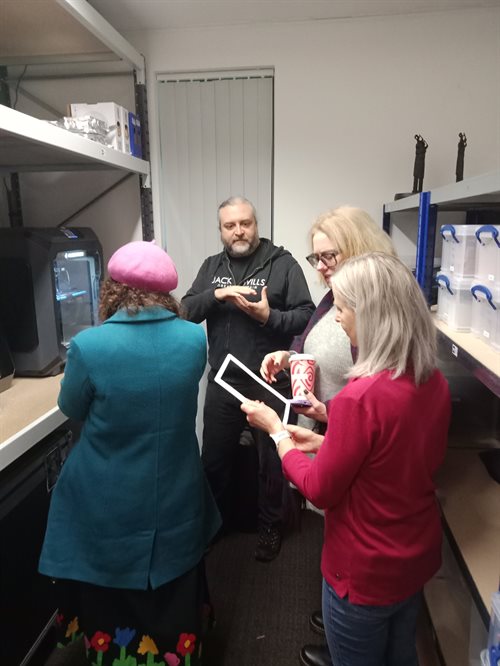 Watching 3D printing in action and inspecting some of the materials used in the process.
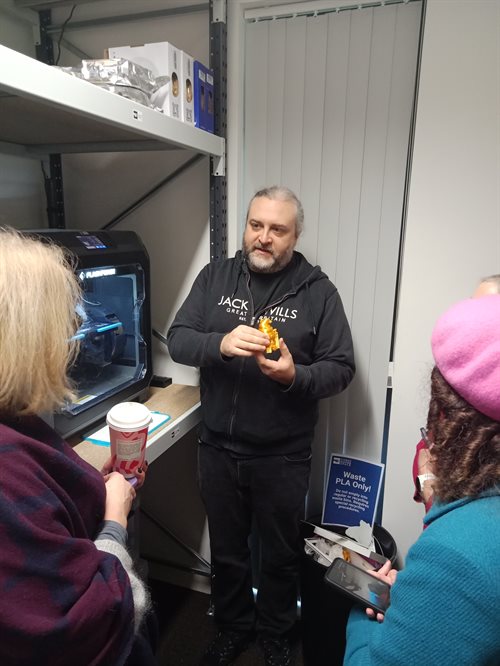 Listening to, exchanging knowledge about, and sharing of, experiences relating to 3D printing processes — including the materials used, how long it takes, and whether it is possible to print in multiple colours or print multi-coloured figures.
Here are the URL links to information and resources mentioned or alluded to above: