By Kaitlen Elaine Wood
In this blog post, Kaitlen Elaine Wood writes about her experience of researching and digitising selected museum objects in the context of the Curating, Researching, Digitising and Exhibiting Leicestershire Museum Collections Placement. In addition to offering students distinctive professional development competencies and skills coveted by graduate job employers, the Placement is also providing students with first-hand experience of working on an exciting and real-world project at the intersection of the heritage sector, the digital media industries, and local government context.

Kaitlen Elaine Wood is currently a Masters student in the School of Cultures, Languages and Areas Studies. She expects to graduate in 2025.
- My name is Kaitlen Elaine Wood and I am currently a postgraduate student in the International Media and Communication Studies MA.
- I have just recently moved to Nottingham, England from the United States of America, where I received a Bachelor of Arts in English and a Bachelor of Science in Global Studies.
- During my undergraduate studies, I was awarded two Certificates of Excellence in the 'Best Overall English Major' and 'Most Outstanding Professional Writing and Rhetoric' awards, as well as being a University Honours Scholar.
- In addition, I was president of the Mu Phi chapter of Sigma Tau Delta, an international English honours society, and a student representative of the Dean’s Student Advisory Board of the College of Liberal Arts.
- During my time at the University of Nottingham, as well as working alongside Culture Leicestershire, I am excited to continue enhancing my academic skills and adding new experiences in research, photogrammetry and 3D modelling, and digital media and marketing to aid in my furthered education and career endeavours.
- Being a member of the 'Curating, Researching, Digitising and Exhibiting Leicestershire Museum Collections' placement through the University of Nottingham has introduced me to invaluable experiences and incredible history.
- While working with Culture Leicestershire, I have had the opportunity to digitise three Emperor Hadrian coins found in the surrounding area of Leicestershire.
- As an international student from the United States, I never thought that I would have this type of hands-on learning experience with ancient artefacts, but I am so grateful for this opportunity and the knowledge that I can take with me beyond this placement.
- Leading up to the digitisation of these coins, I wanted to be aware of their significance.
- I gathered a lot of research on Emperor Hadrian’s life and the lasting memory connected to the artefacts that I would be handling.
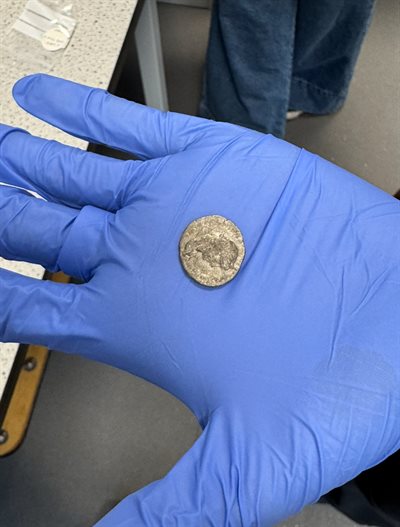 A coin featuring Hadrian held in a palm using gloves during a visit at the Collections Resources Centre (CRC) located in Barrow upon Soar in northern Leicestershire. CRC is one of several Leicestershire Museum Collections facilities.
Through my research and some prior knowledge, I learned that Hadrian, or Publius Aelius Hadrianus, was born in Rome on 24 January 76 CE and lived until 138 CE. It is believed that Hadrian lost his father at a young age and was taken care of by the then-emperor, Trajan.
There are conspiracies surrounding whether Trajan truly adopted Hadrian or not; however, throughout Hadrian’s life, he became one of Emperor Trajan’s closest allies.
This meant that when Trajan died, many people supported Hadrian as the next emperor of the Roman Empire.
Hadrian became the Roman Emperor in 117 CE. He is now best known for his contributions in consolidating and fortifying its borders and reigning during the ‘Pax Romana,’ a period of relative peace and stability.
In the United Kingdom, Emperor Hadrian is often remembered for Hadrian’s Wall, which served as a defensive barrier marking the northern limit of Roman Britain.
After reading a journal article by Harold Mattingly, a British historian of Roman civilisation, about coins created during Hadrian’s reign, I found that each coin is significant in its own way.
Coins minted during Hadrian’s reign provide insight into both economic and cultural conditions during the period. Roman coins were widely circulated throughout the empire, including in Britain. Most obviously, the discovery of coins from Emperor Hadrian’s era shows economic activity within specific regions of Britain during his reign.
In addition, the imagery found on the coins shows images of Hadrian himself but also culturally significant exchanges during this time, like symbols representing peace. Some Hadrian coins seem to signify the generosity shown by Hadrian in his financial administration while other coins seem to tell a more ambiguous story with the doubts that lingered about Hadrian's adoption by Trajan.
From what I’ve understood, the coins from this era represent the notable—and dramatic—events that took place.
In the University of Nottingham’s Archaeology Lab, we used the Artec Micro 3D Scanner to scan the Hadrian coins precisely. The Artec Micro is an extremely accurate 3D scanner designed for capturing intricate details of small objects, making it perfect for scanning ancient coins. Once the coins are scanned, the computer software linked to the Artec creates a detailed digital model that can be used for all types of things ranging from preservation to study and display.
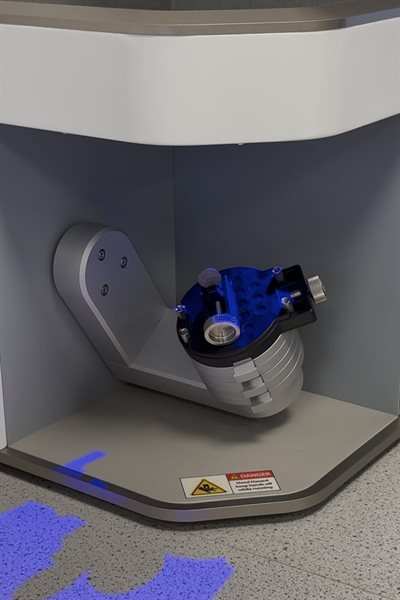
First image showing Artec scanning in progress in the Archaeology Labs.
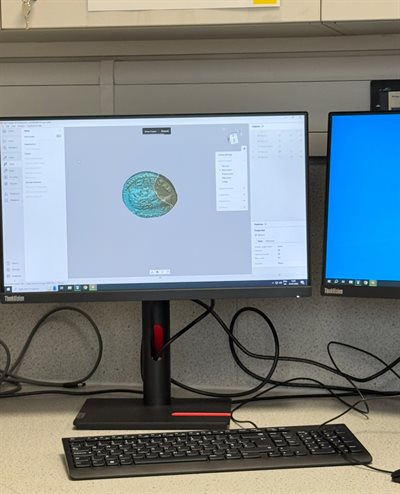 Second image showing Artec scanning in progress in the Archaeology Labs.
The process of scanning the coins was very informative, and the Artec’s technology made it simple. We placed one coin at a time on the turntable of the Artec Micro scanner, and once the Artec measured the size of the coin, the turntable rotated automatically, allowing for complete coverage of all angles of the coin without needing manual adjustments.
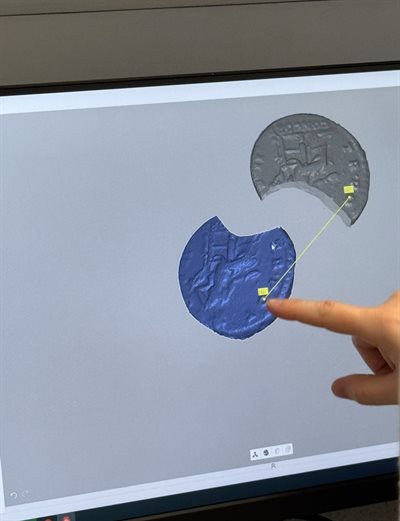
Third image depicting a detailed digital model created by the Artec Micro 3D Scanner and relayed on the monitor screen in the Archaeology Labs.
After completing the scan, the Artec’s software processes the scanned data and creates a 3D model of the coins. Technology isn’t perfect, so after looking for any imperfections or areas needing refinement, we used the built-in tools to edit or enhance specific features of the 3D scans.
Using the Artec Micro 3D Scanner was an eye-opening experience and allowed me to understand technology’s role in archaeology and preservation first-hand.
The scanner’s ability to capture intricate details—down to the tiny inscriptions—was astonishing. It made me appreciate how far technology has come in aiding our understanding of history.
During my research into Emperor Hadrian’s life, I found something interestingly relevant to Culture Leicestershire’s project, ‘Villiers Revealed: Darling of the Stuart Court,’ which reveals the hidden and overlooked queer history of George Villiers, the 1st Duke of Buckingham, and King James I.
As explained in the Villiers Revealed exhibition in Melton Carnegie Museum, the relationship between King James and Villiers included elements of deep personal affection and political alliance. Villiers’ appearance and charm captivated the king, leading to a close romantic bond.
Similarly, Hadrian had a relationship with a young Greek boy from Bithynia, Antinous. Their bond is often described as one of deep affection, with many historical accounts suggesting that Hadrian loved Antinous profoundly.
According to Professor Caroline Vout, Antinous travelled around the Roman Empire with Hadrian; however, in 130 AD, he fell into the River Nile. After Antinous died, Hadrian was reportedly devastated.
In his memory, Hadrian made him into a deity and commemorated him across the empire. He established a city named after him (Antinoöpolis), statues that celebrated Antinous, and coins minted by provincial cities.
Moreover, in Roman Britain, Professor Vout points out that they had little perfume jars shaped like Antinous busts. The emotional depth of Hadrian’s grief led many historians to interpret the pair’s connection as romantic and personal, quite similar to the relationship between George Villiers and King James I.
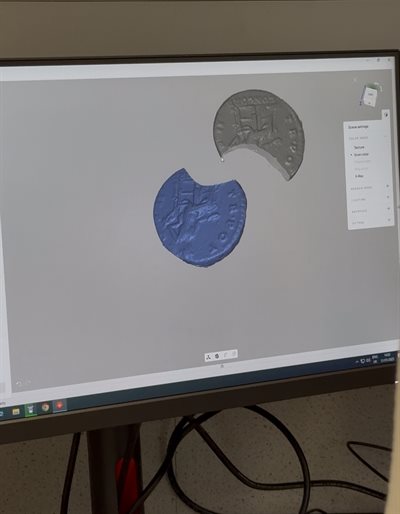
The Artec Micro 3D Scanner showcasing its great ability to capture intricate details of the coins' surfaces.
Just like the story of George Villiers, Emperor Hadrian can also be seen as a queer icon for the LGBTQ+ community.
While Hadrian might be most well-known in the United Kingdom for Hadrian’s Wall, he was a man of many faces and had an undeniable passion for Antinous, a powerful reminder that love knows no boundaries.
By embracing this narrative, Hadrian’s legacy can encourage ongoing discourse about sexuality, identity, and acceptance within society today.
Thanks to guidance from Dr. Daniel Mutibwa, Matt Davies in the Digital Transformations Hub, archaeology technician Susie Sherwin, and the Culture Leicestershire team, I have been able to take part in an unforgettable project that has deepened my admiration for cultural institutions that are working to reveal the hidden and untold stories from the past that deserve to be heard and represented.
References