By Arwyn Clayton
In this blog post, Arwyn Clayton recounts her experience of our team-building session that took place on the afternoon of Wednesday 12 February 2025 on University Park Campus.
The aim of the session was for students and staff participating in the Curating, Researching, Digitising and Exibiting Leicestershire Museum Collections in Co-production placement to get to know each other better, to hear about the exciting and multi-faceted work that was happening within the different strands of the placement, to provide feedback on the experience and learning gained on the placement so far, and to reflect on how best to evidence that experience and learning in the context of ongoing personal and professional development.
To achieve these objectives, the session entailed a programme of fun, playful, and learning activities that Arwyn gives her account of below.
The session was led by Esther Shaw (Community Participation Worker, Culture Leicestershire) and Daniel H. Mutibwa (University of Nottingham). Parts of the session were led by Pippa Vidal Davies (Volunteering Manager, Culture Leicestershire), Alison Clague (Senior Curator, Leicestershire Museum Collections), and Matt Davies (Manager, Digital Transformations Hub, University of Nottingham).
The refreshments served during the session were generously sponsored by the School of Cultures, Languages, and Areas Studies (CLAS).
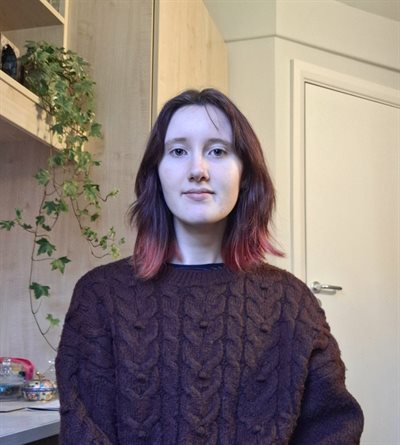
Arwyn Clayton is a first-year student in the School of English studying a BA in English with Creative Writing. Arwyn expects to graduate in the summer of 2027.
- My name is Arwyn, and I am currently in my first year of an English with Creative Writing degree at the University of Nottingham.
- Though only a few short months into my university experience, I have already been offered many unique and educational experiences, such as taking part in this placement with Leicestershire County Council, which I am very proud to have been selected for.
- For my BA in English with Creative Writing, I am studying to write both fiction and poetry, exploring different forms and genres along the way.
- These may include potentially environmental and political poetics, creative non-fiction, flash fiction and short stories among other things.
- The work in English studies is strengthening my creative writing skills and laying a good and solid foundation for learning more advanced techniques and forms of creative writing.
- In my second and third years, I will have flexibility to specialise in the areas I enjoy most, including digital storytelling.
The team-building afternoon began with a round of introductions, as such sessions often do.
However, rather than the usual ‘name and fun fact’, we instead each gave some information about our names – the meaning, why it had been chosen, whether we liked it, for instance.
I personally felt that the specificity of this made the introductions far less stressful, and it led to some very interesting stories, many of which provided us with potential conversation topics in the following task of ‘speed meeting’.
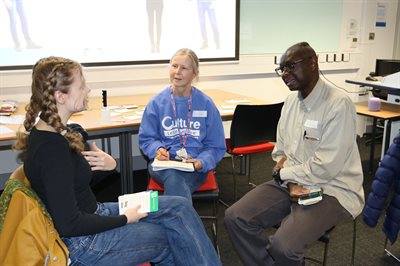
From left to right: Emily Moseley, Esther Shaw, and Daniel H. Mutibwa during a round of 'speed meeting'.
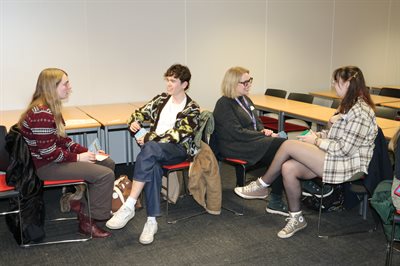 From left to right: Julia Irvine, Conrad Padgett, Alison Clague, and Aimee Lee during a round of 'speed meeting'.
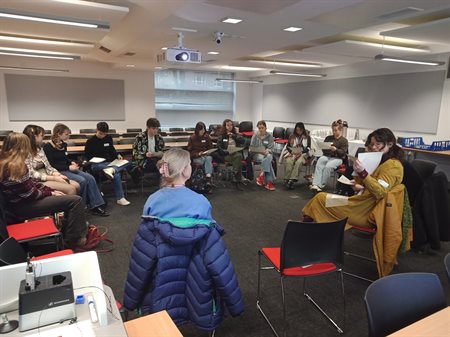 Pippa Vidal Davies (far right) steering us through the activity of reflecting on what positive health and wellbeing might feel like in our daily routines.
Although most of us had already met at the previous placement activities, it was still very valuable to have a dedicated time for introducing ourselves to each other without the unique distractions of museum artefacts or exhibition opening events around us.
For a time, the system of two-minute conversations in pairs worked well, but inevitably the structure fell apart, and various groups were formed as people sporadically sought those that they hadn’t yet spoken to.
With the additional prompts of some ice-breaker questions, the conversations flowed smoothly, and, despite the slight chaos, we can at last all consider ourselves officially acquainted.
During the following break for refreshments, we were able to make pronoun badges and continue the discussions from the previous activity.
This session had a much more relaxed and casual atmosphere than those we had attended before, and I think we all appreciated the opportunity to simply get to know each other, as much as we valued and learnt from the more formal trips.
After this, we were given a variety of historical artefacts to guess the uses of; from stone age hand axes to a carved corset busk from 1760.
My interest was particularly piqued by the hat sizer, a strange device shaped like a top hat that stretched open when placed on a head, shaping the pins in a cork-lined press on the top into a diagram representative of the head’s measurements, which would then be pierced onto a piece of paper inserted into the top.
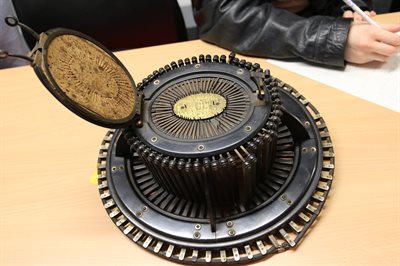
Image of a hat sizer from earlier centuries. This was one of several objects that were displayed and became centrepieces for conversation, discussion, and learning.
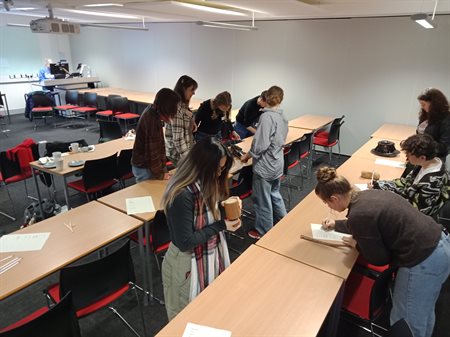 Students and staff collectively working out what the objects laid out were, from which time period they originated, and what they were used for.
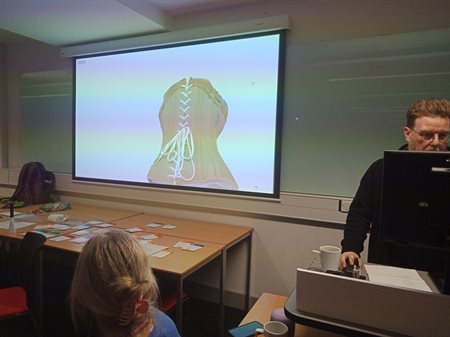
Matt Davies (right) walking us through the progress made on the 3D photogrammetry work so far, including a discussion of some of the challenges presented by some of the most distinctive museum objects.
Despite our failure to correctly identify most of them, we were all fascinated to discover so many objects that had at various times been so commonplace, yet were utterly bewildering to us.
The session was brought to a close by an update on our 3D photogrammetry work.
Unfortunately, the butterflies that I had been working proved too thin and delicate to quite work, while a corset and Care Bear toys were digitised brilliantly, forming intricately detailed models almost identical to their physical counterparts.
By the end of the afternoon, we all felt it had been a great chance to interact with the fellow members of this placement - as well as the staff facilitating it - in a pleasantly informal environment, and I now look forward all the more to our remaining meetings.