Voltic - Discreet Conductive Energy Device
Hi, I’m Harriet, and my project focuses on redesigning a Conductive Energy Device (CED), commonly known as a Taser, specifically for undercover police officers operating in high-risk, covert environments.
Through interviews, product analysis, and user-centred research, I identified key limitations in current Taser models for undercover use. Officers often face situations—such as operations to disrupt human trafficking—where carrying a standard Taser is either impractical or dangerous. Existing devices are bulky, overtly weapon-like, and difficult to conceal, leading some officers to forgo carrying them altogether. This jeopardises both their safety and the success of the operation.
My response is the Voltic, a compact, discreet, and ergonomic CED designed to maintain performance while reducing visibility and aggression through form. Voltic is 25.4% narrower than the leading Taser, and 37.7% narrower than the latest model, achieved by minimising component dimensions and using a tight-tolerance shell that streamlines around the internals to form the grip.
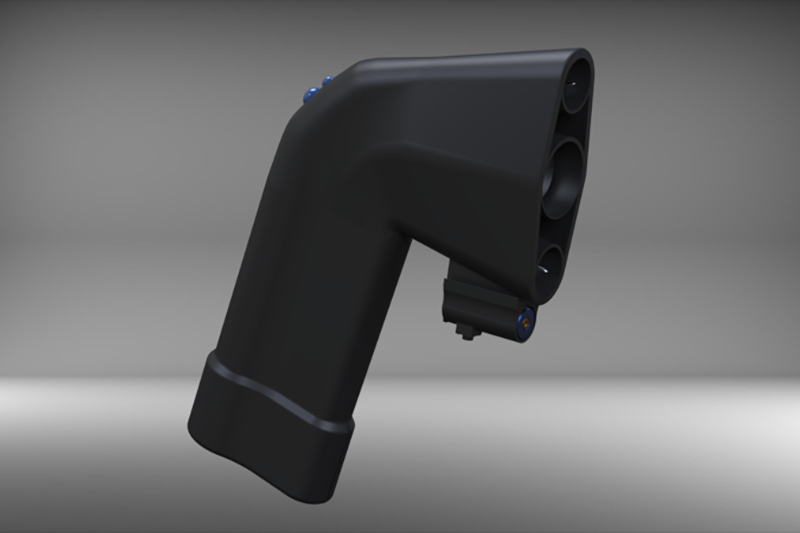
A key innovation is the non-threatening aesthetic. Recognising that weapons can escalate tension, the Voltic uses soft curves and a neutral visual image—moving away from gun-like design—to reduce psychological threat. Despite this, the grip remains intuitive, with optimised ergonomics for quick draw and trigger access across a wide range of hand sizes.
Internally, components are arranged for efficient function and modular cartridge replacement. The casing is designed for ease of disassembly, using fasteners, threads and snap fits to enable maintenance, testing, and end-of-life recycling.
Finally, safety is integrated throughout: from secure battery access and lock mechanisms to pulse regulation and trigger design. Voltic balances discretion, usability, and safety—offering a practical solution for modern undercover operations.
Design work