Grandma's House
Team
Dr Adele Horobin (UoN PI), Prof Jo Morling (UoN), Monica Tucker (public member), Shanine Fasasi (Diversify and Education CC), Gemma Poole (Essential Baby CIC)
Funding
Phase 2 – NIHR SPCR (Sep 2025-Aug 2026) £5,000
Phase 1 – UoN PCE (Mar 2025-Jul 2025) £9,000
Younger and older members of society are underrepresented in research. People from deprived communities and ethnic minorities are also underrepresented. Grandma’s House is joining these communities with researchers from across the School of Medicine and through academic networks such as the UoN Health Inequalities and Communication network.
Traditionally in Afro-Caribbean society, young people visit elder members of the community to learn practical life skills, such as sewing and cooking, parenting and to share experiences. This is known colloquially as visiting ‘Grandma’s House’. We are replicating this generation-to-generation support model. Working with community members, highlighting and applying the community’s shared cultural heritage to strengthening community cohesion, creating educational opportunities, tackling taboos and building stronger relationships between community members, researchers and health and social care services.
Sited within local ethnically diverse and socially deprived Nottingham city wards, young and old are invited to interact and learn from each other. Grandma’s House is a culturally appropriate vehicle for creating positive impact, built around the needs of the people involved.
Ultimately researchers will be able to drop in to Grandma’s House to:
- join activities building mutual trust and confidence, removing one-sided power dynamic weighted towards academia
- understand the day-to-day health issues people face. Share their knowledge on health-related topics
- develop community-centred ideas for research, co-produced with the community
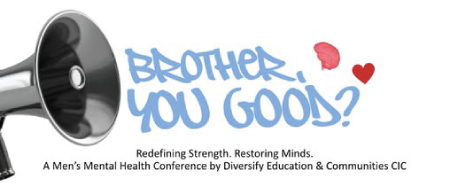
Grandma's House vs Brother You Good?
Grandma’s House attended Diversify, Education and Communities CIC’s landmark men’s mental health event on the 22nd November 2025. Following the launch of the first UK Government Men’s Health Strategy just days earlier, the event was both a celebration and call to action to support creating safe spaces for men to talk about their feelings.
The event included:
- personal stories
- uplifting and inspiring music from Luke Powell, reminding us of the power of faith, resilience and brotherhood
- poetry from Zayden Lindsay
- collaborative discussion across communities, health and care services, voluntarily organisations and beyond.
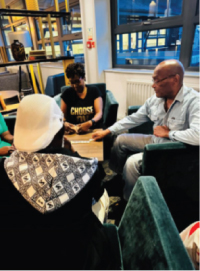
Grandma's House vs Dads and Lads Retreat
Grandma’s House funded elders to join the event – bringing grandparents to children and parents – creating a true multi-generational event.
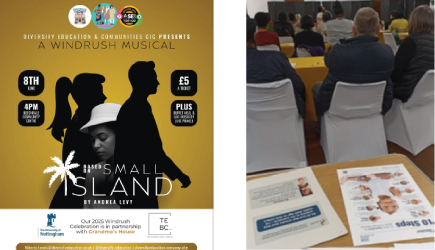
Grandma's House vs A Windrush Musical
In remembrance of the events of the Windrush, Grandma’s House attended Diversify and Education Communities CIC’s presentation of A Windrush Musical on 8th June 2025. Inspired by the themes of Small Island by Andrea Levy the production was developed and performed by community members.
Grandma’s House supported welcoming audience members to discuss traditional African-Caribbean remedies and talk with Dr Maulina Sharma and Dr Emma Campbell about skin health.
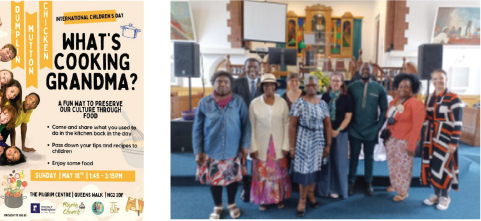
Grandma's House vs Pilgrim Church
On the 18th May 2025 to tie in with International Children’s Day, Grandma’s House led What’s Cooking Grandma at the Pilgrim Church in the Meadows area of Nottingham. Supported by a number of community Elders this was an opportunity to share Caribbean and African foods with the Pilgrim Church congregation and discuss the role of food in heritage and family.
Huge thanks to Rev Clive Foster MBE and all the staff and congregation at the Pilgrim Church for welcoming us with open arms.
Grandma's House vs Fernwood School
Grandma’s House launched its inaugural event on 22 April 2025 in collaboration with the Fernwood School, Nottingham – purposefully coinciding with Stephen Lawrence Day.
As well as our community team members, four local elders – some from the Windrush generation – joined with twenty Year 10 students to:
- invite students and elders to share their experiences of growing up
- guide conversations to reflect on how communities and attitudes to racism have changed over time and to share peoples’ hopes for the future
- discuss what students think of school now and efforts to help everyone feel included
- develop shared understandings and mutual respect across generations
Back to the BRIDGE project home